 Globe Quest
 Human Quest · LearningSign in
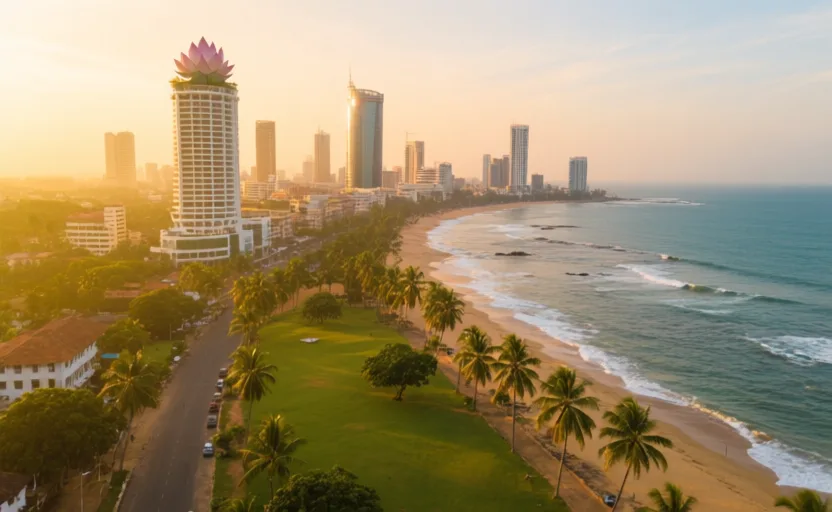 Colombo · AI city illustration · Artistic impression
City · South Asia
Colombo
Also known as Kolamba, කොළඹ
Saved in this browser — no account needed. Sign in later and it comes with you.
Where it is
Colombo lies on the island’s west coast, where a river, a lake and a harbour meet. The Kelani River forms its northern and northeastern edge and reaches the sea through the district called Modera, a name that means river delta. In the middle of the city sits the 65-hectare Beira Lake, and canals thread the lowlands around it. The harbour is artificial and has been enlarged repeatedly. Colombo has a tropical rainforest climate: hot all year, with highs around 31 °C in March and April, about 2,500 mm of rain a year, and two heavy monsoon periods, from April to June and from September to November.
The land and water around it
The Kelani Riverriver
The river marks Colombo’s northern and northeastern boundary and enters the sea at the delta area called Modera. One account derives the city’s name from the Sinhala words for “port on the river Kelani”.
Beira Lakelake
A 65-hectare lake in the heart of the city, used by colonial rulers for centuries as a defensive water barrier. It hosts regattas and theatrical events on its shores.
A built harbourharbour
Colombo Harbour was created as an artificial port in the colonial period and has been expanded since. It ranks as the island’s biggest port and among its busiest, and the Sri Lanka Navy keeps a base within it.
Its history, in short
Colombo was a trading harbour long before it was a capital. Arab merchants settled there from about the 8th century, because the port gave them a hold on the island’s overseas commerce. In 1505 the Portuguese made a treaty with the king of Kotte that allowed a trading post; they soon expelled the Muslim residents and began a fort in 1517. Their rule was challenged by the kingdom of Sitawaka, which repeatedly besieged Colombo, and after the Sitawaka kingdom fell in 1593 the Portuguese held the whole coast from here. The Dutch, allied with the king of Kandy, took Colombo after a long siege in 1656 and ran it until the British captured it in 1796. Britain made it the capital of its crown colony in 1815, and unlike its predecessors built civilian streets outside the fort walls. A municipal council was created in 1865. After independence in 1948 Colombo remained the capital until 1978, when government offices moved to Sri Jayawardenepura Kotte and Colombo was left as the commercial capital. Most foreign embassies stayed.
Timeline
Dates are shown on a timeline rather than as changing shapes on the map. The globe draws modern boundaries only, and tinting a modern outline to stand for a historical one would state something we cannot source.
Post-classical world
8th century
Arab traders settle
Arab merchants begin to settle at the port, which lets them control a large share of exchanges between the Sinhalese realms and overseas. Popular belief makes them the ancestors of the Sri Lankan Moors, although the community’s genetics are mostly South Indian.
Approximate dateWikipedia
Early modern & oceanic
1505
The Portuguese arrive
Lourenço de Almeida reaches Sri Lanka, and a treaty with King Parakramabahu VIII of Kotte lets Portugal trade in the island’s cinnamon and set up a post in Colombo.
Well attestedWikipedia1517
A fort at Colombo
The Portuguese start building a fort after expelling the Muslim inhabitants. After 1593 they rule the coast from Colombo, and the Fort area still carries the name.
Well attestedWikipedia1656
The Dutch take Colombo
The Dutch, who had made a pact with Rajasinha II, king of Kandy, in 1638, capture the fort after a long siege. Only 93 Portuguese survivors are allowed to leave. The Dutch do not hand the coast back to the Sinhalese kings.
Well attestedWikipedia1796
British capture
The British take Colombo and use it as a military outpost until 1815, when the Kandyan kingdom is ceded and Colombo becomes capital of crown colony Ceylon.
Well attestedWikipedia
Industrial & imperial
1865–1866
A municipal council
The Legislative Council of Ceylon creates the Colombo Municipal Council in 1865, partly as a means of training local people in self-government. It meets for the first time on 16 January 1866, when the region’s population is around 80,000.
Well attestedWikipedia
Contemporary
1978
Commercial capital
Government offices move to Sri Jayawardenepura Kotte, next door, and Colombo is designated the commercial capital, though most countries keep their embassies in Colombo.
Well attestedWikipedia
Places that carry meaning
Fort and Pettah1517 onward
The Fort began as the Portuguese stronghold, and today holds the presidential palace and most of Colombo’s five-star hotels. The area outside its walls is called Pettah, from the Sinhala for “outer fort”, and is the commercial hub, with the Khan Clock Tower as a landmark.
Fort station and the Pettah bus terminalsColonial period onward
The Fort railway station and the three main bus terminals in Pettah are the island’s main rail and bus hubs, so Colombo’s old colonial centre is also its transport centre.
National Museum of Colombo1877
Established on 1 January 1877 under the governor Sir William Henry Gregory in the Cinnamon Gardens district. It holds the crown jewels and throne of Sri Vikrama Rajasinha, the last king of Kandy.
Languages here
Places are usually multilingual. This lists what is actually spoken, not one language per border.
SinhalaIndo-Aryan family
An official and national language, spoken by the majority Sinhalese.
Sinhala is the first language of the Sinhalese, who are about 74 per cent of Sri Lanka’s population. Around 92 per cent of Sri Lankans can speak it.
TamilDravidian family
The other official and national language.
Tamil is spoken by Sri Lankan Tamils and Indian Tamils and by most of the Sri Lankan Moors, who are one of Colombo’s main communities, with the Sinhalese and Sri Lankan Tamils.
EnglishGermanic family
The constitutional link language.
English is common in schools and business, and the Constitution names it the link language.
Sri Lanka Malay
The language of a small community with roots in Southeast Asia.
Spoken by more than 40,000 people on the island, it is a variety formed through contact with Sri Lanka’s other tongues, and Malays are among Colombo’s small communities.
Learn the language here
- 1Understand which languages are spoken hereColombo is multilingual. Start with which languages are used, by whom, and for what — the phrase list only covers one of them.Written by Globe Quest
- 2Learn 12 phrasesCurated everyday phrases for Colombo, with audio and a written form.Written by Globe Quest
- 3Say them out loudSpeaking practice with pronunciation feedback, one phrase at a time.Globe Quest material, your own additions
- 4Come back to themSpaced review, so what you learned this week is still there next month.Written by Globe Quest
Check yourself
Which colonial power built the first fort at Colombo?
The Portuguese
The Portuguese began the fort in 1517. The Dutch captured it in 1656 and the British took it in 1796, and the Fort district still bears the name.
What changed for Colombo in 1978?
Government offices moved to Sri Jayawardenepura Kotte and Colombo became the commercial capital
Colombo had been the national capital since 1815. The move to neighbouring Kotte left it as the commercial capital, though embassies mostly stayed.
Worth arguing about
- Colombo’s harbour, fort and streets were laid out by three successive colonial powers. How much of a city’s identity can survive being built by outsiders for outsiders?
- The executive capital sits in Colombo while the legislature meets in Sri Jayawardenepura Kotte. Does splitting a capital strengthen government or weaken it?
What we have not established
These are open questions, listed rather than filled in. We would rather show a gap than a plausible guess.
How many people live in Colombo?
The municipal limits are given as 752,993 in one place and 642,163 in another, and the metropolitan area is estimated at 5.6 million. The answer depends on where Colombo is taken to end and which count is used.
Sources
- Wikipedia · ColomboWikipedia · encyclopedia · checked 2026-11-24
- Wikipedia · Sri LankaWikipedia · encyclopedia · checked 2026-11-24
- Wikipedia · Languages of Sri LankaWikipedia · encyclopedia · checked 2026-11-24
Reviewed by Globe Quest editorial on 2026-11-24. Drafted with AI assistance and checked against the sources above before publication.