 Globe Quest
 Human Quest · LearningSign in
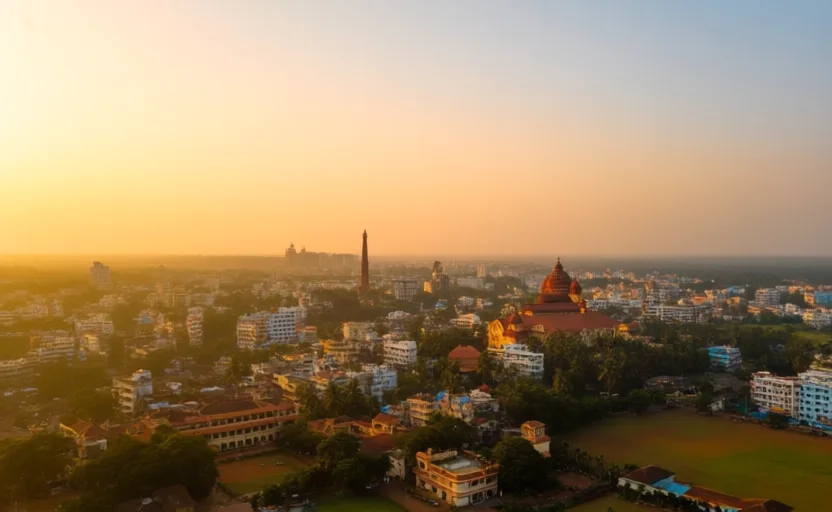 Goa · AI city illustration · Artistic impression
City · South Asia
Goa
Saved in this browser — no account needed. Sign in later and it comes with you.
Where it is
Goa is a small coastal state, 3,702 km², squeezed between the Arabian Sea and the Western Ghats on the Konkan coast. The Ghats cut it off from the Deccan plateau and reach 1,167 m at Sonsogor. Short monsoon-fed rivers run west to the sea; the Mandovi and the Zuari are the busiest, linked by the Cumbarjua canal into one estuarine system with islands in it. At the mouth of the Zuari lies Mormugao harbour, one of the best natural harbours in South Asia. The soil is mostly red laterite, the climate is hot and humid, and more than nine-tenths of the year’s rain, roughly 3,000 mm, falls between June and September.
The land and water around it
The Western Ghatsmountains
The range forms Goa’s eastern edge, separating the coast from the Deccan plateau and feeding every river in the state. The forests on its slopes are part of a biodiversity hotspot, and the highest point in Goa, Sonsogor, is here.
The Mandovi–Zuari estuaryestuary
The two rivers and the canal between them make a tidal network with more than 40 estuarine islands, and 253 km of navigable river. These are some of the busiest rivers in India, and Mormugao harbour lies at the mouth of the Zuari.
The laterite coastcoast
About 103 km of sandy beaches and rocky headlands backed by reddish laterite. Prehistoric people engraved animals on laterite platforms and granite boulders, and coconut palms grow throughout the lowlands.
Its history, in short
Goa’s history is mostly a story of who held the rivers and the port. Before 1510 the territory passed through Mauryan, Kadamba, Delhi Sultanate, Vijayanagara, Bahmani and Bijapur hands, and the Bijapur sultans kept a second capital at the site of Old Goa. In 1510 Afonso de Albuquerque took it with help from the local privateer Timoji and made it the seat of Portugal’s eastern empire, with authority stretching from east Africa to Macau. At its height between 1575 and 1625 travellers called it Golden Goa. The church dominated: Goa had India’s first printing press in 1556 and the Inquisition from 1560 to 1812, and many people in the older territories became Catholic. Decline followed disease and the loss of allies, and in 1843 the capital moved to Panaji. Portugal refused to leave when India became independent in 1947. India sent troops in December 1961, and Goa, Daman and Diu became a union territory. After a language agitation Goa became a state in 1987, with Konkani as its official language.
Timeline
Dates are shown on a timeline rather than as changing shapes on the map. The globe draws modern boundaries only, and tinting a modern outline to stand for a historical one would state something we cannot source.
Early modern & oceanic
1510
Albuquerque takes Goa
Portugal seizes the city from the Bijapur Sultanate, loses it, and retakes it by force on 25 November, with surrender on 10 December. It becomes the capital of the Estado da Índia.
1556
India’s first printing press
A press is set up at Saint Paul’s College in Goa, and in 1563 it prints Garcia da Orta’s treatise on the medicinal plants of India.
Well attestedWikipedia1560–1812
The Goa Inquisition
A church tribunal operates for over two centuries. Surviving records, as counted by H. P. Salomon and I. S. D. Sassoon, show 16,202 people tried up to 1774, of whom 57 were executed and 64 burned in effigy. Most received lesser penances.
Well attestedWikipediaSalomon and Sassoon, working from surviving Inquisition records
Industrial & imperial
1843
The capital moves to Panaji
The viceroy’s residence moves downriver to Nova Goa, today’s Panaji, completing a move discussed since 1684. Old Goa’s population falls steeply through the 1700s.
Contemporary
19 December 1961
The end of Portuguese rule
After India’s independence in 1947 India asked Portugal to give up its Indian territories. Portugal refused, and Indian forces entered in Operation Vijay. Goa, Daman and Diu were then administered as one union territory.
India’s government, which called for Portuguese territories to be ceded, and Portugal, which held Goa to be an integral part of Portugal since 1510 and rejected negotiation on sovereignty
1967
A referendum
Goans choose between remaining a union territory and merging into Maharashtra. The majority chooses to remain separate, in the only referendum held in independent India.
Well attestedWikipedia30 May 1987
Statehood
Goa is made India’s twenty-fifth state, following the Konkani language agitation, while Daman and Diu stay a union territory.
Places that carry meaning
Churches and Convents of Old Goa1510 to 18th century
Seven surviving monuments form the World Heritage property: the Chapel of St Catherine, the Church of St Francis of Assisi, Our Lady of the Rosary, the Sé Cathedral, St Augustine, Bom Jesus and the Chapel of St Cajetan. They spread Manueline, Mannerist and Baroque styles to mission churches across Asia, adapted to local materials.
Bom Jesus Basilica1605
Holds the remains of St Francis Xavier, whose body was shipped to Goa in December 1553. His relics are shown to the public in occasional expositions, the first in 1782.
Usgalimal rock engravingsPrehistoric
Animal figures, a mother goddess and tree-like motifs cut into laterite and granite beside the Kushavati river, among the earliest traces of human life in India. Their age is not agreed: the figure of about 10,000 years sits beside estimates from 6,000 to 8,000 years and from 20,000 to 30,000 BC.
Archaeologist P. P. Shirodkar, who proposed an Upper Palaeolithic or Mesolithic date, and Nandkumar Kamat, who favours 6,000 to 8,000 years
Panaji1843 onward
The state capital, which replaced Old Goa as the seat of government. Panaji and Margao are the historic cities that still reflect the Portuguese legacy.
Languages here
Places are usually multilingual. This lists what is actually spoken, not one language per border.
KonkaniIndo-Aryan family
The official language of the state, written in Devanagari.
The Official Language Act of 1987 made Konkani in Devanagari the sole official language, with Marathi allowed for official purposes. Supporters of the Roman script want it recognised too. Konkani is spoken by most of the population.
MarathiIndo-Aryan family
A permitted language for official business.
The state also replies in Marathi to correspondence it receives in that language. Goa was nearly merged into Maharashtra, until the 1967 referendum.
PortugueseRomance family
The sole official language during colonial rule, now much reduced.
Its use has fallen sharply since 1961, but it survives in names, architecture and the Catholic community’s inheritance of the colonial period.
English and Hindi
National and link languages used in schools, work and tourism.
Hindi is the official language of India’s federal government and English continues alongside it, so both are part of daily life alongside Konkani.
Learn the language here
- 1Understand which languages are spoken hereGoa is multilingual. Start with which languages are used, by whom, and for what — the phrase list only covers one of them.Written by Globe Quest
- 2Learn 11 phrasesCurated everyday phrases for Goa, with audio and a written form.Written by Globe Quest
- 3Say them out loudSpeaking practice with pronunciation feedback, one phrase at a time.Globe Quest material, your own additions
- 4Come back to themSpaced review, so what you learned this week is still there next month.Written by Globe Quest
Check yourself
Who helped Albuquerque take Goa in 1510?
The local privateer Timoji
Timoji asked the Portuguese to take over, and Albuquerque appointed him a leading administrator among the Hindu population.
What was Goa before it became a state in 1987?
Part of Daman and Diu, a single union territory
After 1961 Goa, Daman and Diu were governed together as a union territory, and the 1987 split made Goa a state while the other two stayed administered from the centre.
Worth arguing about
- Portugal and India took opposed positions in 1961: one held Goa to be an integral part of Portugal, the other held that it had to be ceded. How should a place teach the end of colonial rule when both sides still claim the story?
- Konkani in Devanagari is the official language, but Roman-script Konkani has been the form many Catholics grew up with. Who should decide which script a language is written in?
What we have not established
These are open questions, listed rather than filled in. We would rather show a gap than a plausible guess.
What share of Goa is Christian today?
The 2011 census recorded 66.1 per cent Hindu, 25.1 per cent Christian and 8.3 per cent Muslim. In 2024 the state’s governor cited figures of 36 per cent falling to 25 per cent for Christians, then clarified that he had meant “brain drain”, not religious demographics. The 2011 census is still the latest national count.
How old are the Usgalimal rock engravings?
Laterite is difficult to date by carbon methods, and published estimates range from about 6,000 years to tens of thousands of years.
Sources
- Wikipedia · GoaWikipedia · encyclopedia · checked 2026-11-24
- Wikipedia · History of GoaWikipedia · encyclopedia · checked 2026-11-24
- UNESCO · Churches and Convents of GoaUNESCO World Heritage Centre · intergovernmental · checked 2026-11-24
- Wikipedia · IndiaWikipedia · encyclopedia · checked 2026-11-24
Reviewed by Globe Quest editorial on 2026-11-24. Drafted with AI assistance and checked against the sources above before publication.