 Globe Quest
 Human Quest · LearningSign in
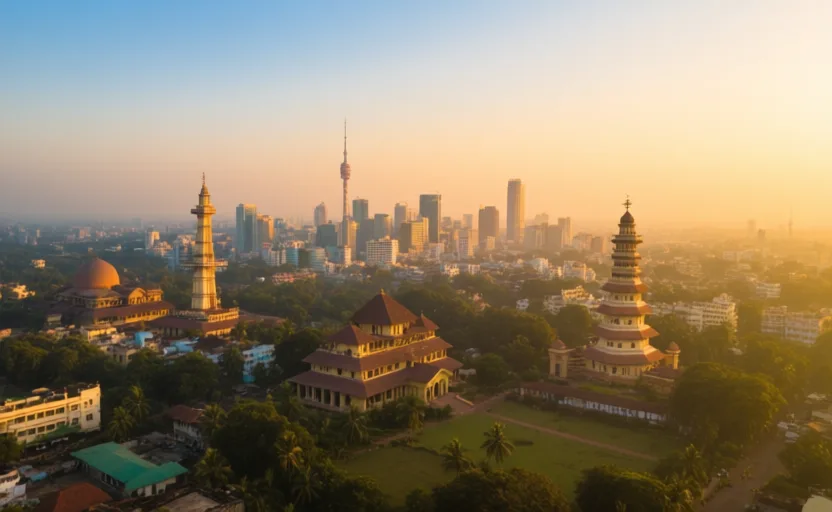 Kochi · AI city illustration · Artistic impression
City · South Asia
Kochi
Also known as Cochin
Saved in this browser — no account needed. Sign in later and it comes with you.
Where it is
Water decides the shape of Kochi. It is built where the Malabar Coast meets a maze of backwaters, so the city is spread over the northern tip of a peninsula, a scatter of islands in Vembanad Lake and a slice of the mainland, mostly at or near sea level. The Laccadive Sea lies to the west, and 48 km of coast belong to the city. Kochi sits on the windward side of the Western Ghats, which gives it a tropical monsoon climate: about 3,000 mm of rain a year over some 124 rainy days, most of it from June to September, with lighter rain from the northeast monsoon in October to December. Temperatures barely change through the year.
The land and water around it
The backwaters of Vembanad Lakelagoon
A network of channels and islands behind the coast, which the city straddles. The name Kochi is thought to come from the Malayalam words for “small lagoon”, and early travellers also linked it to the river that joins the backwaters to the sea.
The Periyar riverriver
Its flood in 1341 is held to have destroyed the port of Muziris and handed trade to Kochi. Today the Periyar and the Muvattupuzha river supply the city’s water, together with groundwater.
The Malabar Coast and the Western Ghatscoast
The Ghats trap the southwest monsoon on the coastal side, which is why Kochi receives over three metres of rain. The same coast sits on the sea routes that carried pepper and other spices to Romans, Arabs and Chinese.
Its history, in short
Kochi is a young port by the standards of the coast. For centuries the great spice harbour was Muziris, probably near Kodungallur to the north, and Kochi rose after the Periyar flood of 1341 destroyed it. The local rulers, the Perumpadappu line, built a kingdom of Cochin and played the larger powers against each other. In the early 15th century China, through Zheng He’s fleet, took Kochi under its protection against its rival Calicut. In 1500 the Portuguese made Kochi the site of India’s first European settlement, and in 1663 the Dutch drove them out; in 1814 the Dutch gave the territory to Britain in return for the island of Bangka. The 1920s brought the modern port: the harbour engineer Robert Bristow reclaimed Willingdon Island and built a sheltered inner harbour. Cochin was the earliest princely state to accede to independent India of its own accord, and in 1967 the old towns of Ernakulam, Mattancherry and Fort Kochi were merged into one corporation. The city took the name Kochi in 1996.
Timeline
Dates are shown on a timeline rather than as changing shapes on the map. The globe draws modern boundaries only, and tinting a modern outline to stand for a historical one would state something we cannot source.
Post-classical world
1341
Muziris destroyed
A great Periyar flood wrecks the old spice port at Muziris, usually identified with Kodungallur. Kochi grows into the main harbour of the region.
Early 15th century
A Ming seal for Kochi
During a rivalry with Calicut, the Ming court grants Kochi’s ruler a seal and a stone tablet carried by Zheng He’s fleet. While the voyages last, Calicut does not attack. After they stop, Calicut occupies Kochi in the late 15th century.
Approximate dateWikipedia
Early modern & oceanic
1500–1503
The Portuguese arrive
At Kochi in 1500 Pedro Álvares Cabral sets up what is recorded as India’s first European settlement, and Fort Emmanuel is held by Portugal from 1503. The period is hard on the Saint Thomas Christians, Muslim Mappilas and Jews, since the Inquisition is active in Portuguese India.
Well attestedWikipedia1663
The Dutch take over
The Dutch capture the fort. In 1664 they set up the Fort Kochi municipality, described as the first in the Indian subcontinent. It lapses when Dutch power weakens in the 18th century.
Well attestedWikipedia
Industrial & imperial
1814
Handed to Britain
Under the Anglo-Dutch Treaty, Kochi passes to Britain and the Dutch receive the island of Bangka, off Sumatra, in return. The kingdom of Cochin continues as a princely state.
Well attestedWikipedia1928
Willingdon Island and the port
The reclamation of Willingdon Island, planned by Robert Bristow from 1920, turns Kochi into a major seaport with an inner harbour where ships berth beside steam cranes.
Well attestedWikipedia
Contemporary
1 November 1967
One corporation
Ernakulam, Mattancherry and Fort Kochi, with Willingdon Island and four panchayats, merge into the Corporation of Cochin, eleven years to the day after the state of Kerala was created.
Well attestedWikipedia2012
The Biennale
The Kochi-Muziris Biennale, India’s first art biennale, opens, with a name that reaches back to the lost port of Muziris.
Well attestedWikipedia
Places that carry meaning
Fort Kochi1503 onward
The old Portuguese and then Dutch fort quarter on the western side. St Francis Church held the grave of Vasco da Gama until his remains went back to Portugal in 1539, and the Santa Cruz Basilica is among the city’s main churches.
The Chinese fishing nets14th century
Large cantilevered nets along the shore, said to have been introduced by the Chinese in the 14th century and still a symbol of the city.
Mattancherry16th century onward
The old trading quarter beside the harbour, with Mattanchery Palace. The Cochin Jews, known as the Malabar Yehuden, were prominent in trade here and owned several synagogues in and around Kochi, although few families remain.
Willingdon Island1920s
An artificial island raised from reclaimed harbour land, the heart of the modern port. Cochin Shipyard, now India’s largest shipbuilding and maintenance facility by capacity, belongs to the same maritime economy.
Languages here
Places are usually multilingual. This lists what is actually spoken, not one language per border.
MalayalamDravidian family
The main language of daily life and primary schooling.
Most residents are Malayalis, and Malayalam is the medium for primary education, although some schools teach in English.
EnglishGermanic family
The usual language of higher education and business.
Kochi’s trading and colonial past left English in the commercial world. Tamil and Hindi are widely understood but rarely spoken.
Konkani and GujaratiIndo-Aryan family
Languages of long-settled trading communities.
Konkanis and Gujaratis are among the ethnic minorities of the city, along with Tamils, Anglo-Indians, Sikhs and a few Jewish families, each tied to a different phase of Kochi’s trading history.
Learn the language here
- 1Understand which languages are spoken hereKochi is multilingual. Start with which languages are used, by whom, and for what — the phrase list only covers one of them.Written by Globe Quest
- 2Learn 11 phrasesCurated everyday phrases for Kochi, with audio and a written form.Written by Globe Quest
- 3Say them out loudSpeaking practice with pronunciation feedback, one phrase at a time.Globe Quest material, your own additions
- 4Come back to themSpaced review, so what you learned this week is still there next month.Written by Globe Quest
Check yourself
What event pushed trade from Muziris towards Kochi?
A great Periyar flood in 1341
The flood destroyed the old port of Muziris near Kodungallur, and Kochi became the main harbour of the coast in its place.
What did Britain give the Dutch for Kochi in 1814?
The island of Bangka
The Anglo-Dutch Treaty traded Kochi for Bangka, an island off Sumatra, one of several territorial swaps that redrew the colonial map.
Worth arguing about
- Kochi has been ruled in turn by a local kingdom, Portugal, the Netherlands and Britain, and has protected itself with Chinese and Portuguese alliances. What does a port gain from always choosing the strongest friend?
- Fort Kochi, Mattancherry and Ernakulam were merged into one corporation in 1967 but each kept its own character. Does merging administrations ever merge a city?
What we have not established
These are open questions, listed rather than filled in. We would rather show a gap than a plausible guess.
How large is Kochi?
The corporation counted 677,381 people in 2011, but the urban agglomeration around it held about 2.1 million, and the city is also called Ernakulam after its central district. Which figure is “Kochi” depends on where the boundary is drawn.
Sources
- Wikipedia · KochiWikipedia · encyclopedia · checked 2026-11-24
- Wikipedia · History of KochiWikipedia · encyclopedia · checked 2026-11-24
Reviewed by Globe Quest editorial on 2026-11-24. Drafted with AI assistance and checked against the sources above before publication.