 Globe Quest
 Human Quest · LearningSign in
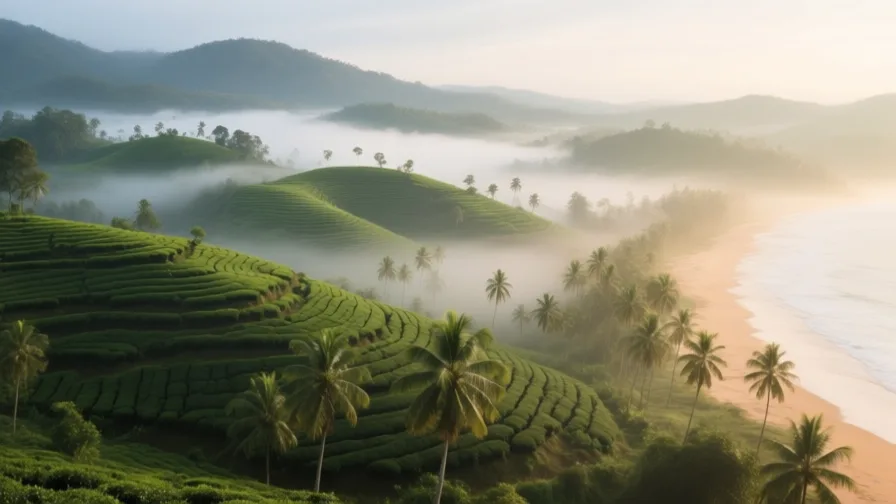 Sri Lanka · AI landscape illustration · Artistic impression
Country · South Asia
Sri Lanka
Saved in this browser — no account needed. Sign in later and it comes with you.
Where it is
Sri Lanka is an island of 65,610 km² in the Indian Ocean, cut off from India by the Palk Strait and the Gulf of Mannar. Most of it is flat to rolling plain, with a rugged mass of highlands in the south-central interior rising to Pidurutalagala at 2,524 m. Rivers fan out from those highlands to the sea, and the longest, the Mahaweli, runs 335 km. Two monsoons divide the year, the southwest one from June to October and the northeast one from December to March, and they divide the island into a wet zone in the southwest, with up to 2,500 mm of rain a year, and a drier north and east.
The land and water around it
The Central Highlandsmountains
A high plateau and ranges in the south-central interior hold Pidurutalagala at 2,524 m, Adam’s Peak at 2,243 m and the Hatton Plateau to the west. Rivers radiate from here in every direction, and 103 rivers drain the island. Frost can occur in the highlands in winter.
The Palk Strait and Adam’s Bridgestrait
A chain of limestone shoals, with water as shallow as 1 m in places, runs between Mannar Island and the Indian coast. Hindu tradition makes it a bridge built for Rama, and temple records say a storm broke through it in 1480. The shallows hinder navigation.
The wet and dry zonesclimate
The southwest and the windward highland slopes catch up to 2,500 mm of rain a year, while most of the north, east and southeast, the dry zone, gets far less, and the driest coasts start at about 800 mm a year. The dry zone is where ancient kings built artificial lakes known as tanks to hold water through the dry season.
Its history, in short
Sri Lanka’s written history begins with its own chronicles. The Mahāvaṃsa and related Pali texts say that Prince Vijaya arrived from Bengal in 543 BCE, and that the Anuradhapura kingdom, founded around 380 BCE, was the capital for nearly 1,400 years. Buddhism came in the third century BCE and the Pali Canon was first written down on the island. Medieval kings, above all Parākramabāhu the Great in the 12th century, built a network of reservoirs that watered the dry zone. In 1505 the Portuguese arrived, and in 1517 they built a fort at Colombo. The Dutch held the whole coast by 1660, the British replaced them in 1796, and the Kandyan kingdom fell in 1815. Independence came in 1948. In 1956 the Sinhala Only Act made Sinhala the sole official language, which the Tamil community saw as a threat to its language and culture. From 1983 to 2009 a civil war was fought between Tamil separatists and the armed forces. The communities involved tell that history in different ways, and this entry sets their positions side by side rather than choosing between them.
Timeline
Dates are shown on a timeline rather than as changing shapes on the map. The globe draws modern boundaries only, and tinting a modern outline to stand for a historical one would state something we cannot source.
Classical world
543 BCE (traditional)
Prince Vijaya lands
The chronicles place the arrival of the semi-legendary prince Vijaya, expelled from the Vanga kingdom in Bengal, at the start of Sinhalese history. He is said to have founded the Kingdom of Tambapanni near Mannar.
The Mahāvaṃsa and other Pali chronicles, which call Vijaya semi-legendary and are the island’s main written tradition for its early history
3rd century BCE
Buddhism arrives
According to the Buddhist chronicles, Mahinda, son of the Mauryan emperor Ashoka, brings Buddhism to the island during the reign of Devanampiya Tissa, and Sanghamitta carries a cutting of the Bodhi Tree. The Pali Canon is first written down at Aluvihara around 30 BCE.
Sri Lankan Buddhist chronicles
Post-classical world
1153–1186
Parākramabāhu the Great
The reign is a high point of medieval Sri Lanka. The king repairs and builds a huge number of reservoirs, 1,470 by one count, among them the Parakrama Samudra, the largest irrigation project of the medieval island.
Well attestedWikipedia
Early modern & oceanic
1505
The Portuguese arrive
Lourenço de Almeida finds the island divided into seven kingdoms. The Portuguese build a fort at Colombo in 1517 and by 1619 have ended the independent Jaffna kingdom.
Well attestedWikipedia
Industrial & imperial
1815
Kandy falls
The British had held the coast since 1796 and made it a crown colony after 1802. In the second Kandyan War they annex the Kandyan kingdom, which ends the island’s independence.
Well attestedWikipedia
Contemporary
4 February 1948
Independence
Ceylon becomes a dominion with D. S. Senanayake as its first prime minister. It becomes a republic in 1972.
Well attestedWikipedia1956
The Sinhala Only Act
Prime Minister S. W. R. D. Bandaranaike makes Sinhala the only official language of government. It is partly reversed in 1958, but the Tamil community still sees a threat to its language and culture, and the Federal Party responds with non-violent resistance.
DisputedWikipediaBandaranaike, who cast himself as defender of a besieged Sinhalese culture, and Tamil leaders, who saw a threat to their language and culture
1983–2009
The civil war
The LTTE, a Tamil separatist group, and the country’s armed forces fight a long war that ends in 2009 with the separatists beaten. How the war began, how it was fought and how it ended is described differently by the state, by Tamil organisations and by outside observers.
DisputedWikipediaThe Sri Lankan state and its armed forces, who fought the LTTE as separatists, and Tamil political movements that had been resisting language policy since the 1950s
Places that carry meaning
AnuradhapuraFrom 380 BCE
The first great capital, the seat of kings for nearly 1,400 years. Its builders were known for reservoirs, pyramid-like stupas and palaces, and the Ruwanwelisaya stupa dates to Dutugemunu in the second century BCE.
Polonnaruwa11th–13th centuries
Capital of the second major Sinhalese kingdom, which lasted from 1055 to about 1212 and included the reign of Parākramabāhu. His Parakrama Samudra, the largest medieval irrigation lake, belongs to this era.
Kandy1592–1815
The inland capital to which the Sinhalese kings withdrew in 1592, safer from attack. It was the last independent kingdom of the island and fell to the British in 1815.
JaffnaKingdom until 1619
The centre of the Tamil cultural region in the north. The independent Jaffna kingdom ended in 1619, and the Jaffna Peninsula is separated from the mainland by lagoons.
Languages here
Places are usually multilingual. This lists what is actually spoken, not one language per border.
SinhalaIndo-Aryan family
An official and national language, spoken by the Sinhalese majority.
The Sinhalese were 74.12 per cent of the 2024 census. About 92 per cent of Sri Lankans can speak Sinhala, which is written in its own script derived from Brahmi.
TamilDravidian family
An official and national language and the first language of about one in five.
Sri Lankan Tamils and Indian Tamils speak it, and so do most Sri Lankan Moors. Tamils make up 12.31 per cent of the 2024 census, the Moors 10.47 per cent and the Indian Tamils 2.76 per cent, and the language’s speakers number about 3.8 million.
EnglishGermanic family
The constitutional link language.
English is common in schools, laboratories and business.
Sri Lanka Malay and smaller languages
Languages of minority communities.
Sri Lanka Malay has more than 40,000 speakers and is a variety formed through contact with Sri Lanka’s other tongues. Some Burghers on the east coast speak a Portuguese creole, about 300 Veddas speak a language of debated origin, and Telugu is spoken by perhaps 40,000 to 125,000 people.
Learn the language here
Check yourself
Which language does Sri Lanka’s Constitution call the link language?
English
Sinhala and Tamil are the official and national languages, and English serves as the link between them and in education and commerce.
What did Parākramabāhu the Great build in unusual numbers?
Reservoirs for irrigation
His reign saw 1,470 reservoirs built and many dams and canals repaired, which suits a dry zone where rain is seasonal.
Worth arguing about
- The Mahāvaṃsa, a Pali chronicle written by a monk in the 5th century CE, is a main record of the island’s early centuries. Whose history gets left out when one tradition supplies the written record?
- A language law passed in 1956 and softened in 1958 is still argued about. When a state chooses a single official language, what does it owe the speakers of the others?
What we have not established
These are open questions, listed rather than filled in. We would rather show a gap than a plausible guess.
How many people died in the civil war?
No casualty total is given here: the death toll and the conduct of the final phase of the war are contested, and the accounts of the state, Tamil organisations and international observers differ.
How long is the coastline?
The coast is given as 1,585 km in one account and 1,340 km in another, and the two figures are not reconciled.
Sources
- Wikipedia · Sri LankaWikipedia · encyclopedia · checked 2026-11-24
- Wikipedia · History of Sri LankaWikipedia · encyclopedia · checked 2026-11-24
- Wikipedia · Geography of Sri LankaWikipedia · encyclopedia · checked 2026-11-24
- Wikipedia · Languages of Sri LankaWikipedia · encyclopedia · checked 2026-11-24
Reviewed by Globe Quest editorial on 2026-11-24. Drafted with AI assistance and checked against the sources above before publication.