 Globe Quest
 Human Quest · LearningSign in
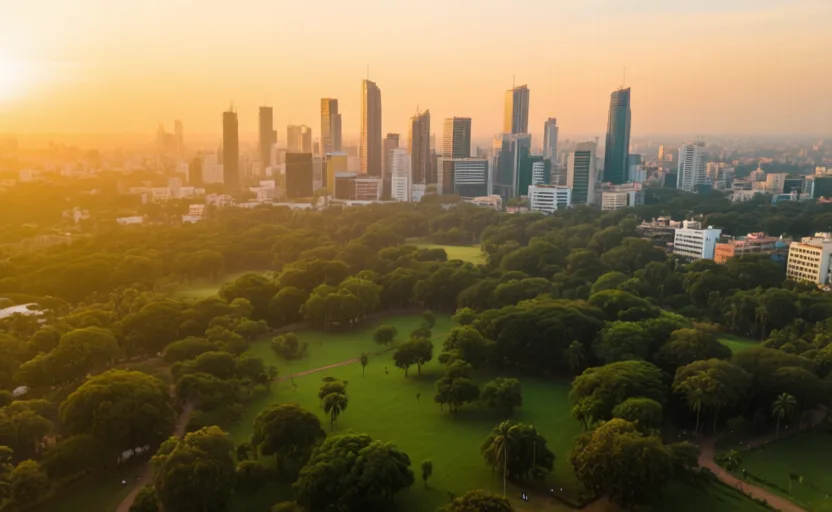 Bengaluru · AI city illustration · Artistic impression
City · South Asia
Bengaluru
Also known as Bangalore
Saved in this browser — no account needed. Sign in later and it comes with you.
Where it is
Bengaluru is a city of the high plateau, around 900 metres up on the Mysore Plateau at the southern end of the Deccan. The ground is mostly flat, with small granite and gneiss hills to the south and a highest point of 962 metres on a ridge in the west. No major river passes through it. Six rivers rise at the Nandi Hills about 60 kilometres to the north, but they water only its edges, and the Kaveri, running to the south-west, supplies most of the city’s water. The altitude keeps the climate moderate, with rain from both the south-west and north-east monsoons.
The land and water around it
The Mysore Plateauplateau
The plateau, part of the Deccan, gives the city its altitude of about 900 metres, its moderate climate and its red laterite and loamy soils. Doddabettahalli, at 962 metres on a western ridge, is the highest point.
The tanks and lakeslake
With no large river, the city has always relied on rain-fed tanks. Kempe Gowda built several in the sixteenth century, and Shahaji added reservoirs to solve a water shortage. The city had 265 lakes in the 1960s and only 98 by the late 2010s, and most of those are polluted.
The Kaveririver
A river to the south-west of the city that supplies most of its water, a gap between where the city stands and where its water comes from. The rivers nearer by, such as the Vrishabhavathi, are polluted and depleted by sewage.
Its history, in short
A hero stone found at Begur gives the earliest known mention of the name, in an Old Kannada inscription of about 890, in a battle under the Western Ganga dynasty. The region then passed to the Cholas in the early eleventh century and to the Hoysalas after 1117, and then to the Vijayanagara Empire. The city proper dates from 1537, when the local chieftain Kempe Gowda I built a mud fort and laid out the market streets as divisions called petes, with tanks for water. After Vijayanagara fell in 1565 the Kempe Gowdas ruled independently, until an Adil Shahi army took the town in 1638 and gave it to Shahaji. It later passed to the Mysore kingdom and then to Hyder Ali and his son Tipu Sultan, who held it until the British took it in the Anglo-Mysore Wars. In 1809 the British set up a cantonment outside the old city, so that by the late nineteenth century Bengaluru was two cities, the Pete and the Cantonment. They merged under one administration in 1949. It became capital of the enlarged Mysore State in 1956, renamed Karnataka in 1973. Information technology firms followed Texas Instruments from 1985.
Timeline
Dates are shown on a timeline rather than as changing shapes on the map. The globe draws modern boundaries only, and tinting a modern outline to stand for a historical one would state something we cannot source.
Post-classical world
c. 890
First mention of the name
An Old Kannada hero stone at Begur, from the Western Ganga period, mentions the place in a battle. It is the earliest known reference to Bengaluru.
1004 or 1024
The Cholas take the region
Under Raja Raja Chola I the Cholas defeat the Western Gangas. Another account dates the conquest to 1024. The Hoysala king Vishnuvardhana later defeats them in 1117.
Early modern & oceanic
1537
Kempe Gowda’s fort
Kempe Gowda I, who held the area as a lord under the Vijayanagara emperors, builds a mud fort that is regarded as the foundation of the modern city. The streets are divided into petes.
1638
An Adil Shahi army takes the town
Kempe Gowda III is defeated and the town becomes a feudal estate of Shahaji. In 1687 a Mughal general takes it and leases it to the Mysore ruler Chikkadevaraja Wodeyar.
Well attestedWikipedia
Industrial & imperial
1809
The cantonment
The British set up a military garrison and cantonment outside the old city, leading to the pairing of the Pete, whose residents were mainly Kannadigas, with the Cantonment, whose residents were mainly Tamils and English.
Well attestedWikipedia1905 or 1906
Electricity
Bengaluru becomes one of the first cities in India with electricity, though sources give 1905 and 1906. Its reputation as the Garden City begins with the silver jubilee projects of 1927.
Contemporary
1985
Texas Instruments arrives
The first multinational company to set up in the city is followed by other information technology firms, and by the end of the twentieth century Bengaluru is known as the Silicon Valley of India.
Well attestedWikipedia1 November 2014
Officially Bengaluru
Bangalore, the anglicised form, ceases to be the official name after the Union ministry approves a change proposed by the state in 2005. The name Bengaluru is the older Kannada one.
Places that carry meaning
Begur Nageshwara Templec. 860
Commissioned under Ereganga Nitimarga I of the Western Ganga dynasty, with additions by the king who followed him. The hero stone found at Begur carries the first mention of Bengaluru.
The PeteFrom 1537
Kempe Gowda’s original town, with two main streets, Chickpet and Doddapete, meeting at Doddapete Square. The Pete is the older core of the city, whose residents were mainly Kannadigas.
The CantonmentFrom 1809
The British Civil and Military Station expanded through the nineteenth century and housed many soldiers alongside a mixed civilian population drawn from beyond Mysore. It acquired its own culture and politics.
Lal Baghc. 1760
A garden established around 1760, in the period when Hyder Ali and then Tipu Sultan ruled the city. The Garden City label itself dates from the 1927 jubilee projects.
Languages here
Places are usually multilingual. This lists what is actually spoken, not one language per border.
KannadaDravidian family
The state’s official language and the mother tongue of 42 per cent of the city.
In 2011 about 3.57 million spoke Kannada as their mother tongue, and Bengaluru Kannada is the local dialect. The language has been an issue of dispute: a 2023 order requiring Kannada on all business signboards led to protests, and the city has seen court cases and mixed public opinion over how Kannada, English and other languages should be used.
TamilDravidian family
The second most spoken language, with 1.39 million speakers in 2011.
Tamil speakers settled in the region for business in the sixteenth century and were many in the cantonment. The city’s second largest language community.
TeluguDravidian family
The third most spoken language, with about 1.17 million speakers.
Telugus came to the city at the invitation of the Mysore royalty. About 90 per cent of migrants to the city have come from the south Indian states.
UrduIndo-European family
The fourth most spoken language, with 1.10 million speakers.
Spoken by the city’s Dakhini and Urdu-speaking Muslims. Hindi, Malayalam and Marathi follow, and English is the principal business language among white-collar workers.
Learn the language here
- 1Understand which languages are spoken hereBengaluru is multilingual. Start with which languages are used, by whom, and for what — the phrase list only covers one of them.Written by Globe Quest
- 2Learn 12 phrasesCurated everyday phrases for Bengaluru, with audio and a written form.Written by Globe Quest
- 3Say them out loudSpeaking practice with pronunciation feedback, one phrase at a time.Globe Quest material, your own additions
- 4Come back to themSpaced review, so what you learned this week is still there next month.Written by Globe Quest
Check yourself
Who is regarded as the founder of the modern city in 1537?
Kempe Gowda I
Kempe Gowda I, a chieftain under the Vijayanagara Empire, built a mud fort in 1537 and laid out the petes, the market divisions, that still exist.
Where does most of Bengaluru’s water come from?
The Kaveri to the south-west
No major river crosses the city, and the rivers that rise at the Nandi Hills water only its fringes. The Kaveri, to the south-west, supplies most of its needs.
Worth arguing about
- A city that was two cities until 1949, a Kannada-speaking Pete and a Tamil- and English-speaking cantonment, is now a magnet for migrants from across India. Whose city is it, and who decides the language on its signs?
- Bengaluru lost most of its lakes and much of its forest cover as it grew. Can a city built for the tank and the garden be rebuilt around its water?
What we have not established
These are open questions, listed rather than filled in. We would rather show a gap than a plausible guess.
How many people live in Bengaluru?
The 2011 census counted 8,443,675 in the city and about 8.5 million in the urban agglomeration, while a 2016 estimate for the agglomeration is about 10.45 million. The city’s boundary and the lack of a later census make a current total uncertain, so none is given.
When did the Cholas conquer the region?
One account gives about 1004 under Raja Raja Chola I and Rajendra Chola I, while another gives 1024, and little evidence of the period survives in the city today.
Sources
- Wikipedia · BengaluruWikipedia · encyclopedia · checked 2026-11-24
- Wikipedia · History of BengaluruWikipedia · encyclopedia · checked 2026-11-24
Reviewed by Globe Quest editorial on 2026-11-24. Drafted with AI assistance and checked against the sources above before publication.