 Globe Quest
 Human Quest · LearningSign in
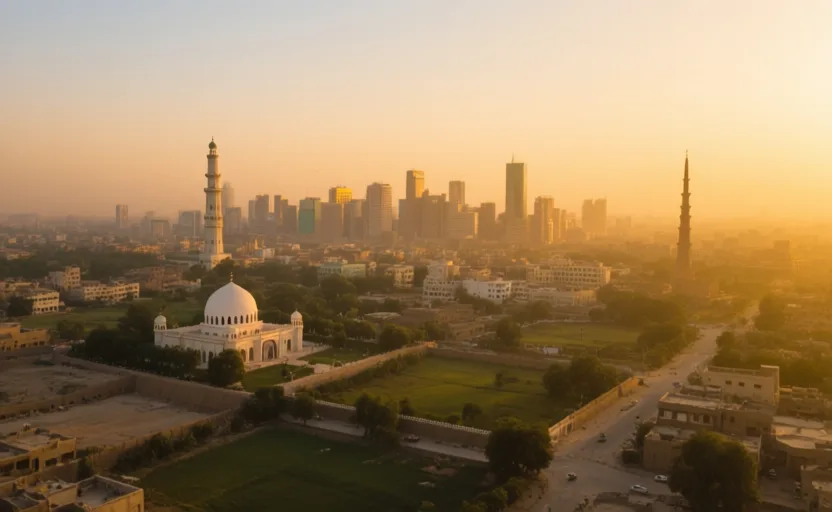 Multan · AI city illustration · Artistic impression
City · South Asia
Multan
Saved in this browser — no account needed. Sign in later and it comes with you.
Where it is
Multan occupies the flat alluvial plain of southern Punjab, on the eastern bank of the Chenab. The Sutlej runs nearby and separates the surrounding region from Bahawalpur. Orchards and mango farms ring the city, and beyond them lies desert, which is why Multan is classed as hot desert and receives only about 200 mm of rain a year. Summer heat is among the worst in Pakistan, with a record of 50 degrees Celsius in May 2010, and dust storms are made worse by the clearing of local forest. The Sulaiman Mountains rise to the west, an extension of the southern Hindu Kush.
The land and water around it
The Chenab and the alluvial plainriver
Multan stands on the Chenab's eastern bank, with the Sutlej close by. The plain between them is flat and fertile where irrigated.
The Sulaiman Mountainsmountains
A range to the west that continues the southern Hindu Kush. Its best-known peak, Takht-e-Sulaiman, the Throne of Solomon, reaches 3,487 metres.
A hot desert climateclimate
Winter western disturbances bring moderate rain and the occasional hailstorm. Summers are punishing, with heatwaves in May and June and dust storms, and the monsoon between June and September cools the air with sometimes heavy downpours.
Its history, in short
Multan is among the oldest cities in South Asia, and nobody has fixed its age. Villages of the early Indus Valley period stand nearby, and the city was a major target for Alexander in 326 BCE. After the Arab conquest of Sindh in 712 it became a major trading centre with strong ties to Iran, Central Asia and the wider Muslim world. It held a famous Sun Temple and was the capital of local emirates from the 9th century. Sufi mystics gathered here in the 11th and 12th centuries and earned it the name City of Saints, and the shrines they left are the best-known buildings in the city today. The Langah sultans, the Delhi sultans, the Mughals, the Durranis and the Sikhs all ruled it in turn, and under Akbar it became the seat of a large Mughal province. In 1848 a revolt against British officials led to a siege, and the bombardment destroyed the fort and the royal citadel at the centre of the old town. After 1849 and again after 1947, its political weight faded, although it remains an important regional centre of southern Punjab.
Timeline
Dates are shown on a timeline rather than as changing shapes on the map. The globe draws modern boundaries only, and tinting a modern outline to stand for a historical one would state something we cannot source.
First cities & states
3000–2800 BCE
Early Harappan sites
Archaeological sites around Multan date to the early phase of the Indus Valley Civilisation. Hindu texts credit the sage Kashyapa with founding the city, and the exact age of the settlement has yet to be pinned down.
Classical world
326 BCE
Alexander and the Mallians
Alexander the Great besieges what is believed to be the capital of the Malli tribe. Some historians say that an arrow wound taken at Multan eventually led to his death.
Some historians' account that a fatal arrow struck Alexander at Multan, set against other accounts of his death
Post-classical world
712
The Umayyad conquest
Muhammad bin Qasim takes Multan after conquering Sindh. An earlier Arab army had occupied the area in 664 but made no attempt to hold it.
Well attestedWikipedia855
Capital of an emirate
The Banu Munabbih, who claimed descent from the Prophet's Quraysh tribe, make Multan the capital of an emirate that lasts about a century. By the mid-10th century the city has come under the influence of the Qarmatian Isma'ilis.
1175
Muhammad Ghori takes Multan
Muhammad Ghori conquers Isma'ili-ruled Multan after entering Punjab by the Gomal Pass and uses it as a base for his campaign into Gujarat in 1178.
Well attestedWikipedia1397–1398
Timur's siege
Timur's grandson Pir Muhammad besieges Multan for half a year before taking it in 1398. The governor, Khizr Khan, allies with Timur and later founds the Sayyid dynasty of the Delhi Sultanate.
1445
The Langah Sultanate
Multan becomes the capital of the Langah Sultanate. Under Shah Husayn, who ruled from 1469 to 1498, it prospers and Baloch settlers arrive at his invitation.
Places that carry meaning
Multan Fort and the saints' tombs13th–14th century
The fort contained the tombs of Bahauddin Zakariya (1170–1267) and Shah Rukn-e-Alam (1251–1335). The latter was completed in the Tughluq era and is considered the first Tughluq monument. The Multani style that grew up around such tombs uses large brick walls reinforced with wooden anchors under inward-sloping roofs.
Prahladpuri TempleOf tradition
The remains of a Hindu temple on a raised platform inside the fort, next to Bahauddin Zakariya's tomb, with a mosque built beside it. Tradition holds that Prahlad, son of the king Hiranyakashipu, built it.
Hindu tradition that Prahlad built the temple
The Sun TempleRecorded in the 10th century
A Hindu temple noted by the Arab geographer al-Muqaddasi to stand in the most populous part of the city. Some accounts say it brought the city's Muslim rulers up to 30% of their revenue.
The old neighbourhoodsMedieval onward
Small private cul-de-sacs branch off the bazaars and main roads, a form shaped by the need for privacy and shelter from the heat. The royal citadel that once stood at the centre was largely destroyed by the British in 1848.
Languages here
Places are usually multilingual. This lists what is actually spoken, not one language per border.
SaraikiIndo-European family
The largest first language, a regional language of southern Punjab.
In the 2023 census 42.69% of residents gave it as their first language. It is closely related to Punjabi and largely mutually intelligible with it, and some 26 million people speak it across southern Punjab and nearby areas.
UrduIndo-European family
The national language, the first language of almost a third of residents.
The census records 30.13% of residents with Urdu as the first language.
PunjabiIndo-European family
The language of the province, spoken by about a quarter of the city.
Some 24.97% of residents named Punjabi in 2023. Pashto accounts for another 1.15%.
Learn the language here
- 1Understand which languages are spoken hereMultan is multilingual. Start with which languages are used, by whom, and for what — the phrase list only covers one of them.Written by Globe Quest
- 2Learn 12 phrasesCurated everyday phrases for Multan, with audio and a written form.Written by Globe Quest
- 3Say them out loudSpeaking practice with pronunciation feedback, one phrase at a time.Globe Quest material, your own additions
- 4Come back to themSpaced review, so what you learned this week is still there next month.Written by Globe Quest
Check yourself
Why is Multan called the City of Saints?
Many Sufi mystics settled there in the 11th and 12th centuries and left their shrines
Sufi mystics gathered here in the 11th and 12th centuries, and the shrines of their successors, like Bahauddin Zakariya and Shah Rukn-e-Alam, dominate the city's monuments.
Which language is most widely spoken as a first language in Multan?
Saraiki
Saraiki, the language of southern Punjab, was named by 42.69% of residents in 2023, ahead of Urdu at 30.13% and Punjabi at 24.97%.
Worth arguing about
- Multan changed hands many times and kept its commercial role through most of them. What lets a trading city survive a change of rulers?
- The royal citadel was largely destroyed in 1848 and is lost today. What does a city lose when its centre of power disappears?
What we have not established
These are open questions, listed rather than filled in. We would rather show a gap than a plausible guess.
How old is Multan?
One account calls its exact age undetermined and puts its history at five millennia, another points to early Harappan sites from 3000 BCE, and traditional histories cite a far older legendary founding. The legendary founding dates are not testable, and the early sites are not the city itself.
How many people live in Multan?
The 2017 census gave about 1.83 million, rising to 2.215 million in 2023, while the 1998 count was 1,078,245. The wider district covers 3,721 km2 against about 560 km2 for the city authority, so totals depend on the boundary used.
Sources
- Wikipedia · MultanWikipedia · encyclopedia · checked 2026-11-24
- Wikipedia · History of MultanWikipedia · encyclopedia · checked 2026-11-24
- Wikipedia · Languages of PakistanWikipedia · encyclopedia · checked 2026-11-24
Reviewed by Globe Quest editorial on 2026-11-24. Drafted with AI assistance and checked against the sources above before publication.