 Globe Quest
 Human Quest · LearningSign in
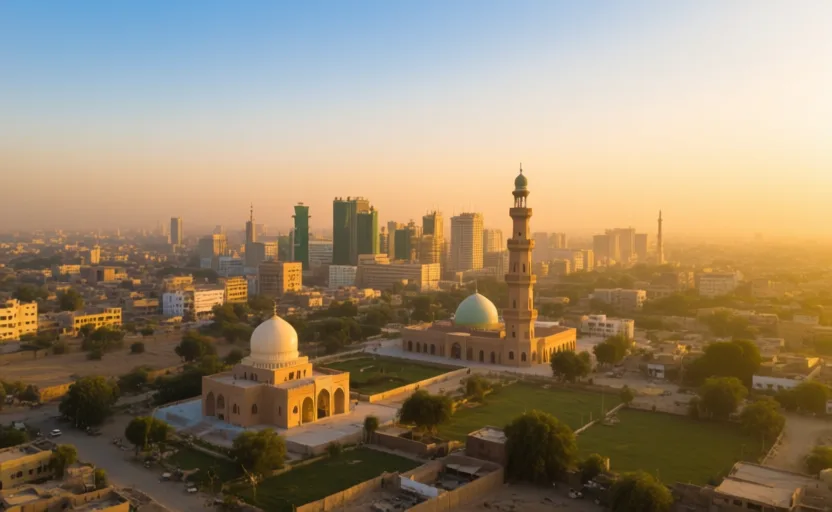 Faisalabad · AI city illustration · Artistic impression
City · South Asia
Faisalabad
Saved in this browser — no account needed. Sign in later and it comes with you.
Where it is
Faisalabad stands on the rolling flat plain of central Punjab at about 186 metres, in the lower Rechna Doab, the tongue of land between the Chenab and Ravi rivers. The Chenab passes some 30 km away and the Ravi about 40 km to the south-east, and a canal system supplies most of the farmland. The soil is young silt and fine sand, a thick alluvial fill laid down by the Indus system, and the climate lies between semi-arid and humid subtropical, with about 650 mm of rain a year, mostly in the monsoon, and summer highs that have touched 48 degrees Celsius.
The land and water around it
The Rechna Doabplain
The interfluve between the Chenab and the Ravi, one of the alluvial lowlands laid down by the upper Indus system. Its deposits are more than a thousand feet thick, and the rivers that built it wind across it, shifting their sandbars and flooding for days in the rainy season.
The Lower Chenab canal systemcanal
The canals that made the city possible. The lower Chenab canal waters about 80% of the cultivated land around Faisalabad, and the Rakh and Gogera branches raise local water levels where the Ravi's own belt remains narrow.
Monsoon floods and winter fogclimate
Monsoon downpours from July to September cause flash floods, and in September 1961 a record 264.2 mm fell in a single day. Winters are cloudy and foggy, October and November are the driest months, and dust-thunderstorms can bring gusts such as the 151 km/h recorded in June 2000.
Its history, in short
Faisalabad has almost no history before the British, because it was designed from nothing. In the 1880s the Punjab government began irrigating the dry western plains by building canal colonies, and the Chenab Colony was the largest. A colonisation officer chose this site for its headquarters, and the new town was named Lyallpur after the province's lieutenant governor. Its centre copied the Union Jack: eight roads ran out from a clock tower and became eight bazaars. A rail link opened in the 1890s, the district was created in 1904, and an agricultural college followed in 1906. Partition changed the city's population: Hindus and Sikhs left, and refugees from East Punjab arrived in such numbers that between 1941 and 1961 its population grew about sixfold. Textile mills and food processing, which had started in the 1930s, became the base for the industrial economy that earned it the title of Pakistan's Manchester. In 1979 the government renamed it Faisalabad, after the king of Saudi Arabia.
Timeline
Dates are shown on a timeline rather than as changing shapes on the map. The globe draws modern boundaries only, and tinting a modern outline to stand for a historical one would state something we cannot source.
Industrial & imperial
1880s
The Chenab Colony
The Punjab government begins turning the dry western plains into farmland through canal colonies. The Chenab Colony is the largest, and the colonisation officer Popham Young picks the site of today's city for its headquarters.
Approximate dateWikipedia1890
Lyallpur is named
The new town is named in honour of Sir James Broadwood Lyall, lieutenant governor of Punjab, for his part in the canal colonisation. Other accounts date the settlement to 1880 or place the planned city in the 1890s.
Approximate dateWikipedia1895–1896
The railway
A rail line from Wazirabad reaches Lyallpur and joins the town and its growing grain surplus to the British rail network.
Approximate dateWikipedia1904
A district of its own
The district of Lyallpur is created within Multan Division, taking in three tehsils, and the town is already a grain-trading centre. It had been incorporated as a municipality in 1898, and by 1911 had 19,578 people.
Well attestedWikipedia1906
The agricultural college
The Punjab Agricultural College and Research Institute is founded in Lyallpur, the origin of today's University of Agriculture.
Well attestedWikipedia
Contemporary
1947–1961
Refugees and rapid growth
Lyallpur's Hindu and Sikh minority leaves for India, and Muslim refugees from East Punjab and Haryana settle in. Counts run from 69,930 residents in 1941, to 179,000 in 1951, to 425,248 in 1961.
Well attestedWikipedia1979
Renamed Faisalabad
The government of Pakistan changes the city's name to honour King Faisal of Saudi Arabia and his country's long relationship with Pakistan.
Well attestedWikipedia1980s
Foreign investment in textiles
The textile sector draws foreign investment, and many Faisalabad residents begin to work abroad, sending remittances that help pay for new infrastructure.
Approximate dateWikipedia
Places that carry meaning
The clock tower and the eight bazaars1890s
The heart of the original plan: eight roads radiate from a large clock tower in a layout said to echo the Union Jack. Each road became a bazaar leading towards a different part of Punjab, and the Commissioner Office compound beside it is where the flag is raised on 14 August.
University of AgricultureFounded 1906
Begun as the Punjab Agricultural College and Research Institute, Lyallpur. It is a reminder that the town was founded for farming, and it remains a centre for agricultural study.
Faisalabad Arts CouncilEstablished 1982, building 2006
A division of the Punjab Arts Council, whose auditorium is named after the musician and singer Nusrat Fateh Ali Khan. Its first literary festival followed in 2014.
Languages here
Places are usually multilingual. This lists what is actually spoken, not one language per border.
PunjabiIndo-European family
The first language of nearly everyone in the city.
In the 2023 census, 90.86% of residents of Faisalabad city gave Punjabi as their first language, a share far higher than in Lahore or Islamabad.
UrduIndo-European family
The national language, the first language of about 8% of residents.
Urdu serves as the shared language between ethnic groups across Pakistan, and a small minority in Faisalabad also speak it at home.
EnglishGermanic family
Co-official language, used in government and higher education.
English serves in courts, administration and higher education across the country, as a legacy of the colonial state that created the city.
Learn the language here
- 1Understand which languages are spoken hereFaisalabad is multilingual. Start with which languages are used, by whom, and for what — the phrase list only covers one of them.Written by Globe Quest
- 2Learn 12 phrasesCurated everyday phrases for Faisalabad, with audio and a written form.Written by Globe Quest
- 3Say them out loudSpeaking practice with pronunciation feedback, one phrase at a time.Globe Quest material, your own additions
- 4Come back to themSpaced review, so what you learned this week is still there next month.Written by Globe Quest
Check yourself
Why was the city founded in the 1880s and 1890s?
As the headquarters of a canal colony that opened dry land to farming
The Chenab Colony was the largest of the Punjab canal colonies, and the town was planned as its administrative and trading centre.
Who is the modern name Faisalabad meant to honour?
King Faisal of Saudi Arabia
The old name, Lyallpur, honoured a British governor. In 1979 it was replaced with one marking Saudi Arabia's long friendship with Pakistan.
Worth arguing about
- A city built from nothing for a purpose, to run a canal colony, has to find a new reason to exist once the purpose is met. What has Faisalabad's been?
- Cities named for colonial officials were renamed for foreign monarchs as well as local heroes. What does a name say about who the city is meant to belong to?
What we have not established
These are open questions, listed rather than filled in. We would rather show a gap than a plausible guess.
When exactly was Faisalabad founded?
One passage says it was settled in 1880 and another says it was founded in 1890, while a third calls it a planned city of the 1890s. The railway link is dated both to 1895 and 1896, so the dates here are given as ranges.
How many people live in Faisalabad?
The 2017 census gives about 3.2 million, but the figure depends on whether the city proper or the wider city district is counted, which has an area of about 1,300 km2.
Sources
- Wikipedia · FaisalabadWikipedia · encyclopedia · checked 2026-11-24
- Wikipedia · PakistanWikipedia · encyclopedia · checked 2026-11-24
Reviewed by Globe Quest editorial on 2026-11-24. Drafted with AI assistance and checked against the sources above before publication.