 Globe Quest
 Human Quest · LearningSign in
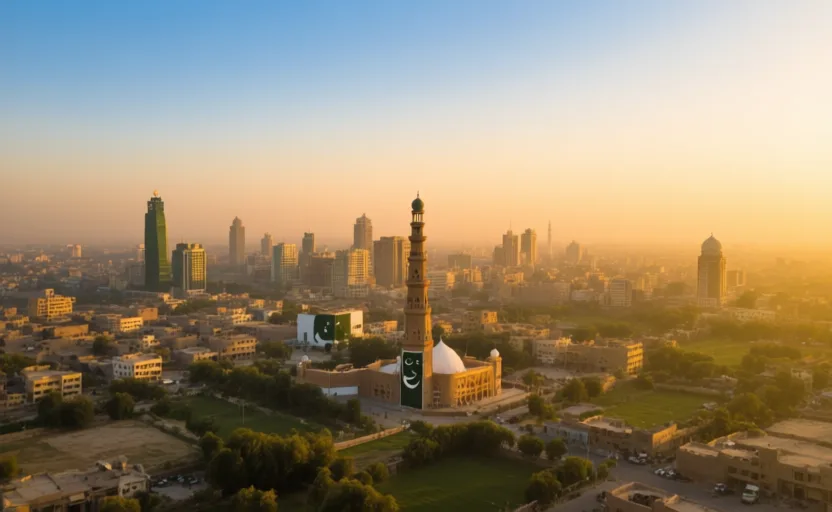 Peshawar · AI city illustration · Artistic impression
City · South Asia
Peshawar
Saved in this browser — no account needed. Sign in later and it comes with you.
Where it is
Peshawar fills the flat floor of a broad valley, the Gandhara plains, enclosed by mountain ranges on three sides and open only to the Punjab plains on the fourth. The Khyber Pass lies to the west, which is why the city has always been the first stop on the road between Afghanistan and the Indus. The climate is hot and semi-arid: summers pass 40 degrees Celsius, and unlike most of Pakistan the city gets no true monsoon, with more rain in the winter and spring storms than in the summer. About 400 mm falls in an average year, though single downpours can be far heavier.
The land and water around it
The Peshawar Valleyvalley
A basin ringed by mountains on three sides and open to the Punjab plains on the fourth. The level ground at its centre, the Gandhara plains, is where the ancient cities of the region, Pushkalavati and then Peshawar, grew up.
The Khyber Passmountains
The old route through the mountains west of the valley, along which most trade between Central Asia and the subcontinent passed. Peshawar's position at its entrance is the historic reason for its economic importance.
A semi-arid basin without a monsoonclimate
Winters are mild and brief and rain peaks between February and April. A record 274 mm fell in one day on 29 July 2010, almost half again the previous record, and a high of 50 degrees Celsius was recorded in June 1995.
Its history, in short
Peshawar was the western capital of Gandhara, and for more than two thousand years its fortunes followed the empires that wanted the passes. Under the Kushans in the 2nd century CE it was a great Buddhist centre, home to a monastery and a stupa that Chinese pilgrims described as the finest they had seen. The White Huns devastated it in the 460s, and Muslim rule began after the Ghaznavids defeated the Hindu Shahis in 1001. Mughals, Durranis and Sikhs held it in turn. Timur Shah Durrani made it his winter capital in 1776, and the Sikhs took it in the 1820s, after which it declined. The British annexed it in 1849 and in 1901 made it the capital of the new North-West Frontier Province. Its character changed in the 1980s: refugees from the Soviet–Afghan War arrived in huge numbers, and Hindko, once the common language of the old city, gave way to Pashto. Today it is the capital of Khyber Pakhtunkhwa, with a historic walled city under pressure from rapid growth.
Timeline
Dates are shown on a timeline rather than as changing shapes on the map. The globe draws modern boundaries only, and tinting a modern outline to stand for a historical one would state something we cannot source.
Classical world
6th–5th century BCE
Earliest settlement
Recorded history reaches back at least to the 6th century BCE, and it probably began as a hamlet in the 5th century BCE, close to the Gandharan capital of Pushkalavati at present-day Charsadda.
Approximate dateWikipedia2nd century CE
Kushan capital
Kanishka moves the capital from Pushkalavati to Peshawar, then called Puruṣapura. It is estimated to have had about 120,000 people, among the largest cities in the world at the time, and Kanishka sponsors a monastery and a giant stupa for Buddhist relics.
460s
The White Huns
The White Huns devastate the city and the surrounding region of Gandhara, destroying many monasteries.
Well attestedWikipedia
Post-classical world
28 November 1001
Battle of Peshawar
Mahmud of Ghazni defeats the Hindu Shahi ruler Jayapala and sets up Ghaznavid rule in the valley. For a time Peshawar is a staging post between the Afghan plateau and the Ghaznavid garrison at Lahore.
Early modern & oceanic
1776
Winter capital of the Durranis
Timur Shah Durrani makes Peshawar his winter capital, and the Bala Hisar fort serves as the residence of the Durrani kings.
Industrial & imperial
1818–1823
The Sikh conquest
Ranjit Singh first takes the city in 1818 but leaves it to local sardars. After defeating Azim Khan at Nowshera in March 1823 he captures it again. By 1830 the economy had sharply declined, with the palace and fields destroyed.
1849 and 1901
British rule and the frontier capital
The East India Company annexes Peshawar with the rest of Punjab in 1849. In 1901 it becomes the capital of the North-West Frontier Province, newly cut from Punjab's north-western districts.
Well attestedWikipedia
Contemporary
1979 onward
Refugees and a changed city
Peshawar becomes a base for Afghan refugees and a political centre for the anti-Soviet resistance. By 2012 Afghans were estimated at around 28% of the city's population, and the city's language and economy were transformed.
Places that carry meaning
The Kanishka stupa2nd century CE
Just outside the old city's Ganj Gate stood a stupa built to house Buddhist relics, possibly higher than any other structure then standing. Faxian, a Chinese monk, saw it in about 400 CE and put its height at around 120 metres, and it was still standing when Xuanzang visited in 634. A casket with relics of the Buddha was excavated from its base in 1909.
Bala Hisar FortMughal and Durrani periods
The fort that Babur rebuilt as a base for expeditions to nearby towns and that later housed the Durrani kings.
The Walled CityMedieval to modern
The old centre once held behind high walls and gates, now mostly gone. It keeps havelis of unbaked brick with wooden balconies, the Mohabbat Khan Mosque and Qissa Khawani Bazaar, and is the last stronghold of the Hindko-speaking Peshoris.
Peshawar MuseumFounded 1907
Opened in memory of Queen Victoria, it holds almost 14,000 items and is known for Greco-Buddhist art of the Gandharan, Kushan, Parthian and Indo-Scythian periods.
Languages here
Places are usually multilingual. This lists what is actually spoken, not one language per border.
PashtoIndo-European family
The main language of the city today.
Urbanisation, migration from rural and former tribal areas and the influx of Afghan refugees turned Peshawar from a Hindko-speaking city into a Pashto-speaking one. Even the Sikh community, bolstered by refugees from the tribal areas, speaks Pashto as its mother tongue.
HindkoIndo-European family
The historic language of the street and the market.
Hindko was the lingua franca of the city until well after independence and is still spoken in the old city by the Peshoris, who formed a majority until the 1960s. Its speakers are increasingly borrowing from Pashto and Urdu.
UrduIndo-European family
The national language, understood across the city.
Urdu is the shared language between ethnic groups across Pakistan, and in Peshawar it is understood throughout the city.
EnglishGermanic family
A language of education.
English is used in the city's schools and colleges alongside Urdu, the legacy of British rule that began here in 1849.
Learn the language here
- 1Understand which languages are spoken herePeshawar is multilingual. Start with which languages are used, by whom, and for what — the phrase list only covers one of them.Written by Globe Quest
- 2Learn 12 phrasesCurated everyday phrases for Peshawar, with audio and a written form.Written by Globe Quest
- 3Say them out loudSpeaking practice with pronunciation feedback, one phrase at a time.Globe Quest material, your own additions
- 4Come back to themSpaced review, so what you learned this week is still there next month.Written by Globe Quest
Check yourself
How did Peshawar's main language change in the late 20th century?
It shifted from Hindko to Pashto as migrants and refugees arrived
Partition removed many Hindko-speaking Hindus and Sikhs, and then rural migrants and Afghan refugees made Pashto the city's main language, leaving Hindko mostly in the old walled city.
Which empire made Peshawar, then Puruṣapura, its principal capital in the 2nd century CE?
The Kushan Empire
Kanishka moved the Kushan capital there, built a monastery and a giant stupa, and made the city a centre of Buddhist learning.
Worth arguing about
- A city at the mouth of the Khyber Pass has been fought over for twenty-five centuries. What does it do to a place to be a gateway first and a destination second?
- Peshawar's old walled city is described as in urgent need of protection. What should be kept when growth and migration change who lives inside the walls?
What we have not established
These are open questions, listed rather than filled in. We would rather show a gap than a plausible guess.
When was Peshawar founded?
One account has recorded history from at least the 6th century BCE and a village in the 5th, while another says the city of Puruṣapura was established after 100 CE. The Sikh conquest is likewise dated to 1818 in one passage and 1823 in another, so the two dates are given as a range.
Sources
- Wikipedia · PeshawarWikipedia · encyclopedia · checked 2026-11-24
- Wikipedia · History of PeshawarWikipedia · encyclopedia · checked 2026-11-24
- Wikipedia · PakistanWikipedia · encyclopedia · checked 2026-11-24
Reviewed by Globe Quest editorial on 2026-11-24. Drafted with AI assistance and checked against the sources above before publication.