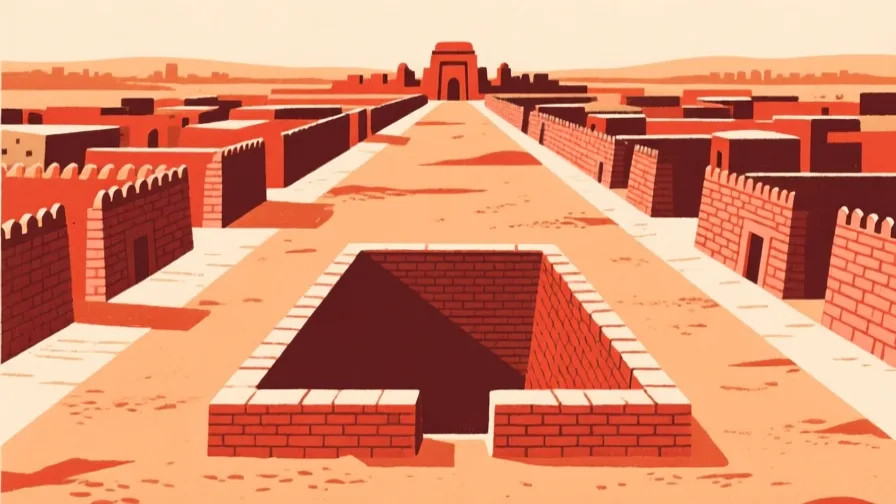
 Mohenjo-daro · AI illustration, not a photograph
Historical place · South Asia
Mohenjo-daro
Also known as Moenjodaro, Mound of the Dead
A planned Bronze Age city of the Indus Valley civilisation, with drainage and street grids laid out from the start.
Saved in this browser — no account needed. Sign in later and it comes with you.
Read its story
Where it is
Mohenjo-daro sits on the right bank of the Indus in Sindh, southern Pakistan, on a plain that the river built and that the river has repeatedly re-crossed. The site is a set of mounds above the floodplain — the name means mound of the dead in Sindhi — and the water table beneath is high and saline, which is the central problem of preserving it. The surrounding land is now irrigated by one of the largest canal systems in the world.
The land and water around it
The Indus floodplainriver
A river that shifts course across a very flat plain and floods on a scale that has repeatedly changed where settlement is possible. The city was built with that in mind — on raised platforms — and was still overwhelmed more than once.
The saline water tablebasin
Modern canal irrigation raised the groundwater, and evaporation draws salts up into the ancient brick. Crystallising salt breaks the bricks apart from inside. The threat to the site is a side effect of agriculture around it.
The Ghaggar-Hakra channelsriver
A now largely dry channel system east of the Indus with many Harappan sites along it. Whether it was a major perennial river during the civilisation's height, and what its drying meant, is actively argued.
Its history, in short
It was one of the largest cities of the Indus Valley civilisation, occupied in roughly the third millennium BCE, and it was laid out to a plan from the beginning: streets on a grid, standardised fired bricks in a fixed ratio, covered drains along the streets, wells in most blocks, and a raised western mound carrying large public structures. It was excavated from the 1920s, which is when the civilisation itself was recognised at all. The city was abandoned in the early second millennium BCE. Its script is undeciphered, so a large, literate, planned urban society is known almost entirely from what it built and threw away rather than from anything it said.
Timeline
Dates are shown on a timeline rather than as changing shapes on the map. The globe draws modern boundaries only, and tinting a modern outline to stand for a historical one would state something we cannot source.
First cities & states
c. 2600–1900 BCE
The city
Mohenjo-daro is occupied at urban scale, rebuilt in successive levels as flood deposits raise the ground. Dating is from radiocarbon and stratigraphy; there are no readable dated texts.
Approximate dateUNESCO World Heritage Centrec. 2500 BCE
Built to a standard
Fired bricks in a consistent 1:2:4 ratio, street drainage, wells, and a grid layout appear across Harappan cities hundreds of kilometres apart. Standardisation on that scale implies coordination; what kind of authority produced it is unknown, because no palace, no royal burial and no unambiguous ruler image has been found.
Well attestedUNESCO World Heritage Centrec. 1900–1700 BCE
The cities are given up
Urban life at the great Harappan sites ends over some generations. Proposed causes include river course changes, a weakening monsoon, the drying of the Ghaggar-Hakra, and the shift of population to smaller eastern settlements. The old account of a violent invasion is no longer supported by the evidence at the site.
Hydrological and climatic explanations now dominate the specialist literature, but their relative weight is unsettled; the mid-twentieth-century invasion narrative has been abandoned by archaeologists though it persists in popular accounts.
Industrial & imperial
1922
Recognised
Excavation at Mohenjo-daro and at Harappa establishes that a previously unknown Bronze Age urban civilisation had existed in the Indus basin, pushing South Asian urban history back by more than a millennium in a single decade.
Well attestedEncyclopædia Britannica
Contemporary
1980
Inscribed as World Heritage
The ruins are inscribed. Conservation since has been a running argument about how to deal with salt, with periods on and off the danger list and repeated warnings about the exposed brickwork.
Well attestedUNESCO World Heritage Centre2022
The floods
Exceptional monsoon flooding across Sindh damages standing structures at the site. A city that was built on platforms against the river was damaged by the river again, four thousand years on.
Well attestedUNESCO World Heritage Centre
Places that carry meaning
The Great Bathc. 2500 BCE
A watertight brick tank on the western mound, sealed with bitumen, with steps at both ends. Usually read as ritual rather than recreational, though that reading is an inference from later South Asian practice rather than from anything the builders wrote.
The drainsc. 2500 BCE
Covered brick drains running along the streets, fed from houses, with inspection holes. Domestic sanitation at this level is not seen again in the region for a very long time.
The sealsc. 2500 BCE
Small carved stone seals showing animals and short sign sequences. Thousands survive; the longest inscriptions run to a few dozen signs, which is part of why the script resists decipherment — there is no long text and no bilingual.
Languages here
Places are usually multilingual. This lists what is actually spoken, not one language per border.
The Indus script
Undeciphered. The writing of the civilisation.
Around 400 distinct signs across some 4,000 short inscriptions. Whether it encodes a language at all is disputed; proposals connect it to Dravidian or to Indo-Aryan, and no proposal has produced a reading others can reproduce. Without a bilingual text or a long inscription the problem may not be solvable.
SindhiIndo-Aryan family
The language of the region today.
Written in a Perso-Arabic script in Pakistan and in Devanagari in India — one language, two scripts, split by a border. The site's name is Sindhi.
UrduIndo-Aryan family
Pakistan's national language.
The language of administration and schooling, and a first language for a minority of Pakistanis — a familiar arrangement in which the unifying language is not the local one.
Learn the language here
- 1Understand which languages are spoken hereMohenjo-daro is multilingual. Start with which languages are used, by whom, and for what — the phrase list only covers one of them.Written by Globe Quest
- 2Read why the language is what it isThe quest for this place covers how its languages got here and who speaks them.Written by Globe Quest
Check yourself
What is missing from Mohenjo-daro that archaeologists expect in a city of its size?
A palace, a royal burial, or any unambiguous image of a ruler
Standardisation across hundreds of kilometres implies coordination, but what kind of authority produced it is genuinely unknown.
What is destroying the brickwork?
Salt drawn up by a water table raised by modern canal irrigation
Crystallising salt breaks the bricks from inside — a side effect of the agriculture around the site.
Worth arguing about
- A large, planned, literate society with no evidence of a king. What do we assume about power that this site does not support?
- The script may never be read. What should a museum say about a civilisation whose own account of itself is lost?
What we have not established
These are open questions, listed rather than filled in. We would rather show a gap than a plausible guess.
Does the Indus script encode a language?
Sign counts and inscription lengths are compatible with both a full writing system and a non-linguistic sign system, and the debate is unresolved. No decipherment has produced readings that others can reproduce.
Why were the Harappan cities abandoned?
River course change, monsoon weakening and the drying of the Ghaggar-Hakra are all argued, and their relative weight is unsettled. What is settled is that the invasion narrative is not supported by the evidence.
Sources
- UNESCO · Archaeological Ruins at MoenjodaroUNESCO World Heritage Centre · intergovernmental · checked 2026-09-08
- Britannica · Mohenjo-daroEncyclopædia Britannica · encyclopedia · checked 2026-09-08
- Britannica · Indus RiverEncyclopædia Britannica · encyclopedia · checked 2026-09-08
Reviewed by Globe Quest editorial on 2026-09-08.
Related places
Themes: How cities work, Rivers & cities, Water & environment