 Globe Quest
 Human Quest · LearningSign in
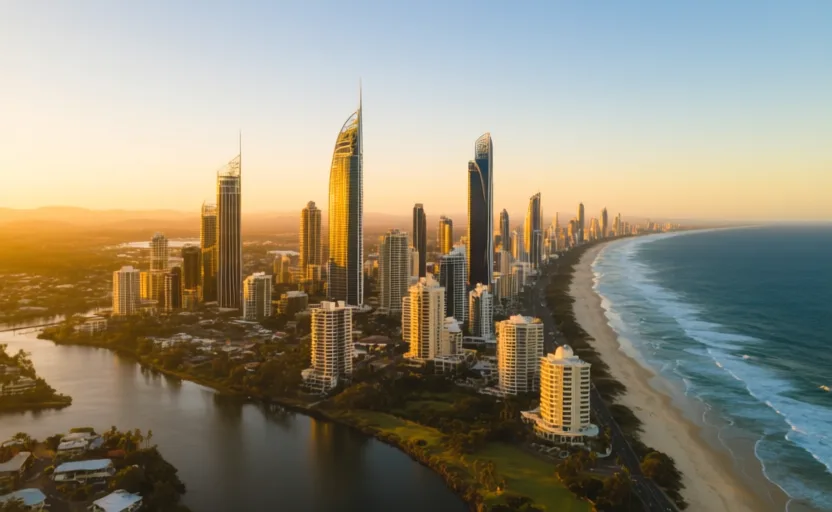 Gold Coast · AI city illustration · Artistic impression
City · Oceania
Gold Coast
Saved in this browser — no account needed. Sign in later and it comes with you.
Where it is
A ribbon of coast 60 to 70 kilometres long, between the Brisbane region and the New South Wales border, makes up the Gold Coast, about 66 kilometres from Brisbane. Along it run 70 kilometres of shoreline and almost 42 kilometres of unbroken beach, backed by tidal waterways, 860 kilometres of them navigable, and by canal estates cut from the Nerang River and its neighbours. A sand barrier, the Spit, and South Stradbroke Island enclose the Broadwater, with the Seaway as the entrance. Inland rises a rainforest hinterland. The climate is humid subtropical, with hot, wet summers in storms and mild, dry winters.
The land and water around it
The surf coastcoast
About 70 kilometres of coastline, with almost 42 kilometres of unbroken beach and famous surf breaks from the Spit to Snapper Rocks. The strip is the region's tourism asset, and Duranbah, over the border in New South Wales, is often counted with it.
The Nerang River, Broadwater and canalsestuary
Canal estates, first dug in the 1950s, are extensions of the Nerang River and other creeks. The Seaway between the Spit and South Stradbroke Island lets boats reach the Pacific, and breakwaters and sand pumping keep the channel open.
The forested hinterlandforest
About half the city area is forest, from pockets of ancient rainforest to mangrove islands, heath and eucalypt woodland. Red cedar in the hinterland first drew colonists in the nineteenth century.
Its history, in short
Yugambeh-speaking peoples, including the Kombumerri, Mununjali and Wangerriburra clans, have lived on this coast for about 23,000 years, hunting, fishing and gathering shellfish, fish and bunya nuts, and meeting at Bundall and other gatherings for ceremony. Cook sailed past in 1770, and John Oxley landed at Mermaid Beach in 1823. Red cedar drew timber cutters into the hinterland from the mid-nineteenth century, Nerang was surveyed in 1865 and Southport in 1875, and the coast became a retreat for wealthy Brisbane families. A railway arrived in 1889. After the First World War cheap seaside shacks spread, and the Surfers Paradise Hotel of the late 1920s started a larger boom. Inflated prices earned the strip the nickname Gold Coast from 1950; local people at first thought it a slight. The town council took the name in 1958, and the area was proclaimed a city in 1959. High-rises, canals and theme parks followed, and the city hosted the 2018 Commonwealth Games.
Timeline
Dates are shown on a timeline rather than as changing shapes on the map. The globe draws modern boundaries only, and tinting a modern outline to stand for a historical one would state something we cannot source.
Early human world
Beginnings in Yugambeh tradition
The Three Brothers
In Yugambeh-speaking tradition, three culture heroes, Berrung, Mommóm and Yaburóng, reached this coast with their families by canoe, a large one, from an island over the sea. A storm broke the canoe and the rocks offshore are its pieces. Berrung taught the first people fire, law and marriage, and the brothers' separation explains why dialects differ along the coast.
Oral historyWikipediaKombumerri and other Yugambeh-speaking peoples
About 23,000 years ago
Archaeological record
Evidence suggests Aboriginal people lived in the district about 23,000 years before European settlement and still live there.
Approximate dateWikipedia
Industrial & imperial
1823
Oxley lands
Explorer John Oxley lands at Mermaid Beach, named for his cutter. Cook had sailed past in 1770 and named Mount Warning and Point Danger as beacons for a reef.
1875
Southport
A small settlement at the head of the Nerang River is surveyed and renamed Southport. It soon gains a name as a quiet holiday retreat for wealthy Brisbane residents.
1897
The Aboriginals Protection Act
Queensland's act turns Aboriginal and Torres Strait Islander people into wards of the state, with local police protectors controlling employment, wages and removal to reserves. Many Kombumerri kept to their country and worked on farms and in oyster beds and sawmills, and kept a low profile so they would not be removed.
Well attestedWikipedia
Contemporary
1950
A new nickname
High prices lead to the label “Gold Coast” for the strip from Southport to Coolangatta. Locals at first thought it derogatory, but businesses began to adopt it.
16 May 1959
A city
The area is proclaimed a city, less than a year after the town council was renamed. The first high-rise follows in 1960.
2018
Commonwealth Games
The city hosts the Commonwealth Games, with a redeveloped cultural precinct opened beforehand.
Well attestedWikipedia
Places that carry meaning
Jebribillum Bora ParkLong before European settlement
A park at Burleigh Heads that holds one of the surviving bora rings of the region, a ceremonial ground. Bundall near the Nerang River was a meeting place for visitors from as far as Grafton and Maryborough.
SouthportSurveyed 1875
The central business district of the Gold Coast, which began as a quiet resort. In 1885 Governor Musgrave built a holiday home, Summer Place, near the Nerang River, and it survives at The Southport School.
Surfers ParadiseLate 1920s onward
The hotel opened in the late 1920s and the area became the leading destination, with meter maids from 1965. High-rise towers followed across the following decades.
Languages here
Places are usually multilingual. This lists what is actually spoken, not one language per border.
EnglishGermanic family
The everyday language, with most residents of English, Australian, Irish or Scottish ancestry.
About 64 per cent of residents were born in Australia, and New Zealand, England, China, South Africa and Japan are the next most common countries of birth.
Yugambeh
The language of the Kombumerri and neighbouring clans, with several dialects.
Yugambeh was spoken by the clans between the Tweed and Logan rivers, and the account of the Three Brothers is tied to the dialects of the coast to the south. Because of the 1897 Act, Kombumerri people kept their cultural practices and language within close, mostly closed networks.
Japanese, Mandarin and Korean
Languages other than English most spoken at home.
Mandarin leads at 1.6 per cent, ahead of Japanese at 1.0, with Korean, Spanish and Cantonese each between 0.5 and 0.6. Japanese investment in the 1980s helped the skyline rise.
Learn the language here
- 1Understand which languages are spoken hereGold Coast is multilingual. Start with which languages are used, by whom, and for what — the phrase list only covers one of them.Written by Globe Quest
- 2Learn 12 phrasesCurated everyday phrases for Gold Coast, with audio and a written form.Written by Globe Quest
- 3Say them out loudSpeaking practice with pronunciation feedback, one phrase at a time.Globe Quest material, your own additions
- 4Come back to themSpaced review, so what you learned this week is still there next month.Written by Globe Quest
Check yourself
How did the Gold Coast get its name?
From a nickname for the inflated prices on the old South Coast from 1950
The strip was first the South Coast. Locals took the nickname for high prices as an insult, but it stuck, and the town council adopted it in 1958.
In Kombumerri and Yugambeh tradition, how did the Three Brothers reach the coast?
They came by canoe from an island over the sea
The story says a storm wrecked the canoe and the people swam ashore. It also explains the different dialects along the coast.
Worth arguing about
- The strip was first called the South Coast, and its new name began as an insult about prices. Who gets to name a place that is mostly seen by visitors?
- Kombumerri people kept a low political profile for generations to avoid removal. How should a booming resort city recognise a community that stayed quiet to survive?
What we have not established
These are open questions, listed rather than filled in. We would rather show a gap than a plausible guess.
Were the Kombumerri driven from their land?
Some accounts say they were pushed into the hinterland, missions and reserves after the 1897 Act. Analyses of historical and anthropological records suggest many remained on country and found work with farmers, oyster producers, timber cutters and wealthy households.
Sources
- Wikipedia · Gold Coast, QueenslandWikipedia · encyclopedia · checked 2026-11-24
- Wikipedia · History of the Gold Coast, QueenslandWikipedia · encyclopedia · checked 2026-11-24
Reviewed by Globe Quest editorial on 2026-11-24. Drafted with AI assistance and checked against the sources above before publication.