 Globe Quest
 Human Quest · LearningSign in
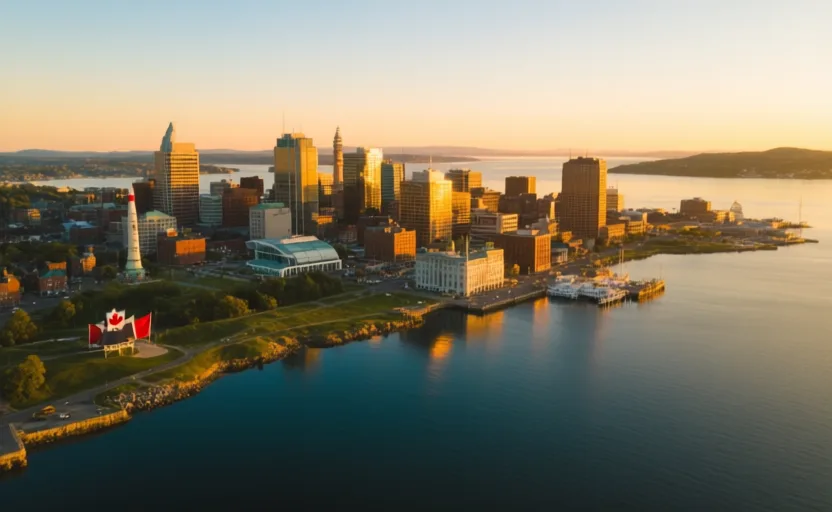 Halifax · AI city illustration · Artistic impression
City · North America
Halifax
Saved in this browser — no account needed. Sign in later and it comes with you.
Where it is
Halifax is built around one of the best natural harbours on the Atlantic coast. A hilly peninsula, with exposed granite beneath it, forms the western shore, Dartmouth faces it across the water on the east, and a narrow channel called The Narrows leads from the outer harbour into the sheltered Bedford Basin. The sea sets the climate: the Gulf Stream moderates it, giving warm summers and relatively mild winters, with a long lag so that August is much warmer than June, and hurricanes such as Juan in 2003 and Dorian in 2019 have caused considerable damage. The urban area covers under five percent of the municipality's roughly 5,475 km².
The land and water around it
Halifax Harbour and the Narrowsharbour
The deep, sheltered harbour was why the British chose the site. At its northern end The Narrows opens into Bedford Basin, where wartime convoys assembled and where the 1917 collision took place.
The Halifax Peninsulapeninsula
A hilly neck of land, carrying Citadel Hill and with exposed granite that makes building difficult. That rock held back suburban sprawl for decades, and only newer blasting methods have let housing spread across it.
The Atlantic influenceclimate
The Gulf Stream and the sea keep winters milder and summers cooler than inland places at the same latitude. Only January has an average high slightly below freezing.
Its history, in short
The Mi'kmaq knew the harbour as K'jipuktuk, the Chief Harbour, and spent summers on the shores of Bedford Basin. Britain had held Nova Scotia since 1710 but governed it from Annapolis Royal until 1749, when Edward Cornwallis arrived with 1,176 settlers and founded Halifax as a new capital, to counter France's Fortress of Louisbourg. The Mi'kmaq saw it as a violation of an earlier treaty, and a war began, ending only with a ceremony of burying the hatchet in 1761. A permanent naval yard was commissioned in 1759, and Halifax served as headquarters of the Royal Navy's North American Station for sixty years. Loyalist refugees swamped the town after the American Revolution. The Intercolonial Railway of 1876 made it a winter gateway for Atlantic trade when the St Lawrence froze. It was the base for recovering victims of the Titanic in 1912 and the assembly point for convoys in both world wars. On 6 December 1917 a munitions ship exploded in The Narrows, killing about 2,000 people. In the 1960s the Black community of Africville was demolished, and in 1996 the province merged Halifax, Dartmouth, Bedford and the county into a single regional municipality.
Timeline
Dates are shown on a timeline rather than as changing shapes on the map. The globe draws modern boundaries only, and tinting a modern outline to stand for a historical one would state something we cannot source.
Early modern & oceanic
21 June 1749
Cornwallis founds Halifax
Edward Cornwallis arrives with thirteen transports and 1,176 settlers and builds a town on the peninsula, with a fortification on Citadel Hill. The British named it for the Earl of Halifax, who authorised it.
1759
The naval yard
The Royal Navy commissions a permanent dockyard after buying land and buildings in 1758. Halifax then serves as the North American headquarters until 1818.
Well attestedWikipedia25 June 1761
Burying the hatchet
A ceremony in the garden of Governor Jonathan Belcher ends a war between the British and the Mi'kmaq that had lasted seventy-five years. Nova Scotians now mark Treaty Day each 1 October.
Well attestedWikipedia
Industrial & imperial
1876
The Intercolonial Railway
The railway connects the port to the continent and makes it the winter gateway for Atlantic trade when ice closes the St Lawrence ports.
Well attestedWikipediaApril 1912
The Titanic recovery
Halifax is the closest city to the wreck site with rail and steamship links, so ships from here recover the bodies. Only 333 are found, and 150 are buried in three Halifax cemeteries.
Well attestedWikipedia6 December 1917
The Halifax Explosion
A French munitions ship collides with another vessel in The Narrows and explodes. About 2,000 people die and nearly 9,000 are injured, with the North End destroyed. Help arrives from Boston, and since 1971 Nova Scotia has donated the Christmas tree lit on Boston Common.
Contemporary
1960s–1970s
Africville demolished
The Black community of Africville is declared a slum and demolished, and its residents are displaced to make room for industry and a bridge. A 2001 United Nations report called for reparations to its former residents.
Approximate dateWikipedia1 April 1996
The Halifax Regional Municipality
The provincial government dissolves the City of Halifax, the City of Dartmouth, the Town of Bedford and Halifax County, and creates one municipality. Residents still often name their old community rather than the region.
Places that carry meaning
Citadel Hill1749 onward
The hilltop fortress above downtown, with its town clock. Businesses proposed flattening it for parking in the late 1940s, but it was preserved in 1956 and has since been restored by Parks Canada as the city's chief landmark.
Pier 211930s–1950s
The ocean terminal and immigration complex at the south end of the harbour. Now the Canadian Museum of Immigration, it opened to the public in 1999 as a National Historic Site, the only national museum in the Atlantic provinces.
The Halifax Common1763
Land set aside for the use of citizens in 1763, the oldest public park in Canada.
Languages here
Places are usually multilingual. This lists what is actually spoken, not one language per border.
EnglishGermanic family
The everyday language of the municipality.
English is the working language of the city. Scottish, English and Irish are the largest reported ancestries, and the city draws most of its immigrants from the United Kingdom, India, China, the United States and the Philippines.
Mi'kmawAlgonquian family
The first language of the province, recognised in 2022.
Mi'kmawi'simk is the language of K'jipuktuk and of the Mi'kmaq who still live in Nova Scotia. The province recognised it as its first language in 2022, and names such as Amntu'kati for the peninsula survive.
FrenchRomance family
The language of the Acadians and of a small French-speaking minority.
Acadians, who make up about 4.5 percent of the municipality, trace their roots to the French settlers of the region, and the province maintains an Office of Acadian Affairs and Francophonie. The nearby community of French Village was first settled by French-speaking Foreign Protestants.
Scottish GaelicCeltic family
A heritage language with a provincial office.
Nova Scotia keeps an Office of Gaelic Affairs for Canadian Gaelic, a reminder that Scottish settlers form the largest single ancestry group in Halifax.
Learn the language here
- 1Understand which languages are spoken hereHalifax is multilingual. Start with which languages are used, by whom, and for what — the phrase list only covers one of them.Written by Globe Quest
- 2Learn 14 phrasesCurated everyday phrases for Halifax, with audio and a written form.Written by Globe Quest
- 3Say them out loudSpeaking practice with pronunciation feedback, one phrase at a time.Globe Quest material, your own additions
- 4Come back to themSpaced review, so what you learned this week is still there next month.Written by Globe Quest
Check yourself
Why did Britain found Halifax in 1749?
To set up a new capital and naval base that could counter the French fortress at Louisbourg
Britain had held Nova Scotia since 1710 but made little effort to settle it. Louisbourg threatened that position, and a deep harbour made Halifax the answer.
Roughly how many people died in the Halifax Explosion of 1917?
About 2,000
A French ship carrying munitions collided with another in The Narrows and blew up, killing about 2,000 and injuring nearly 9,000 in the largest artificial explosion before nuclear weapons.
Worth arguing about
- Halifax rose and fell with the needs of the British Navy and later with two world wars. What does a city do when the reason for its existence is a harbour that others also want?
- Africville was cleared in the name of renewal, and a UN report later called for reparations. How should a city reckon with an act of planning that its own government now regrets?
What we have not established
These are open questions, listed rather than filled in. We would rather show a gap than a plausible guess.
Which year was the earlier treaty the Mi'kmaq said Halifax violated?
One account dates the treaty to 1726, another to 1727, both after the end of Father Rale's War. The surviving accounts do not agree on the year.
How many people live in Halifax?
The 2021 census counted about 440,000 in the municipality and about 349,000 in the urban area, and a 2025 estimate gives about 545,000 for the metropolitan area, which now includes East Hants. The figure depends on which boundary is meant.
Sources
- Wikipedia · Halifax, Nova ScotiaWikipedia · encyclopedia · checked 2026-11-24
- Wikipedia · History of Halifax, Nova ScotiaWikipedia · encyclopedia · checked 2026-11-24
- Wikipedia · Languages of CanadaWikipedia · encyclopedia · checked 2026-11-24
Reviewed by Globe Quest editorial on 2026-11-24. Drafted with AI assistance and checked against the sources above before publication.