 Globe Quest
 Human Quest · LearningSign in
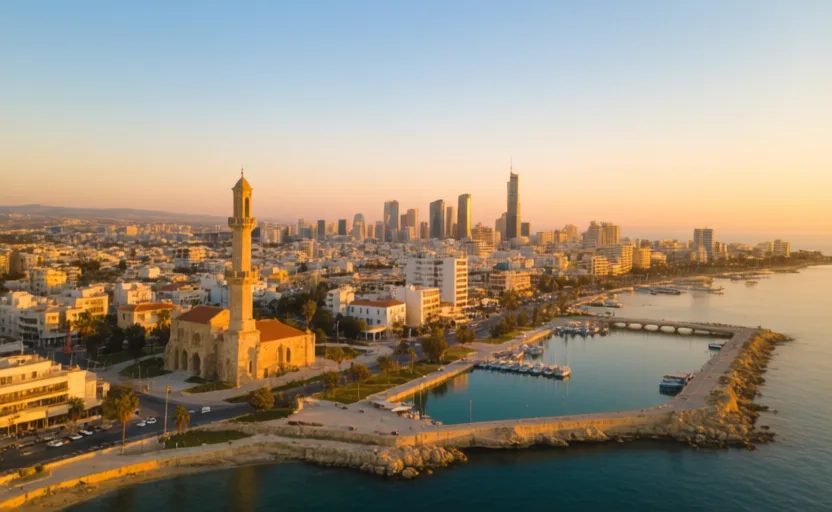 Limassol · AI city illustration · Artistic impression
City · Europe
Limassol
Saved in this browser — no account needed. Sign in later and it comes with you.
Where it is
The city strings along the south coast of Cyprus, in the middle ground between two ancient city-kingdoms, Amathus to the east and Kourion to the west. That middle position is the origin of its name. Its old core lies round the medieval castle and the Old Port, and the suburbs run along the shore towards Amathus, while the British Akrotiri area lies to the west. Inland, the southern slopes of the Troodos Mountains grow the vines that supply its wine companies. The climate is hot-summer Mediterranean, bordering on semi-arid: about 410 millimetres of rain a year, falling mostly in winter, and July and August highs that reach 40 degrees Celsius.
The land and water around it
The southern coastcoast
A long Mediterranean shoreline with beaches and, to the west, the Akrotiri peninsula. Rain is heavy but brief in winter and rare in the six-month summer. Limassol receives about 410 millimetres a year, with droughts every three to five years.
The Troodos wine slopesmountains
The southern foothills of the Troodos supply the grapes behind Commandaria and the island's wines, and Limassol is home to many of the companies that press and bottle them.
Its history, in short
Limassol rose from the ruin of its neighbours. Amathus declined and was destroyed, and settlement in the modern area probably began after that, around the 7th century. By 451 a local bishop at Neapolis took part in the Council of Chalcedon, and by the 10th century the town was called Lemesos. Richard the Lionheart landed here in 1191 on the Third Crusade after his sister and fiancée were refused water by the Byzantine governor, took the island, and destroyed Amathus, moving its people to Limassol. The Ottomans took the town without a fight in 1570, and the castle became an Ottoman fort, in use as a prison until 1950. Under British administration from 1878 the town got roads, a post office, electricity and its first printing press. The growth that made it a city came after 1974. Turkish Cypriots left for the north, Greek Cypriot refugees arrived, and when Famagusta was lost Limassol took over its port and tourism, becoming the island's commercial centre and main seaport.
Timeline
Dates are shown on a timeline rather than as changing shapes on the map. The globe draws modern boundaries only, and tinting a modern outline to stand for a historical one would state something we cannot source.
First cities & states
c. 1100 BC
Amathus and Kourion founded
Greek settlers found the two city-kingdoms that later flank Limassol. The modern city grows up in the gap between them.
Approximate dateWikipedia
Classical world
451
A bishop at Neapolis
Records of the Council of Chalcedon mention the local bishop together with those of Amathus and Arsinoe. The town is called Theodosiana and Neapolis, and by the 10th century Lemesos.
Approximate dateWikipedia
Post-classical world
1191 or 1192
Richard the Lionheart in Limassol
Richard lands and takes control of the island from Isaac Komnenos. He marries Berengaria of Navarre at Limassol, a wedding dated to 1191 in one account of the city and to 12 May 1192 in another. Amathus is destroyed and its inhabitants move to Limassol.
Accounts of the city's history date the wedding to 1191; the island's general history gives 12 May 1192.
Early modern & oceanic
July 1570
Ottoman conquest
Limassol is taken without resistance. The Ottomans rebuild the ruined castle as a fort, completed in 1590.
Well attestedWikipedia
Industrial & imperial
1878
British administration
The first British governor takes an interest in the town. Roads are cleaned and fixed, docks are built for loading ships anchored offshore, and electricity replaces lanterns in 1912.
Well attestedWikipedia
Contemporary
1974
A refugee city and a new port
Turkish Cypriots leave for the north, Greek Cypriots displaced from the north settle in Limassol, and the port takes over from Famagusta as the main seaport of the Republic of Cyprus.
Well attestedWikipedia1990s onward
Pontic Greeks and post-Soviet newcomers
After the Soviet collapse a large community of Pontic Greeks settles. By 2013 about 17 per cent of residents are Russian-speaking, and the city is nicknamed Limassolgrad.
Approximate dateWikipedia
Places that carry meaning
Limassol Castlec. 1000, rebuilt by the Ottomans in 1590
A medieval fortress said to have been built by the Byzantines around the year 1000, with a chapel. It is believed to be where Richard married Berengaria in 1191, served as a prison between 1790 and 1940, and is now a medieval museum.
AmathusFrom about 1100 BC
An ancient city-kingdom about 11 kilometres east of the city, whose acropolis bore a temple of Aphrodite. Iron Age tombs and the remains of baths and an agora survive.
KourionNeolithic to Early Christian
A city-kingdom 19 kilometres west of Limassol, centred on a Greco-Roman theatre built in the 2nd century BC and enlarged in the 2nd century AD. It is restored and still hosts open-air performances above the sea.
Languages here
Places are usually multilingual. This lists what is actually spoken, not one language per border.
GreekHellenic family
The main language of daily life and the official language.
Cypriot Greek is the everyday speech of the Greek Cypriot majority. In 2021 about 77.7 per cent of the district's residents held Cypriot citizenship.
RussianSlavic family
The language of a large post-Soviet community.
About 17 per cent of residents were Russian-speaking in 2013, and about 8 per cent held Russian citizenship. Russian is often the third language on shop and restaurant signs after Greek and English.
EnglishGermanic family
The common language of business, tourism and a large expatriate population.
A legacy of British rule, and a working language for incomers. In the 2021 census 8.6 per cent of the district's residents were citizens of other EU states and 13.1 per cent held other foreign citizenships.
Armenian
The language of a long-established Armenian community.
Armenians live around the Sourp Kevork church and maintain the Nareg Armenian School.
Learn the language here
- 1Understand which languages are spoken hereLimassol is multilingual. Start with which languages are used, by whom, and for what — the phrase list only covers one of them.Written by Globe Quest
- 2Learn 11 phrasesCurated everyday phrases for Limassol, with audio and a written form.Written by Globe Quest
- 3Say them out loudSpeaking practice with pronunciation feedback, one phrase at a time.Globe Quest material, your own additions
- 4Come back to themSpaced review, so what you learned this week is still there next month.Written by Globe Quest
Check yourself
What does the Greek root of Limassol's name suggest about its position?
It lies in the middle, between Amathus and Kourion
Nemesos is read as meaning one found in the middle, which fits the city's position between two ancient city-kingdoms.
Why did Limassol's port gain importance after 1974?
Famagusta, the former main port, was lost to the Republic
After Famagusta came under Turkish control, Limassol took over as the main seaport of the Republic of Cyprus and as a commercial centre.
Worth arguing about
- A city that grew from refugees, then tourism, then post-Soviet money. What does a place built by repeated arrivals owe its older communities?
- Many signs in Limassol use Greek, English and Russian. What decides which languages a city lets its streets speak?
What we have not established
These are open questions, listed rather than filled in. We would rather show a gap than a plausible guess.
Where and when did Richard the Lionheart marry Berengaria?
One account of the city places the wedding at the castle in 1191; the island's general history gives 12 May 1192 at Limassol. Chroniclers do not agree on the year, so the date stays unsettled.
Sources
- Wikipedia · LimassolWikipedia · encyclopedia · checked 2026-11-24
- Wikipedia · CyprusWikipedia · encyclopedia · checked 2026-11-24
- Wikipedia · History of CyprusWikipedia · encyclopedia · checked 2026-11-24
Reviewed by Globe Quest editorial on 2026-11-24. Drafted with AI assistance and checked against the sources above before publication.