 Globe Quest
 Human Quest · LearningSign in
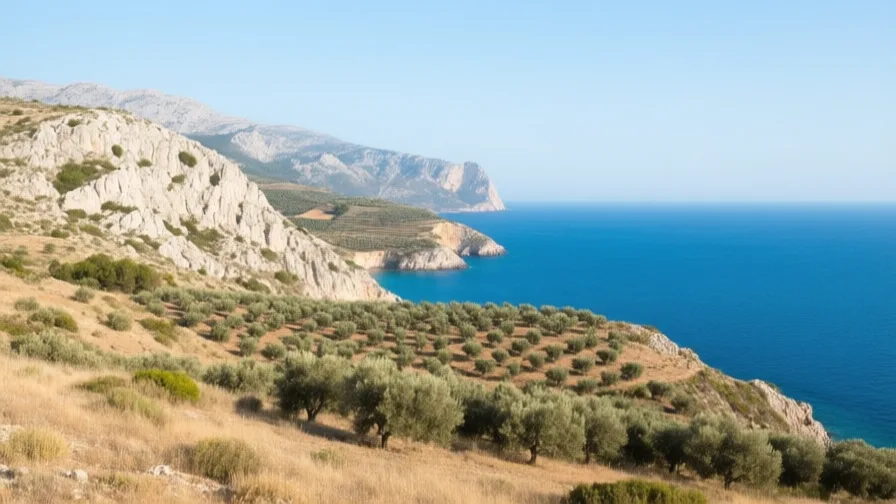 Cyprus · AI landscape illustration · Artistic impression
Country · Europe
Cyprus
Saved in this browser — no account needed. Sign in later and it comes with you.
Where it is
Cyprus is the third largest island in the Mediterranean, about 240 kilometres long and 100 wide at its broadest, lying 75 kilometres south of Turkey and within sight of the Levant coast. Two mountain ranges shape it: the broad volcanic-rock massif of Troodos, topped by Mount Olympus at 1,952 metres, in the south and west, and the narrow limestone Kyrenia Range along the north coast. Between them runs the Mesaoria, a plain with the capital in its middle. Winters are mild and wet, summers long, hot and dry, and water is the permanent shortage, held back by 108 dams and reservoirs.
The land and water around it
The Troodos Massifmountains
A dome of basaltic lava rock occupying roughly half the island, its slopes cut by steep valleys. Its rich copper deposits, formed under the sea and later pushed up, made the island valuable in antiquity and may have given Cyprus its name through the Latin word for copper.
The Kyrenia Rangemountains
A narrow limestone ridge along the northern coast that rises suddenly from the plain. It is also called Pentadaktylos, after a summit that resembles five fingers, and it is lower than the Troodos but more jagged.
The Mesaoriaplain
The central plain between the two ranges. It lies in the rain shadow of the Troodos and holds the capital. Average rainfall has fallen over the last thirty years while demand from residents and visitors keeps rising, so water sets the limit on growth.
Its history, in short
Cyprus has been a prize for most of its history. Hunter-gatherers arrived some 13,000 years ago, around the time the island's dwarf hippopotamus and dwarf elephant died out, and farmers followed by about 8500 BC. In the Late Bronze Age, copper from the Troodos made the island a trading power that corresponded with the pharaohs. Greek settlers came in waves after about 1100 BC, giving the island its mainly Greek character, and it was then ruled by Assyrians, Egyptians, Persians, Alexander, the Ptolemies, Rome and Byzantium. Richard I of England seized it in 1191, and the French Lusignan dynasty ruled a kingdom until Venice annexed it in 1489. The Ottomans took it in 1570 and held it until 1878, when Britain began administering it; Britain annexed it in 1914. Independence in 1960 gave Greek and Turkish Cypriots a joint state, which broke down in 1963 and 1964. After a coup on 15 July 1974 and Turkey's military action five days later, the island has been divided, and the dispute remains unresolved.
Timeline
Dates are shown on a timeline rather than as changing shapes on the map. The globe draws modern boundaries only, and tinting a modern outline to stand for a historical one would state something we cannot source.
Early human world
c. 11,000–10,000 BC
First people reach the island
Hunter-gatherers arrive, and soon after the endemic dwarf hippopotamus and dwarf elephant disappear. Farming communities appear by about 8500 BC.
First cities & states
From c. 1650 BC
Copper makes a trading society
Troodos copper links Cyprus, known in texts as Alashiya, to the wider Mediterranean. Rulers described as kings correspond with other states.
Approximate dateWikipediac. 1100–1050 BC
Greek settlement
After the collapse of Mycenaean Greece, a major wave of Greek settlers gives the island its predominantly Greek character.
Approximate dateWikipedia
Post-classical world
965
Byzantine reconquest
After three centuries in which Arabs and Byzantines ruled the island jointly, the Byzantine navy restores full imperial control.
Approximate dateWikipedia1191
Richard I and the Lusignans
Richard I of England captures the island in the Third Crusade. It passes quickly to Guy of Lusignan, and the Lusignan Kingdom of Cyprus lasts until Venice annexes it in 1489.
Early modern & oceanic
1570
Ottoman conquest
A full-scale Ottoman assault brings the island under Ottoman rule. The conquest produces the first significant demographic change since antiquity, with the formation of a Muslim community.
Well attestedWikipedia
Industrial & imperial
1878
British administration
Under the Cyprus Convention, Britain takes over the island's administration while it stays nominally Ottoman. It is formally annexed in 1914.
Well attestedWikipedia
Contemporary
15 and 20 July 1974
Coup, Turkish landing and division
On 15 July Greek Cypriot nationalists and the Greek junta stage a coup against President Makarios III. On 20 July the Turkish army lands and takes the north. More than 150,000 Greek Cypriots and 50,000 Turkish Cypriots are displaced, and in 1983 a Turkish Cypriot state is declared in the north.
DisputedWikipediaGreek Cypriot and Republic of Cyprus accounts speak of a Turkish invasion; Turkey cited a right to intervene under the 1960 Treaty of Guarantee. The Turkish Republic of Northern Cyprus is recognised only by Turkey.
Places that carry meaning
Khirokitia6th millennium BC
A Neolithic village of round houses, stone vessels and herds of sheep, goats and pigs, one of the best known early farming settlements on the island.
NicosiaPresent day
The capital and largest city, on the central plain. The United Nations Buffer Zone that divides the island runs through it.
Hala Sultan TekkeIslamic period
A Muslim shrine near the Larnaca Salt Lake, an object of pilgrimage.
LimassolPresent day
The district holds 28 per cent of the population of the government-controlled areas, second only to Nicosia at 38 per cent in the 2021 census.
Languages here
Places are usually multilingual. This lists what is actually spoken, not one language per border.
GreekHellenic family
An official language, spoken by the Greek Cypriot majority.
Everyday speech is Cypriot Greek, which differs significantly from the standard register. Greek Cypriots made up 77 per cent of the population at the 1960 census.
TurkishTurkic family
An official language, spoken by Turkish Cypriots.
Cypriot Turkish also differs from the standard form. Turkish Cypriots were 18 per cent of the population in 1960, and most now live in the north.
Armenian and Cypriot Maronite Arabic
Recognised minority languages.
The Armenian and Maronite communities, both constitutionally recognised, keep their own languages.
EnglishGermanic family
A legacy of British rule, still widely used as a lingua franca.
English was the only official language under British rule and the lingua franca until 1960, and courts used it until 1989. In 2010, 80.4 per cent of Cypriots could use it as a second language. Russian is also widely spoken, especially in Limassol and Paphos.
Learn the language here
Check yourself
Why did the Late Bronze Age bring trading wealth to Cyprus?
Copper from the Troodos Mountains
Copper from the Troodos drew the island into Mediterranean trade, and the Latin word for copper, cuprum, comes from the phrase aes Cyprium, the metal of Cyprus.
What happened to the 2004 UN plan for reunification?
Most Turkish Cypriots accepted it and most Greek Cypriots rejected it
In the referendum 65 per cent of Turkish Cypriots voted yes and 74 per cent of Greek Cypriots voted no, so the plan failed.
Worth arguing about
- A single island holds two administrations, two languages and two histories of the same events. Whose account should a visitor hear first?
- Cyprus is short of water but a major destination for tourists and newcomers. How should a dry island choose what to grow?
What we have not established
These are open questions, listed rather than filled in. We would rather show a gap than a plausible guess.
How many people live on the island?
No census has covered the whole island since 1960. The Republic of Cyprus counts only the government-controlled areas, 918,100 residents in 2021, and the last count in the north was in 2006, so any island-wide total is an estimate.
Sources
- Wikipedia · CyprusWikipedia · encyclopedia · checked 2026-11-24
- Wikipedia · History of CyprusWikipedia · encyclopedia · checked 2026-11-24
- Wikipedia · Geography of CyprusWikipedia · encyclopedia · checked 2026-11-24
Reviewed by Globe Quest editorial on 2026-11-24. Drafted with AI assistance and checked against the sources above before publication.