 Globe Quest
 Human Quest · LearningSign in
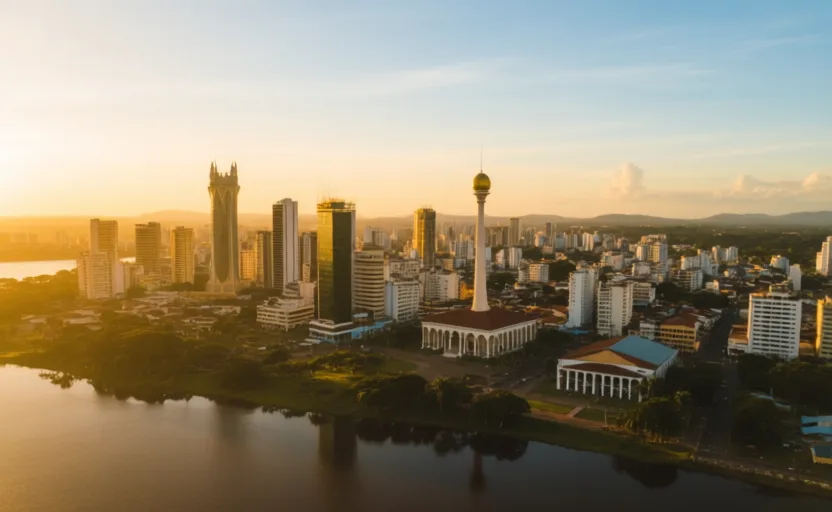 Manaus · AI city illustration · Artistic impression
City · Latin America
Manaus
Saved in this browser — no account needed. Sign in later and it comes with you.
Where it is
Manaus is a river city in the middle of the Amazon forest, built on the Rio Negro just upstream of the point where it joins the Solimões. Brazil counts the stream below that junction as the Amazon proper; elsewhere the Solimões is treated as the upper Amazon itself. The land is a patchwork of small streams, all feeding the Negro, and the forest presses close to the built-up area. Heat is constant because the equator is near. The year divides by rain rather than temperature: roughly December to May is very wet, and July to September is the drier stretch.
The land and water around it
The Negro and the Solimõesriver
The Negro, the Black River that gave the city its first official name, and the Solimões merge just east of the city to form the Amazon. The Portuguese treated the junction as a strategic point and fortified it.
The Amazon forestforest
The city stands inside the world's biggest expanse of tropical rainforest, which also holds the greatest number of species. Green space within the urban area is thin, since building is dense, but protected pockets remain, including the Adolfo Ducke reserve and a refuge for pied tamarins.
Heat without a cold seasonclimate
Manaus has a tropical monsoon climate with an average temperature of 27.4 °C and around 2,300 millimetres of rain a year. Winter, from June to August, is actually hotter than summer. Cold fronts from the south are rare; one in August 1955 pulled temperatures down to 18 °C or lower.
Its history, in short
The city began as a Portuguese fort of rock and clay, raised in 1668 and 1669 at the mouth of the Negro to hold the river against the Dutch, who were then based in what is now Suriname. Indigenous and mixed-descent people settled beside it, and missionaries added a chapel in 1695. Its administrative standing shifted over the next century; in 1791 a governor worried about a Spanish invasion returned the captaincy's seat to the fort town. In the 1830s the Cabanagem revolt, a rising of Indigenous, Black and mixed-descent people against the white political elite, passed through twice and helped create the separate province of Amazonas. Rubber then made the place rich. Between about 1890 and 1910 it gained electricity, piped water, trams, a floating port and an opera house, while migrants from the drought-struck Brazilian Northeast and from Europe poured in. When Asian plantations, grown from smuggled seed, undercut Amazon rubber, the money drained away and the infrastructure decayed. A second life began in 1967 with a free trade zone, and factories drew a new wave of migrants.
Timeline
Dates are shown on a timeline rather than as changing shapes on the map. The globe draws modern boundaries only, and tinting a modern outline to stand for a historical one would state something we cannot source.
Early modern & oceanic
1668–1669
A Portuguese fort at the river mouth
The Portuguese build a fort of rock and clay, with four cannons, to secure the region against the Dutch. Indigenous and mixed-descent people settle nearby and help to build it.
Well attestedWikipedia1791
The seat returns to the fort town
Fearing a Spanish invasion, the governor moves the captaincy's seat back from Mariuá, today Barcelos, to the settlement at the confluence.
Well attestedWikipedia
Industrial & imperial
1835
Cabanagem rebels take the town
Rebels from the upper Amazon occupy the settlement twice during a revolt that began in Belém. Their involvement is credited with helping bring the province of Amazonas into being.
1856
The name Manaus is restored
Raised to a town in 1832 under the name Manaus, then to a city in 1848 as Cidade da Barra do Rio Negro, it takes back the name of the Manaó people on 4 September 1856.
c. 1890–1910
The rubber golden age
Rubber exports pay for a street plan, electric trams, telephones, piped water, a floating port and the Teatro Amazonas. Manaus becomes an international reference point on tropical disease, and yellow fever is eradicated by 1913.
1910
Asian rubber takes the market
Rubber planted in Southeast Asia from seeds taken out of the Amazon floods the world market. Luxury imports collapse, and those who can leave do so.
Contemporary
1967
Free trade zone
Brazil's military government, worried about an empty interior, creates a tax-advantaged free trade zone at Manaus. Population climbs from 343,038 in 1960 to more than a million by 1990.
Well attestedWikipedia1997
Opera returns to the Teatro Amazonas
After a gap of almost ninety years the opera house stages live opera again, having been effectively shut for most of the twentieth century.
Well attestedWikipedia
Places that carry meaning
Teatro AmazonasRubber era
An opera house of domes and gilded balconies, built with marble, glass and crystal brought from Europe at a public cost of ten million dollars. It is the clearest surviving record of how much rubber money there was, and of how quickly it ended.
EducandosFirst neighbourhood of the city
The first bairro established in the city. Newcomers from other parts of Brazil spread outwards from it, and a stream of the same name runs entirely within the urban area.
Cidade NovaModern district
A northern district with 264,449 residents at the count cited, and estimates above 300,000. It is the city's most populous neighbourhood, with a population said to exceed that of any other town in Amazonas, a measure of how far the city has drawn people in.
Adolfo Ducke Forest ReserveEstablished 1963
About 100 square kilometres of protected forest, set aside as a biological reserve in 1963. Its streams feed the Tarumã Açu, which runs through the north and west of the city.
Languages here
Places are usually multilingual. This lists what is actually spoken, not one language per border.
PortugueseRomance family
The language of daily life, schools, administration and business.
Portuguese is used across the city’s public life, as it is across Brazil, where nearly everyone speaks it. The city’s name is an altered spelling of an Indigenous people’s name, and many Brazilians from the Northeast arrived in the rubber years to escape a great drought.
Nheengatu and other Indigenous languages
The speech of Amazonian peoples that long predates Portuguese.
Brazil has over 200 Indigenous languages. Nheengatu, a descendant of Tupi, is official in the municipality of São Gabriel da Cachoeira, and none of today’s Indigenous languages is spoken by more than 40,000 people. Figures for Manaus itself are not given.
Immigrant languages
Languages of the rubber-era newcomers.
The rubber years brought Portuguese, English, French and Italian immigrants, and the 1920 census also counted Japanese, Turks and Germans. Across Brazil, Italian, German and Japanese are the best-known languages of later immigrant communities.
Learn the language here
- 1Understand which languages are spoken hereManaus is multilingual. Start with which languages are used, by whom, and for what — the phrase list only covers one of them.Written by Globe Quest
- 2Learn 12 phrasesCurated everyday phrases for Manaus, with audio and a written form.Written by Globe Quest
- 3Say them out loudSpeaking practice with pronunciation feedback, one phrase at a time.Globe Quest material, your own additions
- 4Come back to themSpaced review, so what you learned this week is still there next month.Written by Globe Quest
Check yourself
What ended Manaus's rubber boom around 1910?
Competition from Asian plantations grown from smuggled seed
Brazil and Peru lost their monopoly once rubber trees, grown from seed taken out of the Amazon, were cultivated in Southeast Asia. Manaus had electrified early on rubber money, and then could not afford to run its generators.
Why did the population of Manaus rise so fast after 1967?
A free trade zone drew factories and migrants
A government anxious about Brazil's empty interior created a tax-advantaged zone, and with new roads it attracted national and foreign investment. The city grew from 343,038 people in 1960 to over a million by 1990.
Worth arguing about
- Manaus has boomed twice, first on rubber and then on a tax regime, both decided far away. What makes a city in the forest less exposed to the next change in rules?
- A city of two million that holds one of the largest tracts of rainforest on Earth around it. Does that make it the best or the worst place to study what the forest needs?
What we have not established
These are open questions, listed rather than filled in. We would rather show a gap than a plausible guess.
How many people live in Manaus?
Published totals differ by year and method: about 2.15 million in one count, 2.18 million for 2019 and an estimate of 2.28 million for 2024. Neighbourhood figures, such as Cidade Nova's, are estimates that outrun the last count.
Sources
- Wikipedia · ManausWikipedia · encyclopedia · checked 2026-11-24
- Wikipedia · History of ManausWikipedia · encyclopedia · checked 2026-11-24
- Wikipedia · BrazilWikipedia · encyclopedia · checked 2026-11-24
- Wikipedia · Languages of BrazilWikipedia · encyclopedia · checked 2026-11-24
Reviewed by Globe Quest editorial on 2026-11-24. Drafted with AI assistance and checked against the sources above before publication.