 Globe Quest
 Human Quest · LearningSign in
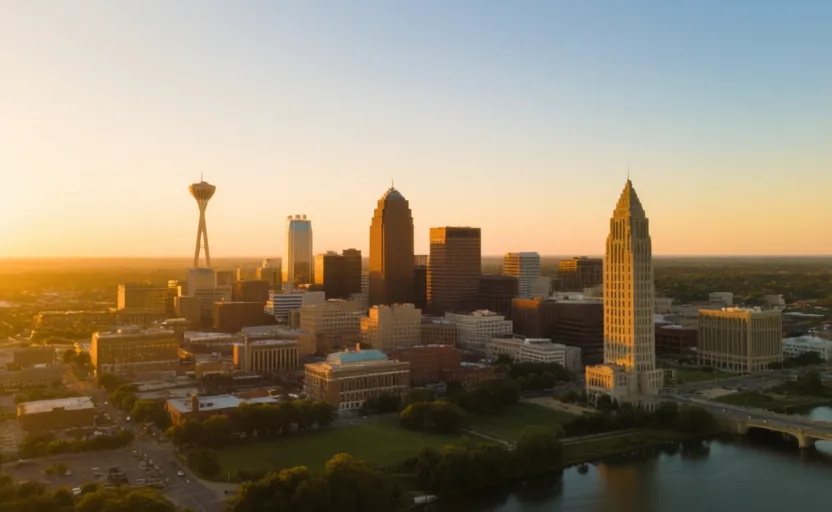 Plano · AI city illustration · Artistic impression
City · North America
Plano
Saved in this browser — no account needed. Sign in later and it comes with you.
Where it is
The name is Spanish for “flat”, and the ground justifies it: Plano is level country in Collin County, with a small part in Denton County, about 17 miles from downtown Dallas. That flatness, together with a street grid, is what let sewers, schools and roads keep up when the population multiplied. The city draws its raw water from Lake Lavon through a regional water district. The climate is humid subtropical, with recorded extremes of 118 °F in 1936 and −7 °F in 1930. Other municipalities now surround it on every side, so Plano cannot grow outward.
The land and water around it
The level groundplain
Residents named the town for its terrain, and the same flatness explains how it handled growth. A grid layout on level land made it cheap to extend sewers, schools and streets as the population jumped from thousands to hundreds of thousands.
Lake Lavonlake
The principal source of raw water for the North Texas Municipal Water District, which supplies Plano through elevated towers, ground tanks and about 1,080 miles of mains. A suburb of this size depends on a reservoir outside its own boundaries.
North Texas weatherclimate
A humid subtropical climate with a wet May on average, a warm July and a cold January. The recorded range, from −7 °F to 118 °F, shows how far a single place can swing.
Its history, in short
Comanche, Caddo and Wichita groups passed through the area before settlers arrived in the early 1840s. A sawmill, a gristmill and a store drew more people, and a post office followed. Residents turned down several names, one of them honouring the sitting president, Millard Fillmore, and picked one that described the terrain. The Houston and Central Texas Railway reached the town in 1872, and Plano was incorporated the next year. A fire in 1881 destroyed most of the business district, but the town rebuilt. For decades it stayed small: 1,304 people in 1900 and 3,695 in 1960. Then the postwar boom of its neighbours caught up with it. Public works, a tax change that removed the farming community from the town, and flat, easily serviced land took the population to 17,872 in 1970 and about 72,000 by 1980. In the 1980s large corporations, among them J. C. Penney and Frito-Lay, moved their headquarters here. By 1990 Plano had left the county seat, McKinney, far behind, and by 2000 it held more than 222,000 people.
Timeline
Dates are shown on a timeline rather than as changing shapes on the map. The globe draws modern boundaries only, and tinting a modern outline to stand for a historical one would state something we cannot source.
Industrial & imperial
early 1840s
Settlers arrive
Settlers reach the area, and a sawmill, a gristmill and a store attract more. A post office accepts the name Plano after residents reject others, including one honouring President Fillmore.
Approximate dateWikipedia1872
The railway arrives
The Houston and Central Texas Railway is completed through the town, and Plano is incorporated in 1873. By 1874 it has more than 500 residents.
Well attestedWikipedia1881
Fire and schools
A fire destroys most buildings in the business district; the town rebuilds and thrives through the decade. In the same year the city takes on responsibility for what becomes the Plano Independent School District.
Well attestedWikipedia
Contemporary
1970–1980
The boom
Population rises from 17,872 to about 72,000. Public works and a tax change that removes the farming community from the town help, and the flat grid keeps services ahead of demand.
Well attestedWikipedia1980s
Headquarters move in
J. C. Penney, Frito-Lay and other large corporations relocate their headquarters to Plano, pushing the population to 128,713 by 1990.
Approximate dateWikipedia2020
A more mixed city
The census counts 285,494 residents. Non-Hispanic white residents are 46.3 percent, down from 58.4 percent in 2010, while Asian residents are 24.08 percent and Hispanic or Latino residents 16.04 percent.
Well attestedWikipedia
Places that carry meaning
Plano Station1908
The 1908 station of the Texas Electric Railway is among the city's listed historic sites and a reminder that the town's first growth followed rail lines.
Heritage Farmstead Museum1891
A farmstead from the years when the economy was farming, preserved in a city that has since become one of the largest suburbs of Dallas.
Legacy Drivelate 20th century onward
A corridor of corporate campuses between Preston Road and the Dallas North Tollway. A 1985 water tower nearby was demolished in 2015 to make room for the Legacy West development.
Languages here
Places are usually multilingual. This lists what is actually spoken, not one language per border.
EnglishGermanic family
The language of daily life and public business.
Across the United States about 77 percent of people speak only English at home, and Plano follows the national pattern of an English-speaking majority with a sizeable minority of other languages.
ChineseSino-Tibetan family
Spoken by one of the largest Chinese communities in Texas.
Chinese professionals began settling in Plano by 1991. The 2010 census counted 14,500 ethnic Chinese, and most Chinese cultural organisations in the Dallas–Fort Worth area are based in Plano and neighbouring Richardson. The city has six Chinese churches and supermarkets.
SpanishRomance family
The most widely spoken language after English.
About 16 percent of residents were Hispanic or Latino in 2020, and in 2000 Mexico was the origin of 22 percent of the city's foreign-born residents.
Learn the language here
- 1Understand which languages are spoken herePlano is multilingual. Start with which languages are used, by whom, and for what — the phrase list only covers one of them.Written by Globe Quest
- 2Learn 12 phrasesCurated everyday phrases for Plano, with audio and a written form.Written by Globe Quest
- 3Say them out loudSpeaking practice with pronunciation feedback, one phrase at a time.Globe Quest material, your own additions
- 4Come back to themSpaced review, so what you learned this week is still there next month.Written by Globe Quest
Check yourself
Why is the city called Plano?
The Spanish word for flat, describing the local terrain
Residents rejected several names, including one honouring Fillmore, and chose a Spanish word for “flat” because the land is level.
By 1990 Plano's population had grown far beyond which county seat?
McKinney
With 128,713 people in 1990, Plano dwarfed McKinney, the county seat, which shows how far a suburb can outgrow the town that holds the courthouse.
Worth arguing about
- Plano is hemmed in by other cities and cannot expand. What happens to a place when its boundary is fixed but its population and economy keep changing?
- Many Chinese residents, by one community leader's estimate, do not take part in the census or in local government. How should a city count and serve people who stay outside its formal channels?
What we have not established
These are open questions, listed rather than filled in. We would rather show a gap than a plausible guess.
How many Chinese residents live in Plano?
The 2010 census counted 14,500 ethnic Chinese, while a community leader estimated about 30,000 and said many residents do not take part in the census. The two figures rest on different counting methods and cannot be reconciled.
Sources
- Wikipedia · Plano, TexasWikipedia · encyclopedia · checked 2026-11-24
- Wikipedia · Languages of the United StatesWikipedia · encyclopedia · checked 2026-11-24
Reviewed by Globe Quest editorial on 2026-11-24. Drafted with AI assistance and checked against the sources above before publication.