 Globe Quest
 Human Quest · LearningSign in
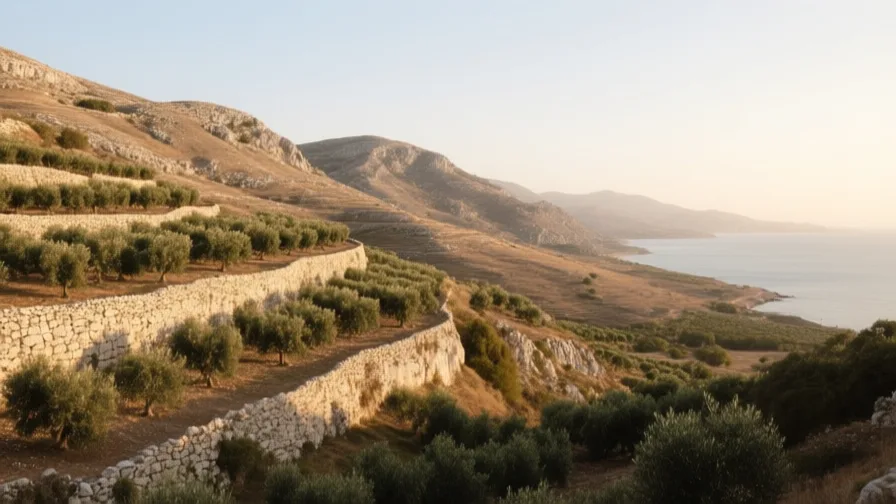 The Levant · AI landscape illustration · Artistic impression
Region · Middle East
The Levant
Also known as Bilad al-Sham, Eastern Mediterranean
The eastern Mediterranean coast and its hinterland, a long-standing corridor between Africa, Asia and Europe.
Saved in this browser — no account needed. Sign in later and it comes with you.
Where it is
Strictly drawn, the Levant is the strip of West Asia between the eastern shore of the Mediterranean and the deserts inland: Syria, Lebanon, Jordan, Israel and Palestine, with Turkey's Hatay and southern Cilicia, and often Cyprus offshore. Archaeologists close it off with the Taurus Mountains or the Plain of ʿAmuq in the north, the Euphrates and the Syrian Desert in the east, and Wadi al-Arish in Sinai in the south. Roughly 400 miles long, it is the land bridge between Africa and Eurasia and, geologically, the north-west corner of the Arabian plate. The Litani River splits it into a northern and a southern Levant, and beyond the Anti-Lebanon range, which ends in Mount Hermon, the land falls away into desert.
The land and water around it
The Levantine coastcoast
The western edge, on the Levantine Sea. Cyprus, geographically distinct, is often counted with the Levant because its copper drew it into close ties with the mainland, a connection archaeologists trace to the early Iron Age.
The Litani Riverriver
In archaeological usage, the line between the northern Levant and the southern, the two main subregions.
The Syrian Desertdesert
The eastern limit. East of the Anti-Lebanon and the Transjordan highlands the farmland gives out, and Bedouin communities of the Syrian Desert, the Naqab and eastern Syria keep their own Arabic.
Its history, in short
This was one of the first places where people settled and farmed: Pre-Pottery Neolithic cultures developed here, and through the Bronze and Iron Ages the region held so many Semitic-speaking peoples and kingdoms that many scholars treat it as the homeland of the Semitic languages. Once seen as a fringe between Egypt and Mesopotamia, it is now widely studied as a centre of civilisation in its own right. Rome took hold in 64 BC, and in the first three centuries AD the population reached perhaps 3.5 to 6 million, a level not seen again until the 19th century. Christianity grew here from a sect within Second Temple Judaism into a separate religion, and Jerusalem and its Temple were destroyed in 70. After the Muslim conquest of 638 the region became Bilad al-Sham, and the Umayyads ruled from Damascus until 750, when the Abbasids shifted the seat of power to Baghdad. Muslim troops settled inside existing cities instead of building garrison towns, and the evidence points to a population that stayed put, with a Muslim majority perhaps reached only by the 13th century. The word Levant itself is European, from the French and Italian for the sun's rising, and after the First World War France's mandate over Syria and Lebanon was called the Levant States.
Timeline
Dates are shown on a timeline rather than as changing shapes on the map. The globe draws modern boundaries only, and tinting a modern outline to stand for a historical one would state something we cannot source.
Classical world
64 BC
Rome arrives
Having finally beaten the Seleucids and Tigranes, Rome gains a foothold. Pompey deposes the last Seleucid king, Philip II Philoromaeus, and takes Syria into Roman domains, though local kingdoms keep wide autonomy for generations.
Well attestedWikipedia66–73
The First Jewish–Roman War
A revolt in Judaea ends with Jerusalem and the Second Temple destroyed in 70. After a second rising, the Bar Kokhba revolt of 132–136, Rome creates the province of Syria Palaestina.
Well attestedWikipedia270–273
Zenobia's empire
Ruling Palmyra as regent for her son, Queen Zenobia breaks from Rome and declares the Palmyrene Empire, conquering much of Syria, Egypt, Arabia Petraea and Asia Minor, until Aurelian and his Tanukhid Arab allies defeat her.
Well attestedWikipedia
Post-classical world
602–628
Byzantium against Persia
The Levant is the front line of a devastating war and is taxed hard afterwards. Written accounts describe flight from Syria and Palestine to Egypt and on to Carthage and Sicily; archaeology suggests most of the population stayed.
DisputedWikipediaWritten accounts of displacement against archaeological evidence of continuity
638
Bilad al-Sham
The Muslim conquest of Syria ends Eastern Roman rule. The region joins the Rashidun Caliphate under the name Bilad al-Sham.
Well attestedWikipedia750
The capital leaves Damascus
The Abbasids move the caliphate's centre to Baghdad. Neglected, the Levant sees repeated revolts in the generations that follow, some pro-Umayyad and some pro-Shiite.
Well attestedWikipedia
Early modern & oceanic
1581
The Levant Company
England sets up a company to trade with the Ottoman Empire. The word Levant, first recorded in English in 1497, had come in from French.
Well attestedWikipedia
Industrial & imperial
After the First World War
The Levant States
France's mandate over Syria and Lebanon takes the name, and Levant comes to mean the modern states of the eastern shore.
Approximate dateWikipedia
Places that carry meaning
Palmyra1st–3rd centuries AD
A desert city of 200,000 to 250,000 at its peak. From here Odaenathus drove back a Persian army in 260 and took the title King of Kings of the East; under Zenobia, regent for his son, the city then launched its own empire.
JerusalemRoman period onward
Destroyed with the Second Temple in 70. After 638 it was one of the existing cities, with Damascus, Homs and Tiberias, where Muslim troops settled alongside local people.
DamascusUmayyad era
The capital under the Umayyads, whose armies drew heavily on Arab tribes long settled in the Levant before Islam, such as Lakhm, Judham, Ghassan and Tanukh.
Salamiyah765–904
Headquarters of the Ismaʿili mission from 765. In 904 the imam Abd Allah al-Mahdi Billah left it for Sijilmasa in Morocco, and by 909 his followers had founded the Fatimid Caliphate.
Languages here
Places are usually multilingual. This lists what is actually spoken, not one language per border.
ArabicSemitic family
The everyday language of most of the region, in several spoken varieties.
Levantine Arabic, known as Šāmī, descends from the pre-Islamic Arabic of Syria and from Hejazi Arabic and carries a strong Aramaic imprint. North Levantine is spoken in Lebanon, Syria and parts of Turkey, South Levantine in Palestine and Jordan, and both shade from city to village speech. Bedouins of the Syrian Desert, the Naqab and eastern Syria speak Bedouin Arabic, and Mesopotamian Arabic is used in eastern Syria. Lebanon and Jordan make Modern Standard Arabic official, yet no child grows up speaking it: it is learned at school and kept for print, news and sermons, while conversation runs in the local dialect. In Israel Arabic is the mother tongue of Arab citizens, about a fifth of the population, and holds a special legal status. Lebanese speakers move freely between Arabic, French and English in a single conversation, and each of the two European languages has around two million speakers there.
HebrewSemitic family
The state language of Israel, used by nearly all its citizens.
Zionist immigrants who arrived from the 1880s turned Hebrew back into a spoken language, and Modern Hebrew is now the medium of Israeli government, schools and daily life; a Basic Law of 2018 calls it the language of the state. When Israelis over 20 were asked in 2011, 49% named Hebrew as their native language, 18% Arabic and 15% Russian, a legacy of large-scale immigration from the former Soviet Union. Around 200,000 Israelis, most of them in Hasidic communities, still speak Yiddish.
AramaicSemitic family
An ancient language of the region whose imprint survives in Arabic, still spoken in a few communities.
Western Middle Aramaic left a deep mark on Levantine Arabic. Further back, the Bronze and Iron Age Levant was home to many Semitic-speaking peoples, and recent ancient-DNA studies find that modern Levantines draw most of their ancestry from them. Aramaic has not vanished: in Lebanon some Syriac Catholic, Syriac Orthodox and Assyrian families still speak Syriac dialects as a first language, and Maronite Catholics pray in Classical Syriac.
Armenian, Circassian, Kurdish and others
Languages kept by the region's smaller communities.
Western Armenian reached Lebanon with refugees between 1895 and 1939, many of them escaping the Armenian genocide. It is still widely spoken by Lebanon's Armenians, around 4% of the country in 2015, and some of them speak Turkish too. In Jordan, where roughly 2% of people are not Arab and most of those trace their roots to the Caucasus, Chechen, Circassian and Armenian live on within their communities. Lebanon's Kurds, put at 70,000 in 2020, have mostly given up Kurdish, which about 23,000 of them still use, and the Dom minority there speaks Domari.
Learn the language here
- 1Understand which languages are spoken hereThe Levant is multilingual. Start with which languages are used, by whom, and for what — the phrase list only covers one of them.Written by Globe Quest
- 2Practise with people: Arabic practice · DohaAn in-person practice circle. It is a prepared plan and needs a host before it runs.Run by members
Check yourself
Where does the word Levant come from?
French and Italian words for the sun's rising
From French levant and Italian levante, “rising”, it meant the lands where the sun comes up, east of Italy. Greek Anatolē and Latin oriens carry the same idea.
Where did Muslim troops settle in the Levant after the conquest of 638?
Alongside local people in existing cities such as Damascus, Homs, Jerusalem and Tiberias
Unlike Iraq, Iran and North Africa, where separate garrison cities were founded, the Levant saw troops move into existing towns, one reason the evidence points to a population that largely stayed.
Worth arguing about
- Scholars took up “Levant” partly because it lacks the political overtones of “Syria-Palestine”. Can a region's name ever be neutral, and who gets to choose it?
- Written sources describe mass flight during the war of 602–628, while archaeology suggests most people stayed. When texts and excavations disagree, which should we trust, and why?
What we have not established
These are open questions, listed rather than filled in. We would rather show a gap than a plausible guess.
How many people live in the Levant?
One total for the modern Levant, about 57.6 million for Syria, Jordan, Israel, Lebanon and Palestine together, comes without a reference year, and broader definitions that add Cyprus, Hatay or Sinai would change it. The answer depends on whose Levant is being counted, and when.
Which other languages are spoken at home across the Levant, and by how many?
Jews, Kurds, Assyrians, Armenians, Circassians, Chechens and Turkmens live in the region alongside Arabs. Israel surveyed its adults' native languages in 2011 and Lebanon has estimates for its Armenian and Kurdish speakers, but no count covers the whole region, so how many people across the Levant still speak these community languages at home is unknown.
Sources
- Wikipedia · LevantWikipedia · encyclopedia · checked 2026-11-24
- Wikipedia · History of the ancient LevantWikipedia · encyclopedia · checked 2026-11-24
- Wikipedia · Languages of IsraelWikipedia · encyclopedia · checked 2026-11-24
- Wikipedia · Languages of LebanonWikipedia · encyclopedia · checked 2026-11-24
- Wikipedia · JordanWikipedia · encyclopedia · checked 2026-11-24
Reviewed by Globe Quest editorial on 2026-11-24. Drafted with AI assistance and checked against the sources above before publication.
Related places
Themes: Trade & exchange, Religion & pilgrimage, Migration & diaspora, Seas & navigation