 Globe Quest
 Human Quest · LearningSign in
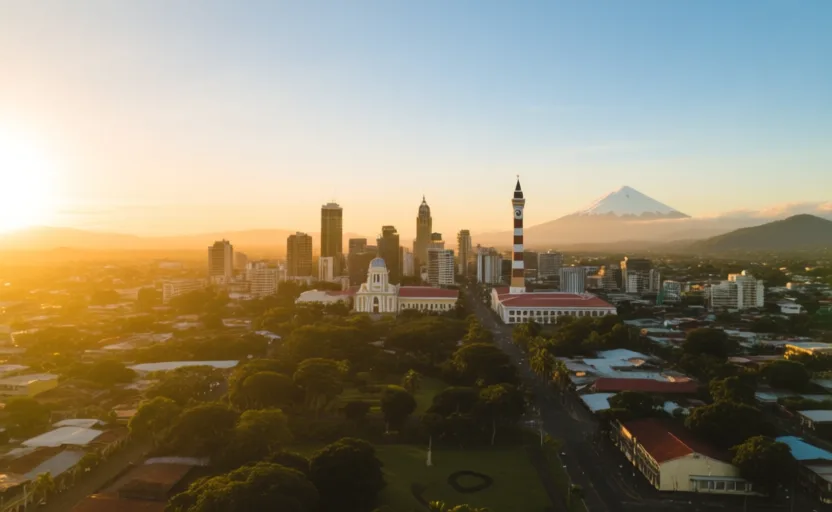 San Jose · AI city illustration · Artistic impression
City · Latin America
San Jose
Saved in this browser — no account needed. Sign in later and it comes with you.
Where it is
In the middle of Costa Rica, towards the western end of the Central Valley, San José is the hub for a country whose people and economy cluster in the highlands. The city proper covers about 44.6 square kilometres, but it is joined to Alajuela, Heredia and Cartago in a metropolitan region of more than two million, and over a million people pass through it daily. The climate is a tropical wet and dry one, with a coolest month near 21.8 °C and a hottest near 23.7 °C. The driest month gets only 6.3 mm of rain and the wettest 355.1 mm, so the year is told in rainfall, not temperature.
The land and water around it
The Central Valleyvalley
The highland basin holding San José, Alajuela, Heredia and Cartago. Most Costa Ricans live here, which is why the capital draws daily flows of workers from neighbouring cantons.
The volcanic cordillerasmountains
Mountains close the valley in. The Cerros de Escazú border it to the south, and the wider Cordillera Central forms part of the spine that separates Caribbean and Pacific drainage.
A tropical wet and dry climateclimate
Average temperatures vary little across the year, but rainfall swings from 6.3 mm in the driest month to 355.1 mm in the wettest. Costa Ricans call the dry season summer and the rainy season winter.
Its history, in short
San José is one of the youngest capitals in Latin America. An order from the cabildo of León in 1736 gathered the scattered farmers of the Aserrí Valley around a chapel near La Boca del Monte, and Saint Joseph became the parish patron a year later, giving the place its name. Unlike Cartago, it was never founded by formal decree and had no town government until the Constitution of Cádiz in 1812; the title of city given in 1813 was annulled in 1814 when Ferdinand VII cancelled the courts, and restored in 1820. A royal tobacco factory opened in 1782, and the capital it generated, together with better water, let the town outgrow its neighbours. In 1823 republican victory over Cartago’s imperialists made it the national capital. Coffee then enriched it: its first modern district, Barrio Amón, was laid out in the late nineteenth century by a French coffee entrepreneur, and the National Theatre dates from the same boom. Today it is the country’s seat of government and its main centre of commerce and transport.
Timeline
Dates are shown on a timeline rather than as changing shapes on the map. The globe draws modern boundaries only, and tinting a modern outline to stand for a historical one would state something we cannot source.
Early modern & oceanic
1736
Settlers gathered at La Boca del Monte
By order of the Cabildo of León, the scattered inhabitants of the Aserrí Valley are drawn together. A modest chapel, finished a year later, is built with help from the church of Cartago.
Well attestedWikipedia1782
The Tobacco Factory
The Tobacco Factory opens. Along with better access to water, it brings capital that lets San José pull ahead of other provinces.
Well attestedWikipedia
Industrial & imperial
1812
First city government
The Constitution of Cádiz gives San José its first municipal body. In 1813 it is named a city, a title lost in 1814 and restored in 1820.
Well attestedWikipedia1823
National capital
After the Battle of Ochomogo, where republicans defeated imperial forces from Cartago, San José replaces Cartago as capital of Costa Rica.
Late 19th century
Barrio Amón and the coffee boom
A French coffee entrepreneur gives his name to the first modern neighbourhood. Barrio Amón and the National Theatre remain symbols of the coffee golden age.
Approximate dateWikipedia1890
Railway to the Caribbean
The line from San José to Limón is completed after a decade of construction under a contract with Minor C. Keith, a second outlet for coffee beside the Pacific road.
Well attestedWikipedia
Contemporary
2016
UNESCO learning city
San José joins the UNESCO Global Network of Learning Cities, and it is also recognised as a Design City.
Well attestedWikipedia
Places that carry meaning
National TheatreLate 19th century
A European-style hall that stands with Barrio Amón as an emblem of the coffee golden age, and the most famous of the city’s theatres.
Barrio AmónLate 19th century
The first modern urban neighbourhood, named for its founder, the French coffee entrepreneur Monsieur Amon, and built in the Belle Époque style of its day.
La Sabana Metropolitan ParkPresent
The largest park, known as the lungs of the city, in the Mata Redonda district on the western side. The city also holds the National Museum and museums of pre-Columbian gold and jade.
Languages here
Places are usually multilingual. This lists what is actually spoken, not one language per border.
SpanishRomance family
The language of government, commerce and daily life.
Costa Rican Spanish is a Central American form with features distinct to the country, and it is the primary language of the capital.
Indigenous languages
Spoken mainly in reservations far from the capital.
Bribri, Maléku, Cabécar and Ngäbere are still spoken, chiefly on indigenous reservations. The capital’s own language remains Spanish.
Learn the language here
- 1Understand which languages are spoken hereSan Jose is multilingual. Start with which languages are used, by whom, and for what — the phrase list only covers one of them.Written by Globe Quest
- 2Learn 11 phrasesCurated everyday phrases for San Jose, with audio and a written form.Written by Globe Quest
- 3Say them out loudSpeaking practice with pronunciation feedback, one phrase at a time.Globe Quest material, your own additions
- 4Come back to themSpaced review, so what you learned this week is still there next month.Written by Globe Quest
Check yourself
Why is San José called one of Latin America’s youngest capitals?
A chapel settlement of 1736 that became the capital only in 1823
It began as a chapel settlement in the 1730s, had no town government until 1812, and became capital only in 1823, far later than most colonial capitals.
What does Barrio Amón record?
The coffee golden age and a French entrepreneur’s district
It was the first modern neighbourhood, built in the late nineteenth century when coffee wealth paid for Belle Époque architecture, and it carries its founder’s name.
Worth arguing about
- San José was never founded by decree and had no council for decades. Does a city that grows from a chapel behave differently from one planned by a crown?
- More than a million people pass through the city daily while fewer than a fifth of the canton’s residents live in its centre. What does the capital mean to people who only commute?
Sources
- Wikipedia · San José, Costa RicaWikipedia · encyclopedia · checked 2026-11-24
- Wikipedia · Costa RicaWikipedia · encyclopedia · checked 2026-11-24
- Wikipedia · History of Costa RicaWikipedia · encyclopedia · checked 2026-11-24
- Wikipedia · Geography of Costa RicaWikipedia · encyclopedia · checked 2026-11-24
Reviewed by Globe Quest editorial on 2026-11-24. Drafted with AI assistance and checked against the sources above before publication.