 Globe Quest
 Human Quest · LearningSign in
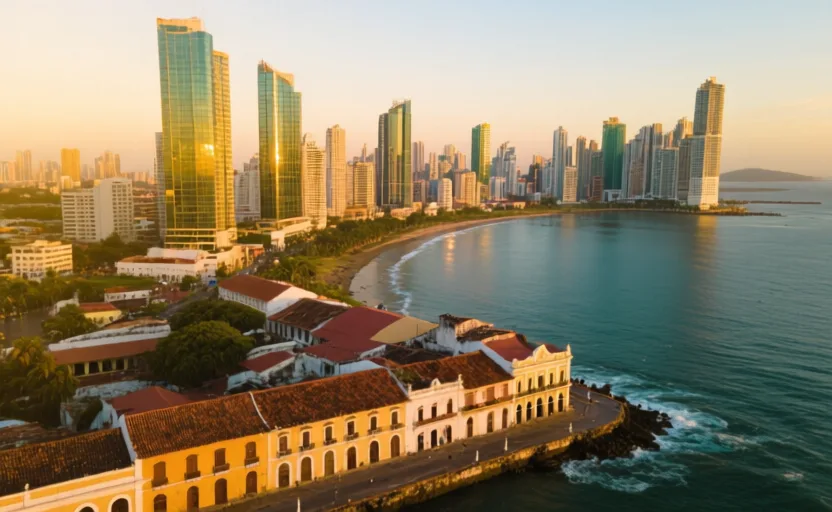 Panama City · AI city illustration · Artistic impression
City · Latin America
Panama City
Saved in this browser — no account needed. Sign in later and it comes with you.
Where it is
Panama City curves around a bay on the Pacific coast at the southern mouth of the canal, with tropical rainforest pressing in from the north. The wet season runs from May to November, the dry season from December to April, and temperatures hold near 27 °C all year. The city gets about 1,900 millimetres of rain a year, and cloud is nearly constant even in the dry months because the Intertropical Convergence Zone lies overhead. Forest on the canal’s banks has been kept almost untouched because the waterway needs its water, so the skyline of high-rises is separated from the jungle by only a few kilometres.
The land and water around it
The Pacific mouth of the canalharbour
The city sits where the canal meets the Pacific, and the port facilities at Balboa, once the administrative centre of the Canal Zone, handle much of the shipping. Panama City produces about 55 per cent of the country’s economic output.
The Chagres and Chepo riversriver
Both rivers lie within the city’s boundaries and generate hydroelectric power. The Chagres was dammed to make Gatún Lake, and together with Madden Lake it supplies the canal’s water and the former Canal Zone’s electricity.
The forest corridorforest
The Metropolitan Nature Park and Soberanía National Park run from the city along the canal and keep tapir, puma and caimans a short distance from downtown. The forests protect the canal’s water supply.
Its history, in short
Pedro Arias Dávila founded the city on 15 August 1519 on the Pacific shore, and within a few years it became the launching point for expeditions to Peru and a transit point for the gold and silver heading to Spain. Genoese merchants controlled its port from about 1520, mainly for the slave trade. On 28 January 1671 the privateer Henry Morgan, with some 1,400 men, sacked it and a fire destroyed the town. It was rebuilt on a peninsula and formally re-established on 21 January 1673, about eight kilometres away; the ruins of the first city and the walled quarter of the second are both now World Heritage sites. Prosperity returned with the railway of 1855 and the gold-rush traffic across the isthmus, then the canal after 1903, which made the city the commercial centre of a new country. Sanitary work by William Gorgas ended yellow fever in 1905. The twentieth century brought tension with the Canal Zone, the riots of 9 January 1964, years as an offshore banking centre and the American invasion of 1989, which burned part of the El Chorrillo district.
Timeline
Dates are shown on a timeline rather than as changing shapes on the map. The globe draws modern boundaries only, and tinting a modern outline to stand for a historical one would state something we cannot source.
Early modern & oceanic
15 August 1519
Founded on the Pacific
Pedro Arias Dávila founds the city, the first Spanish settlement on the Pacific shore of the Americas, and the base from which the expeditions against the Inca Empire set out.
28 January 1671
Morgan sacks the city
Henry Morgan and a band of 1,400 men attack and loot the city, which is then destroyed by fire.
Well attestedWikipedia21 January 1673
Rebuilt on a peninsula
The city is formally re-established on a peninsula about eight kilometres from the first site. This new quarter is known today as Casco Viejo.
Well attestedWikipedia
Industrial & imperial
1855
The railway and the gold rush
The Panama Railroad begins full operation. Between 1848 and 1869 about 375,000 people travel from the Atlantic side to the Pacific side, and 225,000 go the other way, adding to the city’s prosperity.
Well attestedWikipediaNovember 1905
Yellow fever eradicated
William Gorgas, chief sanitary officer for the canal works, has houses fumigated and water cleaned, based on the idea that mosquitoes spread disease. Yellow fever is gone by November 1905, and malaria rates fall sharply.
Well attestedWikipedia1914
The canal opens
The canal is completed after Panama’s separation from Colombia in 1903. Most of its workers are brought from the Caribbean, which produces new racial and social tensions in the city.
Well attestedWikipedia
Contemporary
9 January 1964
Martyrs’ Day
Tension over Panamanian exclusion from large parts of the Canal Zone, including military bases open only to Americans, erupts in violence.
Well attestedWikipedia1999
Full control of the canal
The United States formally transfers full control of the canal to Panama.
Well attestedWikipedia
Places that carry meaning
Panamá Viejo1519–1671
The ruins of the first city, destroyed by Morgan, are a World Heritage site. They show how quickly the Pacific port became a hub for the Spanish empire’s gold and silver.
Casco Viejo1673 onward
The old quarter on the peninsula, in the corregimiento of San Felipe. Its buildings range from Spanish colonial houses to French and Antillean townhouses from the canal years.
The Colonial Transisthmian Route16th–18th century
Part of a World Heritage series covering the forts, towns and roads used to carry goods between the Caribbean and the Pacific until the mid-eighteenth century. The Camino de Cruces, one of the paths, is the direct antecedent of the nineteenth-century railway and the canal.
El Chorrillo1900s onward
A district of old wood-framed buildings from the 1900s, still a large slum area when part of it burned in 1989 during the American invasion.
Languages here
Places are usually multilingual. This lists what is actually spoken, not one language per border.
SpanishRomance family
The language of daily life and government.
Most capital residents, known as capitalinos, are mestizo, and Spanish is their first language. The country’s Panamanian variety is the baseline for everyone in the city.
EnglishGermanic family
The language of shipping, banking and the Canal Zone years.
Americans ran the Canal Zone around the city for most of the twentieth century, and Caribbean labourers brought English-speaking communities to work on the canal. Many people in international jobs use both English and Spanish.
ChineseSino-Tibetan family
The language of a large community, mostly based in the capital.
Chinese and Indian workers were brought for canal construction, and most Chinese Panamanians live in the capital, making up about four per cent of the national population.
ArabicSemitic family
Spoken by a small community with its own mosques.
About one per cent of Panamanians speak Arabic. German, Portuguese, French and Hebrew are also commonly heard in the city.
Learn the language here
- 1Understand which languages are spoken herePanama City is multilingual. Start with which languages are used, by whom, and for what — the phrase list only covers one of them.Written by Globe Quest
- 2Learn 12 phrasesCurated everyday phrases for Panama City, with audio and a written form.Written by Globe Quest
- 3Say them out loudSpeaking practice with pronunciation feedback, one phrase at a time.Globe Quest material, your own additions
- 4Come back to themSpaced review, so what you learned this week is still there next month.Written by Globe Quest
- 5Practise with people: Arabic practice · DohaAn in-person practice circle. It is a prepared plan and needs a host before it runs.Run by members
Check yourself
Why does Panama City have an “old Panama” and a Casco Viejo?
The city moved to a new site after Henry Morgan destroyed it in 1671
Morgan’s sack and the fire of 1671 destroyed the original settlement. Rebuilding began in 1673 on a peninsula about eight kilometres away, leaving the old ruins and the new quarter side by side.
What did William Gorgas’s sanitation campaign achieve?
It ended yellow fever by November 1905 by controlling mosquitoes
Gorgas thought mosquitoes spread disease, so houses were fumigated and water supplies cleaned. Yellow fever disappeared and malaria rates fell sharply, though not to zero.
Worth arguing about
- The city has twice been a trading hub that others controlled: Spain’s treasure route and the American Canal Zone. What does it mean for a city to be the capital of a crossing?
- Panama City is a banking centre that attracted unwanted attention as a money-laundering location in the 1970s and 1980s. Can an economy built on passing capital ever be fully transparent?
What we have not established
These are open questions, listed rather than filled in. We would rather show a gap than a plausible guess.
How many people live in Panama City?
The article gives 410,354 for the city proper, 1,086,990 for the Panamá District and over 2,100,000 for the metropolitan area, so any total depends on which boundary is used. A separate 2026 estimate of about 1,540,000 does not match any of these.
Sources
- Wikipedia · Panama CityWikipedia · encyclopedia · checked 2026-11-24
- Wikipedia · PanamaWikipedia · encyclopedia · checked 2026-11-24
- UNESCO · The Colonial Transisthmian Route of PanamáUNESCO World Heritage Centre · intergovernmental · checked 2026-11-24
Reviewed by Globe Quest editorial on 2026-11-24. Drafted with AI assistance and checked against the sources above before publication.