 Globe Quest
 Human Quest · LearningSign in
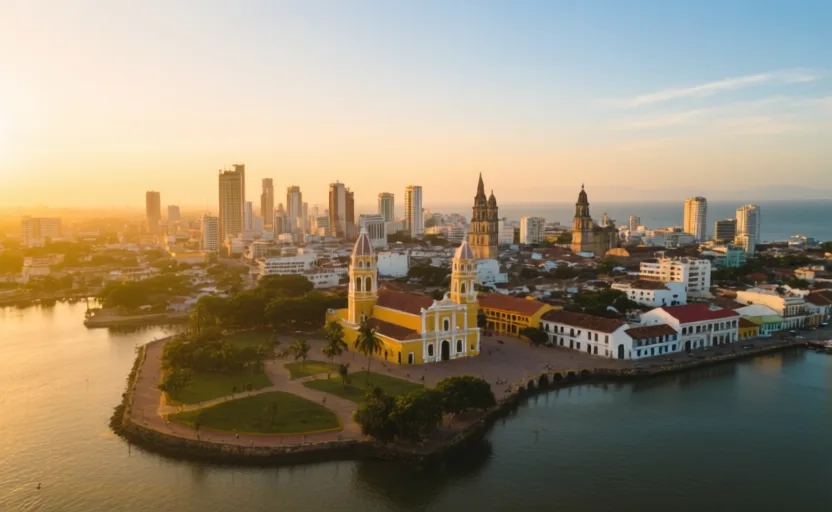 Cartagena · AI city illustration · Artistic impression
City · Latin America
Cartagena
Saved in this browser — no account needed. Sign in later and it comes with you.
Where it is
A sheltered estuary of about 84 square kilometres opens onto the Caribbean here, and Cartagena grew around it. The bay has two mouths, Bocachica to the south and Bocagrande to the north, and forts guard both. The city lies on the coast between the mouths of two large rivers, the Magdalena and the Sinú, which gave it a route into the interior of what was New Granada. The climate is hot and windy, with humidity around 80 percent, and a rainy season that usually runs from May to November. The Intertropical Convergence Zone is one of the ocean-side influences on it.
The land and water around it
Cartagena Bayestuary
An estuary of roughly 84 square kilometres with two entrances. The Spanish used its natural channels and passes to build overlapping forts, among them San Luis and San José at Bocachica, and in the 1770s added a long underwater jetty across Bocagrande.
The Dique Canal and the Magdalenariver
The bay lies between the Magdalena and Sinú rivers. A canal built in the seventeenth century by governor Pedro Zapata de Mendoza joined the bay to the Magdalena, Colombia's main navigable river, but was abandoned after independence when the city lacked the resources to maintain it.
Tropical wet and dryclimate
A hot, windy coastal climate with a rainy season from May to November. Beaches along the northern shore at Bocagrande are made of grey volcanic sand, which can make the water look muddy even though it is not.
Its history, in short
People made pottery on this coast around 4000 BC, among the oldest in the Americas. When Pedro de Heredia entered the bay in January 1533, he found a village of the Calamarí, abandoned. He founded the city on 1 June that year on the same spot, naming it for the Spanish port of Cartagena, where many of his sailors came from. Gold taken from Sinú tombs gave early wealth, and trade soon replaced plunder. Cartagena became a port of the Spanish Indies, a route for Bolivian silver going out and for enslaved Africans coming in under the asiento system, and the seat of the Inquisition. Pirates and navies kept coming, so Spain paid for walls and forts from the 1580s onward. They held in 1741, when a British fleet of 50 warships and 25,600 men failed to take the city. In 1811 Cartagena declared independence, and in 1815 it endured a Spanish siege of 105 days in which 6,000 inhabitants died of famine and disease. The nineteenth century was a period of decline. In 1984 its walled city and fortresses were listed by UNESCO, and today tourism, the port and petrochemicals drive the economy.
Timeline
Dates are shown on a timeline rather than as changing shapes on the map. The globe draws modern boundaries only, and tinting a modern outline to stand for a historical one would state something we cannot source.
First cities & states
About 4000 BCE
Puerto Hormiga pottery
On the coast near the bay, the Puerto Hormiga culture makes ceramics that are the oldest known in the Americas. The earliest documented human community in present-day Colombia lived in this area.
Early modern & oceanic
1 June 1533
Heredia founds Cartagena
Pedro de Heredia raises the city at the former Calamarí village. Cartagena becomes one of the oldest colonial cities in South America.
1586
The first fortifications
The Spanish build the first defences: an urban wall, the bastioned harbour of San Matías guarding Bocagrande, and the tower of San Felipe del Boquerón. They are strengthened and extended to their present size in the eighteenth century.
Well attestedUNESCO World Heritage Centre1697
The French raid
A French force under Baron de Pointis, with Jean du Casse, takes the city. The new walls and forts slow and raise the cost of the attack, but the city loses much anyway.
Well attestedWikipediaApril 1741
Siege by Admiral Vernon
A British armada of 50 warships, 130 transports and 25,600 men besieges the city under Admiral Edward Vernon, in the War of Jenkins' Ear. The Spanish, led by Blas de Lezo and Sebastián de Eslava, hold, and a failed attack on San Felipe de Barajas on 20 April leaves 800 British dead.
Well attestedWikipedia
Industrial & imperial
11 November 1811
Declaration of independence
After expelling the Spanish governor in 1810, a supreme junta signs a declaration of independence. The artisan Pedro Romero, a working-class leader, is key to winning support for it.
1815
The 105-day siege
Spanish forces besiege the city, which loses 6,000 inhabitants to hunger and disease.
Well attestedWikipedia
Contemporary
1984
World Heritage listing
UNESCO inscribes the port, fortresses and group of monuments, citing the scale of the military architecture of the sixteenth to eighteenth centuries and the city's place on the West Indies route.
Places that carry meaning
The walled city16th to 18th centuries
Three neighbourhoods lie inside the walls: Centro, where the cathedral, the Inquisition palace, the government palace and the convent of San Pedro Claver stand; San Diego, where merchants and craftsmen lived; and Getsemaní, an outer quarter of artisans and enslaved people.
Castillo San Felipe de Barajas18th century
A formidable fortress on a rocky crag east of the old city, guarding the isthmus of Cabrero. It was the target of the failed British assault in April 1741.
San Pedro ClaverChurch and convent
The church and convent where the body of the Jesuit saint of enslaved Africans is kept in a casket. It stands beside a square of the same name near the Museum of Modern Art.
GetsemaníColonial to present
Once the suburb of artisans and enslaved people, later a district known for crime, and now a fashionable quarter of boutique hotels and murals, where plazas once used for drug dealing have been reclaimed.
Languages here
Places are usually multilingual. This lists what is actually spoken, not one language per border.
SpanishRomance family
The language of the city and the Caribbean coast.
Costeños, the people of the Caribbean coast, have accents and customs distinct from those of the Andean highlands. About 36 percent of Cartagena's residents identified as Black, mulatto or Afro-Colombian in 2005, and smaller groups as Palenquero, Indigenous, Raizal and Rom, a legacy of the port's role in the slave trade.
Karib languages
Spoken by the Indigenous peoples around the bay at the time of the Spanish arrival.
The peoples around the bay, among them the Calamarí, Carex, Bahaire and Yurbaco, belonged to the Karib language family, specifically its Mocanae sub-family.
Learn the language here
- 1Understand which languages are spoken hereCartagena is multilingual. Start with which languages are used, by whom, and for what — the phrase list only covers one of them.Written by Globe Quest
- 2Learn 11 phrasesCurated everyday phrases for Cartagena, with audio and a written form.Written by Globe Quest
- 3Say them out loudSpeaking practice with pronunciation feedback, one phrase at a time.Globe Quest material, your own additions
- 4Come back to themSpaced review, so what you learned this week is still there next month.Written by Globe Quest
Check yourself
What happened when Admiral Vernon besieged Cartagena in 1741?
The British were driven off after a failed attack on San Felipe de Barajas
Despite his 50 warships and over 25,000 men, Vernon lifted the siege after the failed assault of 20 April left 800 British dead, with many of his men sick. The episode shows why Spain invested so heavily in the city's fortifications.
Why is Cartagena's bay so easy to defend?
It has two mouths, Bocachica and Bocagrande, and natural channels the Spanish could fortify
The estuary has natural channels and passes, and the Spanish placed forts at each of them, so an attacking fleet had to get past several.
Worth arguing about
- The same walls that protected Cartagena also guarded a port for the trade in enslaved people. How should a heritage city tell both stories at the same site?
- Getsemaní went from a place of crime to a fashionable district of boutique hotels. Who gains and who is displaced when an old working-class quarter becomes a destination?
What we have not established
These are open questions, listed rather than filled in. We would rather show a gap than a plausible guess.
How old is the pottery of Puerto Hormiga?
One account dates the settlement to about 7000 BC and the oldest pottery to around 4000 BC; another gives the culture's origin as about 4000 BC. Its decline is placed near 3000 BC either way.
Sources
- Wikipedia · Cartagena, ColombiaWikipedia · encyclopedia · checked 2026-11-24
- Wikipedia · History of Cartagena, ColombiaWikipedia · encyclopedia · checked 2026-11-24
- UNESCO · Port, Fortresses and Group of Monuments, CartagenaUNESCO World Heritage Centre · intergovernmental · checked 2026-11-24
- Wikipedia · ColombiaWikipedia · encyclopedia · checked 2026-11-24
- Wikipedia · Geography of ColombiaWikipedia · encyclopedia · checked 2026-11-24
Reviewed by Globe Quest editorial on 2026-11-24. Drafted with AI assistance and checked against the sources above before publication.