 Globe Quest
 Human Quest · LearningSign in
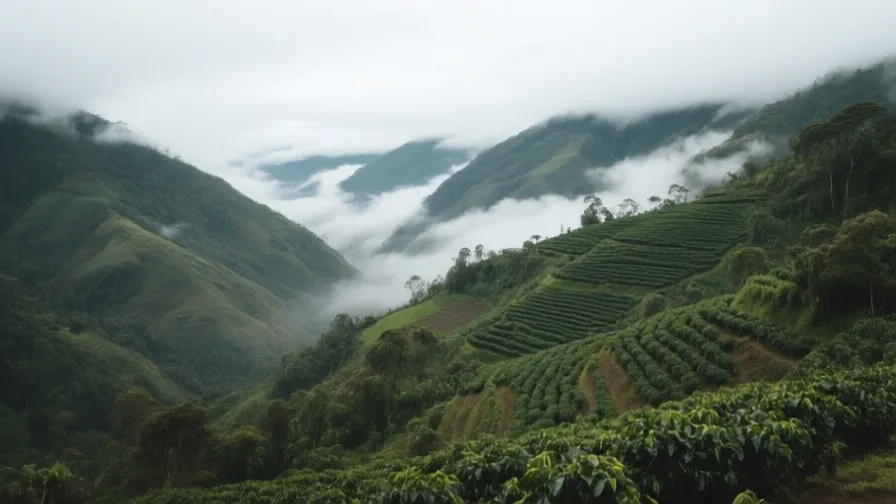 Colombia · AI landscape illustration · Artistic impression
Country · Latin America
Colombia
Saved in this browser — no account needed. Sign in later and it comes with you.
Where it is
The Andes run through the western half of Colombia in several ranges, and almost everything about the country follows from altitude. Coasts on both the Caribbean and the Pacific, the plains of the Llanos, the Amazon forest and a set of islands make up six natural regions. Because the country lies close to the equator, temperature hardly changes through the year but changes sharply with height. Colombians divide the land into a hot zone below about 900 metres, a temperate zone, and a cold zone up to roughly 3,500 metres, with bare páramo above it. Most people live in the mountainous west and along the northern coast, while the south and east are sparsely populated.
The land and water around it
The Andean cordillerasmountains
The Andes carry most of the country's people and its largest cities. Medellín stands at about 1,487 metres and Cali at about 1,030 metres in the temperate zone, while Bogotá averages only 15 °C all year, with less than a degree between its coolest and warmest months.
The Magdalena and Cauca valleysvalley
A long, narrow extension of the hot zone follows the Magdalena Valley, with a smaller one in the Cauca Valley, both interrupting the temperate Andean highlands. Some of the oldest archaeological finds in the country, at Pubenza and El Totumo, lie in the Magdalena Valley southwest of Bogotá.
The Pacific lowlandsforest
Rainfall exceeds 7,600 millimetres a year across most of this coast, making it one of the wettest regions on Earth. Lloro is estimated to have the highest average annual precipitation anywhere, at 13,299 millimetres. The leeward side of the Guajira peninsula in the north is the opposite, with a record low of 350 millimetres at Uribia.
Its history, in short
People were living in the territory by about 12,500 BCE, and later societies included the Muisca confederation, the Quimbaya and the Tairona chiefdoms. The Spanish landed in 1499 and founded Santa Marta in 1525 and Cartagena in 1533. Gonzalo Jiménez de Quesada pushed inland and founded Bogotá in 1538, which became the centre of the New Kingdom of Granada and then, from 1717, of a viceroyalty. A declaration of independence followed in 1810, and Simón Bolívar's army won the decisive Battle of Boyacá in 1819 and created Gran Colombia, which dissolved in 1830. After the Granadine Confederation and a federal period, the country became a centralised republic in 1886. In 1903 Panama seceded, with American and French backing, leaving Colombia with its present borders. Strong regional identities, shaped by geography, persisted through all of this. A civil conflict called La Violencia followed the assassination of the Liberal candidate Jorge Eliécer Gaitán in 1948, and an armed conflict that began in the 1960s was addressed by a peace agreement with the FARC in 2016.
Timeline
Dates are shown on a timeline rather than as changing shapes on the map. The globe draws modern boundaries only, and tinting a modern outline to stand for a historical one would state something we cannot source.
Early human world
By about 12,500 BCE
First peoples
Hunter-gatherers live at El Abra, Tibitó and Tequendama near present-day Bogotá and trade with cultures of the Magdalena Valley. Colombia lay on a corridor between Mesoamerica and the Andes.
Approximate dateWikipedia
First cities & states
5000–4000 BCE
The oldest pottery in the Americas
Ceramics found at San Jacinto are the oldest pottery discovered in the Americas.
Approximate dateWikipedia
Early modern & oceanic
1499
The Spanish arrive
Alonso de Ojeda reaches the Guajira Peninsula. Santa Marta is founded in 1525 and Cartagena in 1533.
Well attestedWikipediaAugust 1538
Bogotá is founded
Jiménez de Quesada founds Santa Fe on the site of a Muisca village. A royal Audiencia installed in 1549 makes it the capital of New Granada.
Industrial & imperial
7 August 1819
Boyacá and Gran Colombia
Bolívar leads an army over the Andes and wins the battle that frees New Granada. The Congress of Angostura creates Gran Colombia the same year, with Bolívar as president and Santander as vice-president. It breaks up in 1830.
1903
Panama secedes
The United States seeks control over the canal, and Panama separates with American and French backing. In 1921 the US pays Colombia 25 million dollars, and Colombia recognises Panama.
Well attestedWikipedia
Contemporary
9 April 1948
Gaitán is assassinated
The murder of the Liberal presidential candidate Jorge Eliécer Gaitán ignites a bloody conflict between the two main parties, known as La Violencia, which lasts into the early 1950s.
Well attestedWikipediaNovember 2016
Peace agreement with the FARC
After a first deal fails in a referendum, the government and the guerrillas sign a revised accord, which Congress approves. President Santos receives the Nobel Peace Prize that year.
Well attestedWikipedia
Places that carry meaning
Serranía de la LindosaPossibly 12,500 years old
A site with about eight miles of pictographs, revealed in November 2020 and still under study. Its suggested age is around 12,500 years, though the dating is not settled.
Cabo de la Vela and the GuajiraFrom 1499
The headland on the Guajira Peninsula where the first Spanish expedition arrived. The leeward side of the peninsula is the driest part of the country.
San Andrés, Providencia and Santa CatalinaPresent day
An island group where English has official status, a reminder that the national language does not cover every community.
Languages here
Places are usually multilingual. This lists what is actually spoken, not one language per border.
SpanishRomance family
The national language, spoken by about 99.2 percent of Colombians.
Regional groups, among them the Costeños of the Caribbean coast, the Antioqueños, the Santandereanos and the Llaneros of the plains, each have distinctive accents and customs. Geography and climate helped produce these identities, and they remain important reference points.
Indigenous languages
Sixty-five Amerindian languages are recognised across the country.
They belong to several families, among them Chibchan, Tucanoan, Arawakan and Cariban. The Muisca and Tairona, whom the Spanish conquered, spoke Chibcha languages.
English and Creole languages
Recognised regionally, with English official in the San Andrés archipelago.
Two Creole languages, Romani and Colombian Sign Language are also recognised alongside the Amerindian languages.
Learn the language here
Check yourself
What most shapes Colombia's climate zones?
Altitude, since temperature barely changes with the seasons
On the equator, a city's temperature depends on how high it is. Colombians speak of tierra caliente, templada and fría, and most of the country's area lies in the hot zone.
What happened to Gran Colombia, created in 1819?
It dissolved in 1830, leaving the Republic of New Granada
Gran Colombia united the old viceroyalty's territories and broke up by 1830. What is now Colombia and Panama continued as the Republic of New Granada; the name Colombia returned in 1863, and the present Republic of Colombia dates from 1886.
Worth arguing about
- Colombian regions have distinct accents, foods and ways of life that mountains and valleys helped create. Does geography make it harder to build a single national identity, or easier to appreciate several?
- The country has been through a long armed conflict and a peace process whose first referendum failed. What does a society owe the places and people that bore most of that violence?
What we have not established
These are open questions, listed rather than filled in. We would rather show a gap than a plausible guess.
How many languages are spoken in Colombia?
Counts range from 65 Amerindian languages, plus two Creoles and others, to a best estimate of about 71 in use, to 101 in the Ethnologue catalogue. Whether a form counts as a language or a dialect decides the figure.
How many people live in Colombia?
Figures run from about 50 million for 2020 to more than 53 million for 2025. They are projections made at different dates, not a single count.
Sources
- Wikipedia · ColombiaWikipedia · encyclopedia · checked 2026-11-24
- Wikipedia · History of ColombiaWikipedia · encyclopedia · checked 2026-11-24
- Wikipedia · Geography of ColombiaWikipedia · encyclopedia · checked 2026-11-24
Reviewed by Globe Quest editorial on 2026-11-24. Drafted with AI assistance and checked against the sources above before publication.