 Globe Quest
 Human Quest · LearningSign in
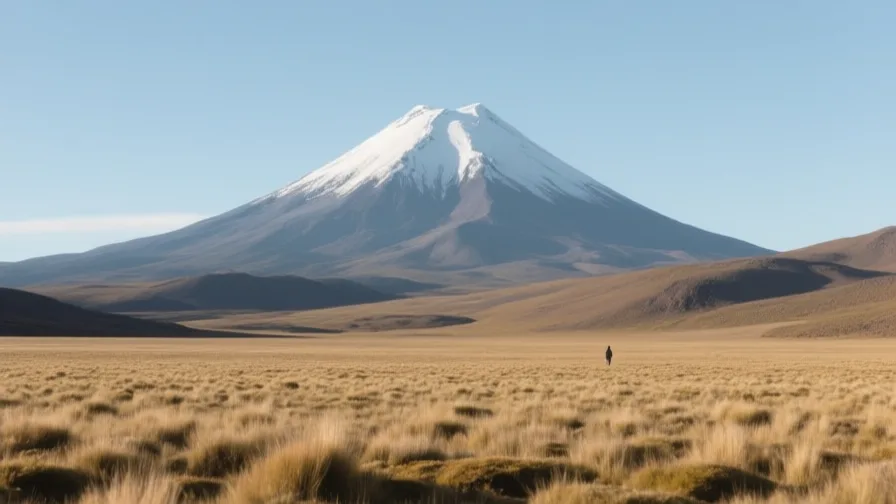 Ecuador · AI landscape illustration · Artistic impression
Country · Latin America
Ecuador
Saved in this browser — no account needed. Sign in later and it comes with you.
Where it is
The country takes its name from the line it straddles, lying between 2°N and 5°S on South America’s Pacific shore, with 2,337 kilometres of coast and the Galápagos Islands about 1,000 kilometres out to sea. The Andes split it lengthwise into the Costa, the Sierra and the Oriente, which are three different worlds: banana lowlands, a belt of snow-capped volcanoes, and Amazonian rainforest. Altitude, more than season, decides the weather, and at the equator the sun rises and sets near six o’clock every day of the year. The country is one of seventeen megadiverse nations.
The land and water around it
The Sierra and its volcanoesmountains
The Andes run through the middle of the country in parallel ranges formed as the Nazca Plate dives beneath South America. Here are Cotopaxi, 5,897 metres and the tallest active volcano on Earth, and Chimborazo, 6,267 metres, the point on the surface farthest from the Earth’s centre. Quito lies in a high valley below Pichincha.
The Costaplain
A broad coastal plain, rising to the Andean foothills. It is the most fertile land, home to the banana plantations of the export trade and to most of the rice crop, though about 98 percent of its native forest has been cleared.
The Orienteforest
Rainforest on the eastern slopes and across the Amazon basin, sometimes drenched with more than 5,000 mm of rain a year. The oil fields lie here, and so does serious environmental damage, as well as the lowland Quechua, Siona, Secoya, Huaorani and Cofán peoples.
Its history, in short
People had lived in the area for thousands of years, in groups with unrelated languages, before the Inca Empire absorbed them in the fifteenth century. Spain followed in the sixteenth. From 1563 Quito had its own Real Audiencia, a court and advisory body that could deal with Madrid directly, first within the Viceroyalty of Peru and, after 1720, of New Granada. The colonial economy rested on the encomienda, textiles and Guayaquil’s trade and shipyards, and sank in the eighteenth century. A junta in Quito challenged Spain in 1809, and Guayaquil proclaimed independence in 1820. Victory at Pichincha brought the rest into Gran Colombia, from which Ecuador separated in 1830. The nineteenth century was one of civil wars and caudillos, and a long argument with Peru over the Amazon basin ran through much of it. The 1895 Liberal Revolution under Eloy Alfaro reduced church and landowner power. Democracy returned in 1979, and a 2008 constitution became the first in the world to recognise the rights of nature.
Timeline
Dates are shown on a timeline rather than as changing shapes on the map. The globe draws modern boundaries only, and tinting a modern outline to stand for a historical one would state something we cannot source.
Early modern & oceanic
1563
The Audiencia of Quito
Quito becomes the seat of a royal court, giving the region its own administration within the Spanish empire.
Industrial & imperial
10 August 1809
Quito’s junta
Leading citizens of Quito seize power in the name of the deposed Ferdinand VII, an early step in Spanish American independence, put down by 1812.
Well attestedWikipedia9 October 1820
Guayaquil declares independence
The Department of Guayaquil is the first territory in Ecuador to break from Spain. Its allies from Argentina and Gran Colombia send troops, and Sucre’s victory at Pichincha brings the rest of the country into Gran Colombia.
13 May 1830
Separation from Gran Colombia
Ecuador leaves Gran Colombia, and its first president, Juan José Flores, claims the territory of the old Audiencia of Quito.
Well attestedWikipedia1830 onward
Claims over the Amazon basin
Ecuador argues from Spanish royal decrees that the old Audiencia of Quito reached into the Amazon. Peru contests this with a decree of 1802, which Ecuador calls an ecclesiastical instrument with no bearing on political borders.
DisputedWikipediaEcuador and Peru, whose accounts of the 1802 decree and of earlier royal borders differ.
1895
The Liberal Revolution
Eloy Alfaro takes power and reduces the influence of the clergy and the conservative landowners.
Well attestedWikipedia
Contemporary
1979
A return to elections
Jaime Roldós Aguilera wins with more than a million votes, the most in the country’s history, and on 10 August becomes the first president elected under a constitution after almost a decade of dictatorships.
Well attestedWikipedia2008
Rights of nature
A new constitution makes Ecuador the first country to recognise legally enforceable rights of nature.
Well attestedWikipedia
Places that carry meaning
QuitoColonial to present
The capital in a high Andean valley, with a historic centre that is one of the country’s two urban World Heritage Sites. About 2.78 million people live there.
GuayaquilColonial to present
The largest city and main port, with 2.72 million people. It was a hub of illicit colonial trade and the largest shipbuilding centre on the west coast of South America before independence.
The Galápagos IslandsNatural heritage
An archipelago far offshore, associated with Charles Darwin’s observations and the origin of the theory of natural selection. It is a World Heritage Site.
Languages here
Places are usually multilingual. This lists what is actually spoken, not one language per border.
SpanishRomance family
The official language.
Spanish is the first language of about 93 percent of Ecuadorians and a second language for another 6 percent.
KichwaQuechuan family
The best-known indigenous language of the highlands.
Northern Kichwa and other pre-colonial languages were spoken by about 2.5 million people in 1991.
Shuar and other Amazonian languages
Spoken in the Oriente.
Shuar Chicham, A’ingae, Awapit, Achuar-Shiwiar, Cha’palaachi, Tsa’fiki, Paicoca and Wao Tededeo are among the indigenous languages still spoken. Thirteen native languages are officially recognised, though linguists count about 24 living ones.
Learn the language here
Check yourself
Where does the country’s name come from?
The Spanish word for “equator”
Ecuador means “Equator”, shortened from the Republic of the Equator, itself derived from a department of Gran Colombia created in 1824.
Which constitutional first did Ecuador achieve in 2008?
Recognising legally enforceable rights of nature
The 2008 constitution was the first in the world to give nature legally enforceable rights, matching the country’s megadiverse landscapes.
Worth arguing about
- Ecuador has the first constitution to grant rights to nature, yet its oil fields in the Amazon cause serious damage. Can a legal right survive an export economy that depends on commodities?
- Three regions separated by the Andes, and a long history of competing coastal and highland elites. Does geography explain Ecuador’s political divisions, or does it excuse them?
What we have not established
These are open questions, listed rather than filled in. We would rather show a gap than a plausible guess.
How large is Ecuador?
The foreign ministry puts the area at 256,370 square kilometres, while another count, including the Galápagos, gives 283,571. Border claims with Peru also affect what counts as national territory.
Sources
- Wikipedia · EcuadorWikipedia · encyclopedia · checked 2026-11-24
- Wikipedia · History of EcuadorWikipedia · encyclopedia · checked 2026-11-24
- Wikipedia · Geography of EcuadorWikipedia · encyclopedia · checked 2026-11-24
Reviewed by Globe Quest editorial on 2026-11-24. Drafted with AI assistance and checked against the sources above before publication.