 Globe Quest
 Human Quest · LearningSign in
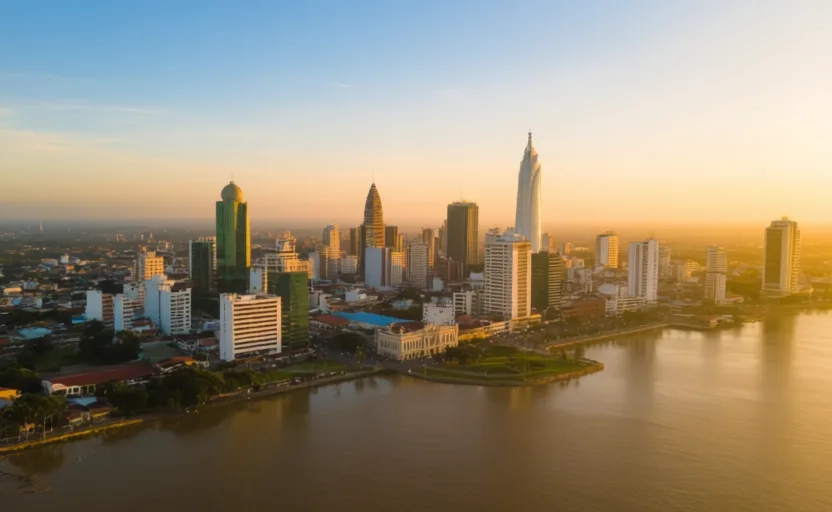 Guayaquil · AI city illustration · Artistic impression
City · Latin America
Guayaquil
Saved in this browser — no account needed. Sign in later and it comes with you.
Where it is
Guayaquil is built on the west bank of the Guayas River, a short way up from where the river empties into the Gulf of Guayaquil and the Pacific, and only a little south of the Equator. The ground is flat, close to sea level, and made of deep soft sediment laid over hard rock. The climate is hot and wet from January to April, then mostly dry from May to December, when the cold Humboldt Current keeps skies cloudy and rain scarce. The river and the gulf explain why the city is a port first and everything else second.
The land and water around it
The Guayas Riverriver
The river runs past the city on its eastern side and is the reason the settlement exists: a navigable channel close to the open Pacific, sheltered enough to build and repair ships.
The Gulf of Guayaquilgulf
Most of Ecuador’s foreign trade passes through this gulf. It is also a zone of many faults and detachment systems, so the same water that brings ships brings tsunami and earthquake risk to the coast around it.
The Humboldt Current climateclimate
Cold water offshore damps rainfall for most of the year, giving cloudy mornings and evening breezes. When the wet months coincide with an El Niño year, rain rises sharply and flooding is common.
Its history, in short
Spanish settlers tried several times to plant a town here before one lasted, and it was set up as a shipyard and trading port serving the empire. Through the colonial centuries it was the main shipbuilding yard on the Pacific coast and a stop on the Manila galleon trade that ran through Acapulco to Callao. Pirates raided it in 1687 and again in 1709. Enslaved people formed a large part of its late eighteenth-century workforce, many of them paying their owners a daily fee in exchange for some independence. On 9 October 1820 civilians and soldiers arrested the Spanish authorities almost without bloodshed, and Guayaquil became a free province before being joined to Gran Colombia. Sucre set out from here for the campaign that ended at Pichincha. Since 1830 the city has been part of Ecuador, and it remains the country’s largest city and its main port, handling most of its imports and exports. Its twentieth-century story includes a great fire in 1896 and a bloodily suppressed general strike in 1922, and in 2020 the pandemic overwhelmed its hospitals.
Timeline
Dates are shown on a timeline rather than as changing shapes on the map. The globe draws modern boundaries only, and tinting a modern outline to stand for a historical one would state something we cannot source.
Early modern & oceanic
1535 or 1538
A port founded for the empire
After earlier attempts at other sites, Guayaquil was set up on the river as a shipyard and trading port. Accounts give 1535 and 1538 for the founding.
Approximate dateWikipedia20 April 1687
Pirates sack the city
More than 260 English and French pirates attacked and looted Guayaquil. Both sides lost heavily: 75 defenders died and more than 100 were wounded.
Well attestedWikipedia1794
María Chiquinquirá wins her freedom
An enslaved woman working in a city household went to court and argued successfully for her own freedom. She is remembered locally as a hero.
Well attestedWikipedia
Industrial & imperial
9 October 1820
Independence from Spain
Civilians, backed by a battalion quartered in the city, overpowered the royalist guards and arrested the Spanish authorities. Guayaquil became the Free Province of Guayaquil under José Joaquín de Olmedo, the first Ecuadorian city to secure independence.
26 July 1822
San Martín and Bolívar meet
The two generals met in Guayaquil to plan the completion of independence in Peru, and with it the rest of Spanish South America.
Well attestedWikipedia1896
The great fire
Large parts of the city were destroyed by fire.
Well attestedWikipedia1922
General strike
Workers stopped work for three days. The strike ended after the military and police killed at least 300 people.
Well attestedWikipedia
Contemporary
April 2020
COVID-19 overwhelms the city
Hospitals and mortuary services failed to cope, and almost 6,000 more deaths than usual were recorded in the first two weeks of April.
Well attestedWikipedia
Places that carry meaning
The Port of GuayaquilColonial era to today
The country’s busiest commercial port. About 70 per cent of its private exports leave through it and 83 per cent of imports arrive through it.
Guayaquil Metropolitan CathedralArchdiocese since 1956
The largest church in a city where about 70 per cent of Christians are Catholic. The diocese was formed in 1838 and raised to an archdiocese in 1956.
Yuan Heng templeModern
Described as the largest Buddhist temple in South America. It stands alongside Latter-day Saints and Pentecostal churches, and Jewish and Muslim communities, in a city with a wide religious range.
Languages here
Places are usually multilingual. This lists what is actually spoken, not one language per border.
SpanishRomance family
The official language and the language of daily life.
Across Ecuador about 93 per cent of people speak Spanish as a first language and a further 6 per cent as a second.
Kichwa (Quechua)Quechuan family
The most widely spoken Indigenous language in the country.
Ecuador recognises 13 native languages, among them Quechua and Shuar. Guayaquil is on the coast, so Spanish dominates its streets, but the national picture is a multilingual one.
Learn the language here
- 1Understand which languages are spoken hereGuayaquil is multilingual. Start with which languages are used, by whom, and for what — the phrase list only covers one of them.Written by Globe Quest
- 2Learn 13 phrasesCurated everyday phrases for Guayaquil, with audio and a written form.Written by Globe Quest
- 3Say them out loudSpeaking practice with pronunciation feedback, one phrase at a time.Globe Quest material, your own additions
- 4Come back to themSpaced review, so what you learned this week is still there next month.Written by Globe Quest
Check yourself
What happened in Guayaquil on 9 October 1820?
Local civilians arrested the Spanish authorities and declared independence
The 1820 takeover was almost bloodless and made Guayaquil the first Ecuadorian city to break with Spain. The pirate raid was in 1687 and the San Martín and Bolívar meeting in 1822.
Why is rainfall low in Guayaquil from May to December?
A cold ocean current cools the air and suppresses rain
The cold Humboldt Current offshore keeps the sky cloudy but dry for most of the year. When it weakens in an El Niño year, rainfall rises and floods follow.
Worth arguing about
- Guayaquil is the country’s economic capital while Quito is its political one. What does it do to a country when its money and its government sit in different cities?
- The city rests on soft sediment beside a gulf prone to earthquakes and tsunamis. How should a major port weigh that risk against the reasons it was built there?
What we have not established
These are open questions, listed rather than filled in. We would rather show a gap than a plausible guess.
In which year was Guayaquil definitively founded?
Accounts give 25 July 1535 in one place and 25 July 1538 in another, and the city was moved after several failed attempts, so the date depends on which settlement is counted.
Sources
- Wikipedia · GuayaquilWikipedia · encyclopedia · checked 2026-11-24
- Wikipedia · EcuadorWikipedia · encyclopedia · checked 2026-11-24
Reviewed by Globe Quest editorial on 2026-11-24. Drafted with AI assistance and checked against the sources above before publication.