 Globe Quest
 Human Quest · LearningSign in
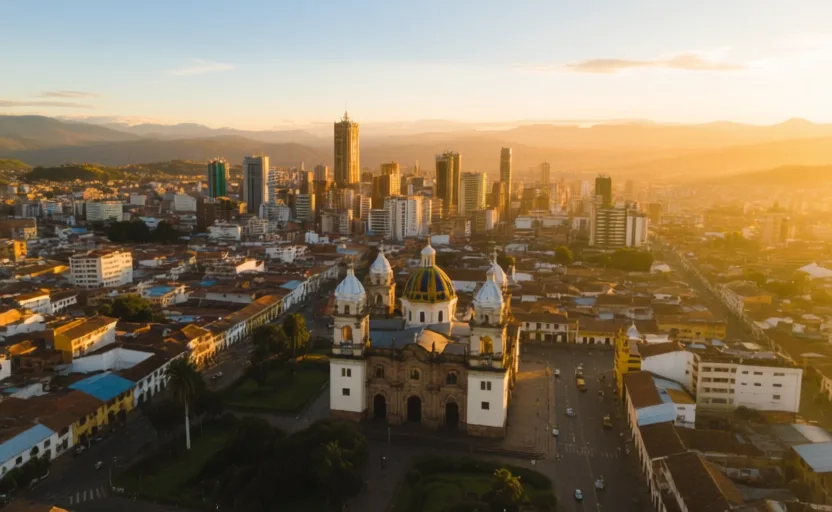 Cuenca · AI city illustration · Artistic impression
City · Latin America
Cuenca
Saved in this browser — no account needed. Sign in later and it comes with you.
Where it is
Four rivers give Cuenca both its name and its shape. The Tomebamba, Yanuncay, Tarqui and Machángara run through a basin in the southern Ecuadorian Andes, in the Paute river basin, at about 2,500 metres above sea level. The first three start in the high páramo moorland of the Cajas park, west of the city. The altitude, just south of the Equator, gives a mild highland climate with cool nights and no real winter: a dry season from about June to December, and rains from January to May that peak in March, April and May. The city lies roughly 470 kilometres south of Quito and 200 kilometres south-east of Guayaquil.
The land and water around it
The four riversriver
The Tomebamba, Yanuncay, Tarqui and Machángara cut the basin into terraces and give the city its name. The Tomebamba, the most important of them, carries the name of the Inca city.
El Cajas páramoplateau
West of the city, the high páramo of El Cajas National Park feeds the Tomebamba, Yanuncay and Tarqui. Cuenca’s water, and its trout, come from this cold moorland.
The Paute basinvalley
Cuenca sits within the Paute river basin, a pocket of stable climate, fertile soil and plentiful water that early peoples used for growing potatoes, quinoa and squash and for keeping guinea pigs, llamas and alpacas.
Its history, in short
People have lived in this basin for thousands of years, and the Cañari had a settlement here called Guapondelig. In the fifteenth century the Inca conquered the Cañari after a hard struggle and built Tomebamba, which came to be called a second Cusco, with a grand complex at Pumapungo. By the time the Spanish arrived, that splendour had largely vanished and the site was thinly settled. Gil Ramírez Dávalos founded the Spanish city in 1557 on the viceroy’s orders, naming it after the viceroy’s birthplace in Spain because the rivers and basin resembled it. It was laid out on a regular grid and grew steadily through the colonial era. Cuenca declared independence on 3 November 1820 and became one of the three provincial capitals of the young republic. In the nineteenth century the quinine and straw hat trades brought a spell of prosperity that shaped its architecture, and in 1999 its historic centre was inscribed by UNESCO.
Timeline
Dates are shown on a timeline rather than as changing shapes on the map. The globe draws modern boundaries only, and tinting a modern outline to stand for a historical one would state something we cannot source.
Post-classical world
c. 500 CE
Guapondelig
Archaeologists believe the Cañari settlement that preceded Cuenca dates to about 500 CE. Earlier peoples had been in the area since at least the sixth millennium BCE.
Approximate dateWikipedia
Early modern & oceanic
1470s
Inca Tomebamba
After defeating the Cañari, the Inca ruler Tupac Yupanqui ordered a great city built at Pumapungo. Spanish chroniclers heard stories of golden temples, but found only ruins.
Approximate dateWikipedia12 April 1557
The Spanish city is founded
Gil Ramírez Dávalos founded Santa Ana de los Ríos de Cuenca on the orders of the viceroy of Peru, decades after Quito, Guayaquil and Loja.
Well attestedWikipedia
Industrial & imperial
3 November 1820
Independence
Cuenca broke from Spain a few weeks after Guayaquil. It went on to head one of the republic’s three original provinces, with Guayaquil and Quito heading the others.
Well attestedWikipedia1885
The New Cathedral begins
Building began on the New Cathedral, one of the landmarks of a century in which exports of quinine and straw hats paid for more substantial houses in the old colonial grid.
Well attestedUNESCO World Heritage Centre
Contemporary
1999
World Heritage inscription
The historic centre, the Pumapungo archaeological site and the old access routes were inscribed as a World Heritage Site.
Places that carry meaning
Historic centreFrom 1557
A planned inland Spanish town that has kept its original orthogonal plan for over four centuries. Around the main square stand the town hall and governor’s office, two cathedrals facing each other, and the law courts.
PumapungoInca period
The archaeological site of the Inca city that replaced Cañari Guapondelig. Little survives above ground, which is why the chroniclers’ descriptions of gold remain a matter of story rather than evidence.
Cajas National ParkNatural
A highland park of lakes and páramo west of the city, source of three of its four rivers and a place for trout fishing.
Languages here
Places are usually multilingual. This lists what is actually spoken, not one language per border.
SpanishRomance family
The everyday and official language.
In Ecuador about 93 per cent of people speak Spanish as a first language. Cuenca’s long literary tradition, which earned it the nickname “Athens of Ecuador”, has been written in it.
Kichwa (Quechua)Quechuan family
An Indigenous language of the Ecuadorian highlands.
The Inca absorbed the Cañari in the fifteenth century, and Ecuador today recognises 13 native languages, Quechua among them. In the city itself Spanish is what most people use.
Learn the language here
- 1Understand which languages are spoken hereCuenca is multilingual. Start with which languages are used, by whom, and for what — the phrase list only covers one of them.Written by Globe Quest
- 2Learn 12 phrasesCurated everyday phrases for Cuenca, with audio and a written form.Written by Globe Quest
- 3Say them out loudSpeaking practice with pronunciation feedback, one phrase at a time.Globe Quest material, your own additions
- 4Come back to themSpaced review, so what you learned this week is still there next month.Written by Globe Quest
Check yourself
Why is the city called Cuenca?
After a Spanish city and for the basin made by four rivers
The viceroy who ordered the foundation came from Cuenca in Spain, and the new site resembled it. In Spanish a cuenca is a basin, which is exactly what the four rivers have made here.
What was the Inca city at the site of Cuenca called?
Tomebamba
The Inca renamed the Cañari settlement Tomebamba and the Spanish later found only ruins. Guapondelig was the earlier Cañari name.
Worth arguing about
- Cuenca is built where Cañari, Inca and Spanish cities each stood. Which layer is easiest to see today, and what has been lost by that?
- Its nineteenth-century prosperity came from exporting quinine and straw hats. What does a city keep when the trade that built it ends?
What we have not established
These are open questions, listed rather than filled in. We would rather show a gap than a plausible guess.
When was Cuenca founded, and how large is it?
One text gives 12 April 1557 for the founding and another gives 1577. Population figures also differ by definition: about 596,000 for the 2022 census on one count and a much smaller figure for the urban area on another.
Sources
- Wikipedia · Cuenca, EcuadorWikipedia · encyclopedia · checked 2026-11-24
- UNESCO · Historic Centre of Santa Ana de los Ríos de CuencaUNESCO World Heritage Centre · intergovernmental · checked 2026-11-24
- Wikipedia · EcuadorWikipedia · encyclopedia · checked 2026-11-24
Reviewed by Globe Quest editorial on 2026-11-24. Drafted with AI assistance and checked against the sources above before publication.