 Globe Quest
 Human Quest · LearningSign in
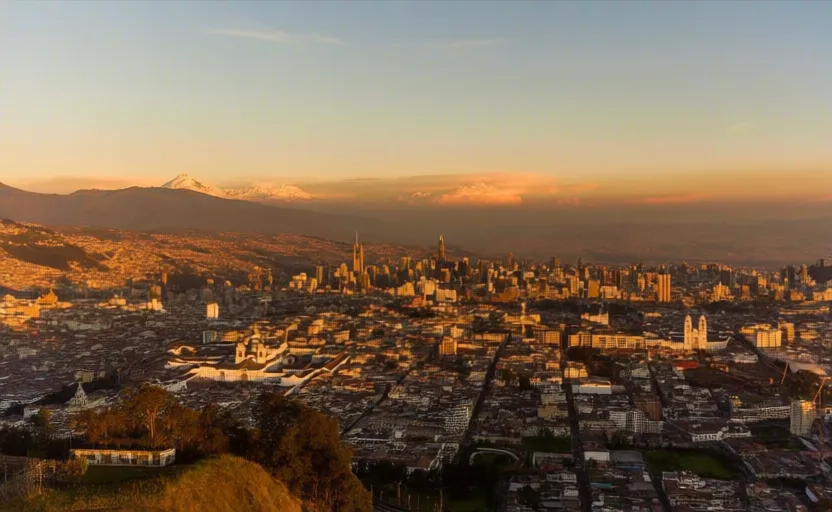 Quito · AI city illustration · Artistic impression
City · Latin America
Quito
Saved in this browser — no account needed. Sign in later and it comes with you.
Where it is
A long, narrow plateau on the eastern flank of the Pichincha volcano holds Quito, 2,850 metres up in the valley of the Guayllabamba River. Snow-capped volcanoes ring the valley, among them Cotopaxi, Antisana and Cayambe to the east and Illiniza and Pululahua to the west, and Pichincha itself is active. The equator runs through the northern end of the metropolitan area. Altitude and latitude together fix the climate: an annual mean near 15.6 °C, afternoons around 21 and nights near 10, and only two seasons, a dry June to August and a wet remainder. The thin air brings some of the strongest solar radiation anywhere.
The land and water around it
The Pichincha volcanovolcano
A stratovolcano rising behind the western edge of the city, with summits at 4,700 and 4,794 metres. Its largest eruption, in 1660, covered the city in more than 25 centimetres of ash, and a smaller one in 1999 dusted it again. Quito is the only capital built so close to an active volcano.
The Guayllabamba valleyvalley
The basin holding the city, flanked by volcanoes of both the Western and Royal cordilleras. The city has grown into three zones separated by hills: the colonial centre, an industrial and working-class south, and a modern north.
The páramoplateau
High grassland above the tree line, below the snow, supplies most of the city’s water. In the 1990s the water company and The Nature Conservancy set up a fund to protect it from cattle, burning and mining.
Its history, in short
People were hunting obsidian on the slopes of Ilaló by 8000 BC, and farmers lived at Cotocollao around 1500 BC. By the late fifteenth century the local Quitu had been conquered by the Inca emperor Huayna Capac, who made Quito the northern capital of his empire. The date most often given for its founding is the Spanish conquest of 1534, after Sebastián de Benalcázar captured the leader Rumiñahui. Under the Real Audiencia of 1563 the city governed a large region, first as part of the Viceroyalty of Peru and later of New Granada. Its convents and churches carried the Quito School of art, blending indigenous and European traditions. A junta challenged Spain in 1809. The republican years brought assassinations and civil wars, including the lynching of Eloy Alfaro in 1912. In 1978 the old centre and Kraków were the first places named World Heritage Sites. A metro line opened in December 2023.
Timeline
Dates are shown on a timeline rather than as changing shapes on the map. The globe draws modern boundaries only, and tinting a modern outline to stand for a historical one would state something we cannot source.
First cities & states
c. 8000 BCE
Obsidian hunters at El Inga
Hunter-gatherers leave obsidian tools on the slopes of Ilaló, the oldest traces of people in the Quito area, excavated in 1960.
Approximate dateWikipedia
Early modern & oceanic
Late 15th century
Inca conquest
Emperor Huayna Capac defeats the Quitu and makes Quito the capital of the Inca Empire’s northern region.
Approximate dateWikipedia6 December 1534
Spanish refoundation
After Almagro’s first foundation of San Francisco de Quito near Riobamba in August, 204 settlers under Sebastián de Benalcázar refound it at the present site. Rumiñahui is executed in January 1535.
Well attestedWikipedia1563
Seat of a Real Audiencia
Quito becomes the centre of a Spanish court district, later passing from the Viceroyalty of Peru to New Granada in 1717.
Well attestedWikipedia
Industrial & imperial
10 August 1809
A first independence movement
Leading citizens unveil a government plan that names Juan Pío Montúfar president, one of the early Spanish American attempts to break with Spain.
Well attestedWikipedia1912
Eloy Alfaro killed
The former president, who led the Liberal Revolution, is jailed and lynched by a mob, and his body is dragged through the streets and burned in a park.
Well attestedWikipedia
Contemporary
1978
World Heritage listing
Quito and Kraków are the first cultural sites to be inscribed by UNESCO.
1 December 2023
The metro opens
A subway with one line begins service, following the Ecovía bus lines built across the city in 2003 and 2004.
Well attestedWikipedia
Places that carry meaning
Historic centreFrom 1534
One of the largest and best-preserved historic centres in the Americas. The streets keep the original grid, aligned with the compass points and built of earth brick and stucco around patios.
The convents of the Quito School16th to 18th centuries
San Francisco, Santo Domingo, San Agustín, La Compañía, La Merced and other complexes hold altarpieces, paintings and sculptures of the Quito Baroque, a school that UNESCO credits with Spanish America’s greatest contribution to world art.
Parque Bicentenario2013
A park on the site of the old airport, which closed on 19 February 2013 when the new Mariscal Sucre airport opened 45 minutes from the centre.
Languages here
Places are usually multilingual. This lists what is actually spoken, not one language per border.
SpanishRomance family
The language of the capital and of nearly everyone in it.
Spanish is the first language of about 93 percent of Ecuadorians and the second language of another 6 percent.
KichwaQuechuan family
The highland indigenous language of Ecuador.
Northern Kichwa and other pre-colonial languages were spoken by roughly 2.5 million Ecuadorians in 1991, and Quito served as the Inca Empire’s northern capital before the Spanish arrived.
Learn the language here
- 1Understand which languages are spoken hereQuito is multilingual. Start with which languages are used, by whom, and for what — the phrase list only covers one of them.Written by Globe Quest
- 2Learn 11 phrasesCurated everyday phrases for Quito, with audio and a written form.Written by Globe Quest
- 3Say them out loudSpeaking practice with pronunciation feedback, one phrase at a time.Globe Quest material, your own additions
- 4Come back to themSpaced review, so what you learned this week is still there next month.Written by Globe Quest
Check yourself
How was Quito founded by the Spanish?
First near Riobamba in August 1534, then refounded at its present site on 6 December 1534
Almagro founded Santiago de Quito at Colta in August 1534, and Benalcázar’s party refounded it at the present site that December.
What distinction did Quito share with Kraków in 1978?
They were the first sites inscribed as UNESCO World Heritage cultural sites
The 1978 inscription was the first session devoted to World Heritage, and Quito’s centre was one of two cultural sites declared then.
Worth arguing about
- A capital built beside an active volcano and prone to ash falls, landslides and water crises. What does a city owe to the hazards it chose to live with?
- The Quito School fused indigenous and European traditions in art that served the colonial church. Is that a story of exchange, or of labour extracted from a conquered people?
What we have not established
These are open questions, listed rather than filled in. We would rather show a gap than a plausible guess.
Was there a Kingdom of Quito before the Inca?
The priest Juan de Velasco described a kingdom of the Cara or Schyris that ruled until the Incas came, citing a lost work whose existence is unconfirmed. Archaeology shows no unity among the region’s peoples, and the Quitu are distinct in art and architecture from their neighbours.
Sources
- Wikipedia · QuitoWikipedia · encyclopedia · checked 2026-11-24
- Wikipedia · EcuadorWikipedia · encyclopedia · checked 2026-11-24
- UNESCO · City of QuitoUNESCO World Heritage Centre · intergovernmental · checked 2026-11-24
Reviewed by Globe Quest editorial on 2026-11-24. Drafted with AI assistance and checked against the sources above before publication.