 Globe Quest
 Human Quest · LearningSign in
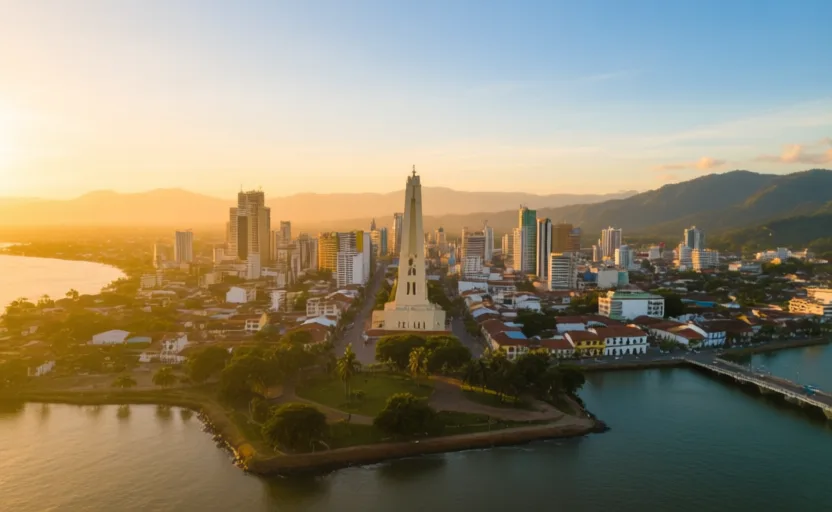 Santa Marta · AI city illustration · Artistic impression
City · Latin America
Santa Marta
Saved in this browser — no account needed. Sign in later and it comes with you.
Where it is
Santa Marta curls around a bay on Colombia’s Caribbean coast, with the sea to its north and west and the municipalities of Aracataca and Ciénaga to the south. It lies about 93 kilometres from Barranquilla and 992 kilometres from Bogotá, and the snow-capped Sierra Nevada, which the city’s blue flag evokes, stands behind it. The climate is tropical savanna edging toward semi-arid, with steady temperatures through the year: dry from December to April, wet from May to November. Because the centre hugs the shore, the built-up area has struggled to spread.
The land and water around it
Santa Marta Baybay
The city sits on the bay that shares its name, with the Caribbean to the north and west. Because the main centre lies so close to the coast, expansion has been hard to control.
The Sierra Nevadamountains
A snow-capped range rising behind the coast. The city’s flag uses blue for the sky, the sea and these peaks, a sign of how the town sees itself against the mountains.
A seasonal coastclimate
Temperatures hardly change through the year, so the calendar is set by rain: a dry season from December to April and a wet one from May to November.
Its history, in short
Before Europeans came, the coast belonged to the Tairona, who built stone pathways, terraces and small underground channels, farmed maize, pineapple and yucca, and gathered and traded salt. Records of them are thin, partly because of the climate and partly because Spanish conquerors destroyed or distorted what they found. Rodrigo de Bastidas founded Santa Marta on 29 July 1525. The town was among the earliest Spanish footholds in Colombia, the oldest that still stands, and second oldest in South America. The cathedral, an eighteenth-century building, once sheltered the remains of Bastidas and of Simón Bolívar, who died at a villa outside the centre. Today the port, fishing, farming and above all tourism carry the economy, with bananas, coffee, mango, citrus, cocoa and cassava as the main crops.
Timeline
Dates are shown on a timeline rather than as changing shapes on the map. The globe draws modern boundaries only, and tinting a modern outline to stand for a historical one would state something we cannot source.
Post-classical world
Before 1500
The Tairona coast
Tairona communities farm terraces, run protected waterways and trade salt, pottery, stonework and gold with peoples along the coast and inland.
Approximate dateWikipedia
Early modern & oceanic
1499
Spanish ships reach the Guajira
Alonso de Ojeda arrives at the Cabo de la Vela, the first European visit to the territory that became Colombia.
Well attestedWikipedia1500
Bastidas explores the coast
Rodrigo de Bastidas leads the first Spanish exploration of the Caribbean coast, 25 years before he founds the city.
Well attestedWikipedia29 July 1525
Founded by Rodrigo de Bastidas
The Spanish settle the bay. It becomes the oldest surviving city in Colombia and the second oldest in South America.
18th century
The cathedral is built
The Cathedral Basilica rises in the eighteenth century and later receives the remains of Bastidas and Bolívar.
Approximate dateWikipedia
Places that carry meaning
Cathedral Basilica of Santa Marta18th century
Among the oldest buildings in town, dating to the 1700s. After their deaths it housed the remains of the founder Bastidas and of Bolívar.
Quinta de San Pedro AlejandrinoIndependence era
The villa just outside the centre where Simón Bolívar died, a death of significance for South America as a whole.
Languages here
Places are usually multilingual. This lists what is actually spoken, not one language per border.
SpanishRomance family
The language of daily life and administration.
About 99.2 percent of Colombians speak Spanish, and Santa Marta, as one of the first Spanish settlements in the country, has used it longest.
Chibchan languages of the TaironaChibchan family
The languages of the coast before the Spanish.
The Tairona belonged to the Chibchan-speaking nations conquered by Spain. Little of their speech survives in the record, and the people themselves are known mainly from archaeology.
Learn the language here
- 1Understand which languages are spoken hereSanta Marta is multilingual. Start with which languages are used, by whom, and for what — the phrase list only covers one of them.Written by Globe Quest
- 2Learn 12 phrasesCurated everyday phrases for Santa Marta, with audio and a written form.Written by Globe Quest
- 3Say them out loudSpeaking practice with pronunciation feedback, one phrase at a time.Globe Quest material, your own additions
- 4Come back to themSpaced review, so what you learned this week is still there next month.Written by Globe Quest
Check yourself
Why is Santa Marta significant in Colombian history?
It is the oldest surviving Spanish city in Colombia
Rodrigo de Bastidas founded it in 1525, making it the oldest city that survives from the Spanish conquest in what is now Colombia.
Which people lived on this coast before the Spanish?
The Tairona
The Tairona built terraces, stone pathways and channels, traded salt, and left pottery, stonework and gold that archaeologists have recovered.
Worth arguing about
- Santa Marta is the oldest city that survives and also the place where Bolívar died. Which of the two histories does it present to visitors, and why?
- Tourism now leads the economy of a port with a bay, a mountain range and a thin written record of its first inhabitants. What gets lost when archaeology is the main source?
What we have not established
These are open questions, listed rather than filled in. We would rather show a gap than a plausible guess.
How large were the Tairona settlements on this coast, and how did they end?
Tropical weather, heavy rain and the destruction or misrepresentation of records by Spanish conquerors mean what is known rests largely on surviving terraces, channels and artefacts.
Sources
- Wikipedia · Santa MartaWikipedia · encyclopedia · checked 2026-11-24
- Wikipedia · ColombiaWikipedia · encyclopedia · checked 2026-11-24
Reviewed by Globe Quest editorial on 2026-11-24. Drafted with AI assistance and checked against the sources above before publication.