 Globe Quest
 Human Quest · LearningSign in
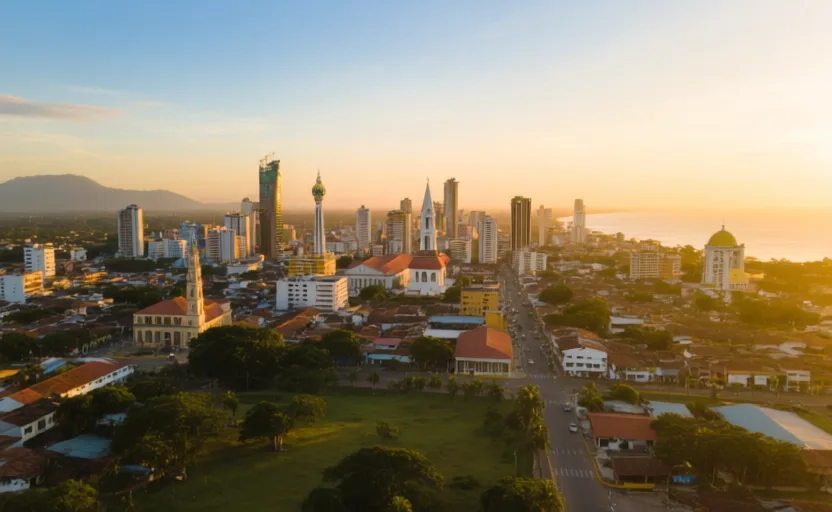 Barranquilla · AI city illustration · Artistic impression
City · Latin America
Barranquilla
Saved in this browser — no account needed. Sign in later and it comes with you.
Where it is
Where the Magdalena River nears the Caribbean, Barranquilla stands on the west bank of its delta, about 7.5 kilometres from the river mouth. Before the city spread, that distance was 25 kilometres. The climate is tropical savanna, hot and humid all year, averaging 28.4 °C with days near 32 °C, though trade winds cool the air from late November to early April. The natural cover is dry tropical forest, with cacti, mangroves and flame trees. The name comes from the barrancas, the ravines that cut the bank beside the river, and a nickname, La Arenosa, recalls the sand.
The land and water around it
The Magdalena deltadelta
The city’s reason for being. It stands on the western bank near the river’s mouth, serving as a port for both river and sea traffic. In 1909 Congress declared the opening of Bocas de Ceniza, at the river’s mouth, a national necessity.
The barrancasvalley
Ravines along the riverside gave the city its name. The word barranca was common in coastal Spanish settlements, so the name says more about the shape of the ground than about any founder.
A dry tropical coastclimate
Holdridge classes the vegetation as dry tropical forest. Heat is constant, but trade winds soften it between November and April.
Its history, in short
Barranquilla was neither a Spanish foundation nor an indigenous site. A traveller recorded canoes landing here in 1533, the Kamash people lived nearby, and a settlement formed around 1629. The town celebrates not a founding but the day in 1813 when Cartagena’s patriot government made it a villa for supporting the independence cause. Its importance came with steam. A river steamship route opened in 1825, linking the coast to the interior, and the town became a principal port for coffee exports. In the twentieth century it took in immigrants from Europe, and later from the Middle East and Asia, and became an early home of aviation: the first airline in South America, SCADTA, later Avianca, began here, and the airport of 1919 was South America’s first. By the 1940s it was Colombia’s second city and a byword for modernity, nicknamed the Golden Gate. Later, corruption in local administrations and investment flowing to other cities eclipsed that position. Its architecture is almost entirely twentieth century, and its Carnival is recognised by UNESCO.
Timeline
Dates are shown on a timeline rather than as changing shapes on the map. The globe draws modern boundaries only, and tinting a modern outline to stand for a historical one would state something we cannot source.
Early modern & oceanic
1533
First written mention
Gonzalo Fernández de Oviedo describes the site as a landing point for canoes from Santa Marta heading into the Magdalena, loaded with dried shrimp and salt to trade.
Well attestedWikipediac. 1629
A settlement forms
A permanent settlement is established around this date, near the earlier home of the Kamash people. No formal foundation is recorded, which is why the city does not celebrate one.
Approximate dateWikipedia
Industrial & imperial
7 April 1813
Made a villa
Manuel Rodríguez Torices, president-governor of the State of Cartagena, grants the title for the town’s defence of Cartagena against royalist Santa Marta. The date is celebrated as Barranquilla Day.
Well attestedWikipedia10 November 1825
Steamships on the Magdalena
The river route introduced by Juan Bernardo Elbers opens. It turns Barranquilla into a point of exchange with the interior and a major coffee port.
Well attestedWikipedia1910
Capital of Atlántico
After several reshufflings, a law of 14 July 1910 definitively establishes the Department of Atlántico with Barranquilla as its capital.
Well attestedWikipedia1919
Ernesto Cortissoz airport
The airport, the first in South America, opens, and the city becomes the first hub of Avianca, descended from the airline SCADTA.
Well attestedWikipedia
Contemporary
2003
The Carnival is recognised
UNESCO recognises the Carnival of Barranquilla, already declared national cultural heritage by Congress in 2001.
Well attestedWikipedia
Places that carry meaning
Centro histórico19th–20th centuries
The old town occupies a rectangle of streets bounded by Carreras 35 to 46 on one axis and Calles 30 to 46 on the other, reaching into San Roque and the downtown.
Museo RománticoRepublican era
A museum in a Republican mansion in the El Prado district, showing objects from the city’s history, among them carnival queens’ costumes.
Ernesto Cortissoz International Airport1919
Built in 1919 as South America’s first airport, and the first hub of Avianca. It is a physical sign of why the city called itself a gateway.
Languages here
Places are usually multilingual. This lists what is actually spoken, not one language per border.
SpanishRomance family
The language of nearly everyone in the city.
Almost all Colombians speak Spanish, and in the 2005 census only 0.4 percent of Barranquilla’s residents had been born abroad. The waves of migrants from Europe, the Middle East and Asia who arrived in the twentieth century shaped trade and society, but the city’s daily language remained Spanish.
Palenquero
A Creole language born on the Atlantic coast of Colombia.
Palenquero arose among Africans brought to Colombia through the Atlantic coast, some of whom escaped and built walled settlements called palenques. It is one of two Creole languages spoken in Colombia.
San Andrés Creole and English
English-based speech of the Caribbean islands.
On the Caribbean islands of San Andrés, Providencia and Santa Catalina, English is an official language and San Andrés Creole is spoken beside it. It is related to the English-based Creoles of the West Indies.
Indigenous languages
Spoken by smaller communities across the country.
Colombia has sixty-five Amerindian languages in twelve families and ten isolates, with around 850,000 speakers at least. These are national figures, and they are mostly not the languages of the city itself.
Learn the language here
- 1Understand which languages are spoken hereBarranquilla is multilingual. Start with which languages are used, by whom, and for what — the phrase list only covers one of them.Written by Globe Quest
- 2Learn 12 phrasesCurated everyday phrases for Barranquilla, with audio and a written form.Written by Globe Quest
- 3Say them out loudSpeaking practice with pronunciation feedback, one phrase at a time.Globe Quest material, your own additions
- 4Come back to themSpaced review, so what you learned this week is still there next month.Written by Globe Quest
Check yourself
Why does Barranquilla celebrate 7 April 1813 rather than a founding date?
It was never founded at a recorded moment; that day is when it was made a villa
The settlement grew up around 1629 without a formal foundation, so the town marks the day Cartagena’s government recognised it as a villa.
What turned Barranquilla into an important port in the nineteenth century?
Steamships on the Magdalena River
The area had no minerals and little interest for Spain. Steamships opened the river route to the interior in 1825, and coffee exports followed.
Worth arguing about
- The city was never founded and grew out of the river. Does a place that appears without a plan end up with the chaotic planning it is known for?
- Barranquilla was second in the country in the 1940s, then overtaken. What turns a leading port into a city that is told it has been left behind?
What we have not established
These are open questions, listed rather than filled in. We would rather show a gap than a plausible guess.
Which languages did the immigrant communities bring, and how long did they last?
Records name waves of newcomers from Europe, the Middle East and Asia, but give no figures for the languages they spoke or how quickly they shifted to Spanish.
Sources
- Wikipedia · BarranquillaWikipedia · encyclopedia · checked 2026-11-24
- Wikipedia · ColombiaWikipedia · encyclopedia · checked 2026-11-24
- Wikipedia · Languages of ColombiaWikipedia · encyclopedia · checked 2026-11-24
Reviewed by Globe Quest editorial on 2026-11-24. Drafted with AI assistance and checked against the sources above before publication.