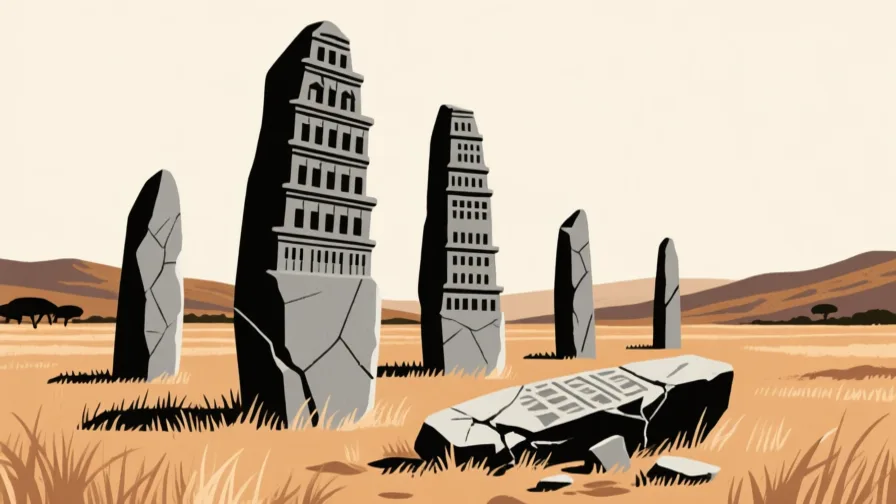
 Aksum · AI illustration, not a photograph
Historical place · Africa
Aksum
Also known as Axum, Akhsum
The centre of a trading kingdom in the northern Ethiopian highlands, known for its carved stelae and early adoption of Christianity.
Saved in this browser — no account needed. Sign in later and it comes with you.
Where it is
Aksum lies in the northern Ethiopian highlands, in Tigray, at around 2,100 metres on a plateau that gets reliable summer rain when the lowlands around it do not. It sat between the Red Sea — reached through its port at Adulis — and the interior that produced gold, ivory and incense, which is the whole commercial logic of the place: a highland capital positioned to tax what moved between an ocean and a hinterland.
The land and water around it
The Tigray plateauplateau
High ground with a summer monsoon, which made rain-fed agriculture possible where the surrounding lowlands are arid. Altitude here is not a hardship but the reason a state was possible.
The Red Sea corridorsea
Reached from the highlands by a descent to Adulis on the coast. Whoever held both the port and the plateau controlled the exchange between the Indian Ocean trade and the African interior.
The stelae fieldplateau
The ground north-west of the town, where carved granite monoliths were raised over tombs. The stone came from a quarry a few kilometres away; how the largest were moved and raised is not established.
Its history, in short
From roughly the first to the seventh century CE, Aksum was the centre of a kingdom that minted its own coinage in gold, silver and bronze, wrote in its own script, controlled the Red Sea trade at its end, and at times held territory across the water in southern Arabia. A third-century Persian text lists it among the great powers of the world alongside Rome, Persia and China. Its king converted to Christianity in the fourth century, making this one of the earliest Christian states anywhere. The kingdom declined from the seventh century as Red Sea trade reorganised and the environment around the capital degraded. The town remains the ceremonial centre of the Ethiopian Orthodox Tewahedo Church.
Timeline
Dates are shown on a timeline rather than as changing shapes on the map. The globe draws modern boundaries only, and tinting a modern outline to stand for a historical one would state something we cannot source.
Classical world
1st century CE
A port and a kingdom
A Greek merchants' handbook of the Red Sea describes Adulis and the inland capital, its ruler and the goods traded. It is the earliest external description of the kingdom.
Approximate dateEncyclopædia Britannicac. 3rd century
Coinage
Aksum begins minting in gold, silver and bronze, with legends in Greek for external trade and in Ge'ez for domestic use. Very few states outside Rome, Persia and India were striking gold at all.
Approximate dateEncyclopædia Britannicac. 330s
The kingdom becomes Christian
King Ezana converts, and the coinage changes: the disc and crescent give way to the cross. The coins date the conversion better than any text does, which is a rare case of numismatics settling a religious chronology.
Approximate dateEncyclopædia Britannicac. 4th century
The great stelae
The largest carved monoliths are raised — one of about 24 metres standing, and a larger one of some 33 metres that broke, probably during erection, and lies where it fell. It would have been the largest single stone block ever raised by anyone.
Approximate dateUNESCO World Heritage Centre
Post-classical world
c. 520s
Across the water
Aksum intervenes in Himyar in southern Arabia. The episode shows a state operating across a sea, and it is recorded from several sides — Aksumite, Byzantine, and South Arabian — which do not agree on motive.
DisputedEncyclopædia BritannicaAksumite, Byzantine and South Arabian accounts each frame the intervention differently — as religious protection, as Byzantine proxy action, or as conquest. The event is established; the motive is not.
7th century onward
Decline
The capital's importance falls away as Red Sea trade reorganises and the political centre shifts south. Soil exhaustion and deforestation around the capital are also proposed as contributing causes.
Approximate dateEncyclopædia Britannica
Industrial & imperial
1937–2008
A stele leaves and comes back
Italian forces take one of the great stelae to Rome in 1937. It is returned in 2005 after decades of negotiation and re-erected in 2008 — one of the few large-scale restitutions actually completed.
Well attestedUNESCO World Heritage Centre
Contemporary
2020–2022
War in Tigray
Conflict in the region cuts the site off, and reports of damage and looting at heritage sites across Tigray circulate without independent verification being possible at the time.
DisputedUNESCO World Heritage CentreReports of damage came from parties to the conflict and from diaspora networks while independent access was blocked. The scale of damage at Aksum specifically is not independently established.
Places that carry meaning
The Church of Our Lady Mary of ZionFounded 4th century; rebuilt repeatedly
The chapel beside it is held by the Ethiopian Orthodox Church to hold the Ark of the Covenant. One monk is appointed guardian and nobody else may enter, so the claim is by its nature not open to examination.
The presence of the Ark is an article of Ethiopian Orthodox Tewahedo tradition, held and transmitted by that church. It is recorded here as their claim, not as an established fact.
The fallen stelec. 4th century
About 33 metres of carved granite lying broken on the ground, cut to look like a many-storeyed building with false doors and windows. Its failure is as informative as the standing ones: it marks the limit of what the technique could do.
The Ezana stone4th century
An inscription in three scripts — Ge'ez, Sabaean and Greek — recording the king's campaigns. A trilingual is exactly what the Indus civilisation lacks, and it is why Aksum can be read.
Languages here
Places are usually multilingual. This lists what is actually spoken, not one language per border.
Ge'ezSemitic family
The kingdom's written language, and still the liturgical language of the Ethiopian Orthodox Church.
Its script began as a consonantal alphabet and became a syllabary, with vowels marked by modifying each consonant — a development that happened here rather than being borrowed. Ge'ez stopped being spoken but never stopped being used.
TigrinyaSemitic family
The language of the region today.
Descends from the same branch as Ge'ez and is written in the same script. Spoken across the Ethiopia–Eritrea border, which is one reason that border has been so bitterly contested.
AmharicSemitic family
Ethiopia's federal working language.
Also written in the Ge'ez script. Its status as the language of government has been a live political grievance for speakers of Oromo, Tigrinya and Somali, and the constitution's recognition of regional languages is a direct response to it.
Learn the language here
Check yourself
What do Aksum's coins settle that texts do not?
The date of the royal conversion to Christianity
The disc and crescent give way to the cross, which dates the conversion more precisely than any surviving text.
What is unusual about the Ge'ez writing system?
It became a syllabary by modifying each consonant to mark its vowel
The vowel-marking development happened here rather than being imported, and the script is still in use for several languages.
Worth arguing about
- A stele was taken in 1937 and returned in 2008. Why are completed restitutions so rare?
- A claim nobody outside one appointed guardian may examine. How should a reference work record it?
What we have not established
These are open questions, listed rather than filled in. We would rather show a gap than a plausible guess.
How were the great stelae raised?
No contemporary account describes the method, and the broken 33-metre monolith is the only direct evidence about the limits of the technique. Reconstructions are inference from the quarry, the stone and the fall.
What damage did the Tigray conflict do to the site?
Independent access was blocked during and after the fighting, and the reports available came from parties to the conflict. We record that the question is open rather than repeating an unverified assessment.
Sources
- UNESCO · AksumUNESCO World Heritage Centre · intergovernmental · checked 2026-09-08
- Britannica · AksumEncyclopædia Britannica · encyclopedia · checked 2026-09-08
- Britannica · Geʿez languageEncyclopædia Britannica · encyclopedia · checked 2026-09-08
- Britannica · Amharic languageEncyclopædia Britannica · encyclopedia · checked 2026-09-08
Reviewed by Globe Quest editorial on 2026-09-08.
Related places
Themes: Trade & exchange, Religion & pilgrimage, Empires & independence