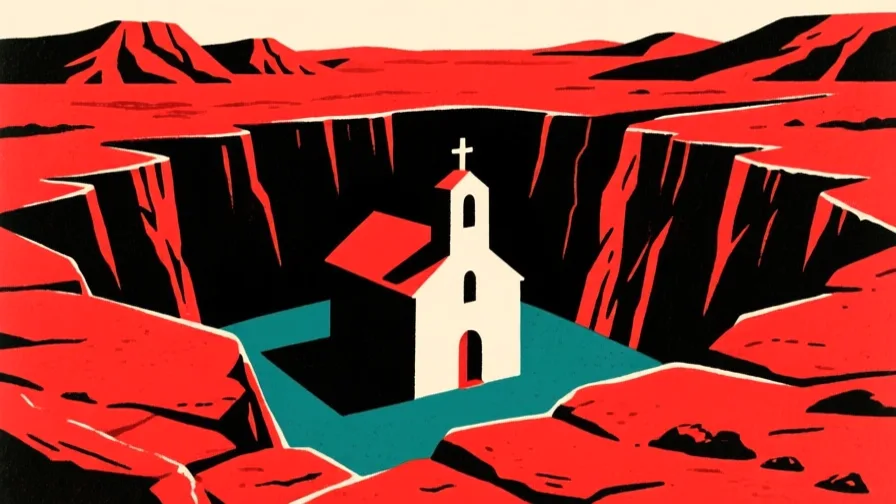
 Lalibela · AI illustration, not a photograph
Historical place · Africa
Lalibela
Also known as Roha
A highland town whose churches are cut downward into solid rock rather than built up from the ground.
Saved in this browser — no account needed. Sign in later and it comes with you.
Where it is
Lalibela is a town in the Ethiopian highlands of Amhara, at around 2,500 metres, on a slope of soft red volcanic tuff. That rock is the reason the place exists in the form it does: it is soft enough to cut with hand tools and hard enough to stand once cut. The churches here were not built. They were excavated — trenches cut down into the hillside to isolate a block of rock, which was then carved from the outside in and hollowed out, so that a finished church stands below ground level in its own pit.
The land and water around it
The volcanic tuffplateau
Soft, workable, and consistent enough to carve a roof and columns from a single mass. It is also porous, so water gets in — which is the conservation problem, and the reason for the shelters over several churches.
The Jordan Riverriver
The name given to the stream running through the site, part of a naming scheme that maps Jerusalem onto the landscape — a Golgotha, a Tomb of Adam, a Mount Tabor. The topography was renamed rather than reproduced.
The Lasta highlandsmountains
Steep, high country that kept the region defensible and hard to reach. Isolation preserved the site and also kept it out of most external accounts until the sixteenth century.
Its history, in short
The churches are traditionally attributed to King Lalibela of the Zagwe dynasty around the turn of the thirteenth century, in an account that says they were made to give Ethiopia a Jerusalem of its own after the routes to the original became difficult. Modern study suggests a longer and messier story — several phases of cutting over centuries, some structures possibly beginning as fortifications or as earlier rock-cut work and later adapted to churches. They have never been ruins: eleven churches remain in continuous liturgical use by the Ethiopian Orthodox Tewahedo Church, and the town is a major pilgrimage destination, especially at Christmas.
Timeline
Dates are shown on a timeline rather than as changing shapes on the map. The globe draws modern boundaries only, and tinting a modern outline to stand for a historical one would state something we cannot source.
Post-classical world
12th–13th centuries
The Zagwe period
The Zagwe dynasty rules from this region, and the churches are traditionally credited to King Lalibela within it. Contemporary documentation is very thin; the attributions come from later hagiography.
Approximate dateEncyclopædia BritannicaThe attribution to King Lalibela rests on Ethiopian hagiographic tradition written down considerably later, not on contemporary record.
c. 13th century, in phases
Cut, not built
The churches are excavated from the rock. Archaeological and architectural study points to several phases rather than one campaign, and to some structures being adapted from earlier rock-cut work rather than conceived as churches.
DisputedUNESCO World Heritage CentreThe single-reign account is Ethiopian tradition; the multi-phase account comes from architectural and archaeological analysis. They have not been reconciled.
Early modern & oceanic
1520s
Described from outside
A Portuguese priest, Francisco Álvares, visits and writes the first European description, adding that he expects not to be believed. The churches were never lost — the town had been a pilgrimage centre throughout.
Well attestedEncyclopædia Britannica
Contemporary
1978
Inscribed as World Heritage
The rock-hewn churches are inscribed, among the earliest African sites on the list.
Well attestedUNESCO World Heritage Centre2008 onward
The shelters
Large temporary canopies are erected over several churches to keep rain off the porous tuff. They were intended as a short-term measure, they are widely disliked, and they are still there — a conservation decision that has become part of the site.
Well attestedUNESCO World Heritage Centre2021
The town changes hands
Lalibela is taken and retaken during the northern Ethiopian conflict. The churches were reported undamaged, though pilgrimage and the town's economy were badly disrupted.
Approximate dateUNESCO World Heritage Centre
Places that carry meaning
Bete GiyorgisTraditionally 13th century
A cross-shaped church cut from a single block in its own square pit, entered by a trench. It is the most photographed and probably the last of the group to be cut.
The tunnels and trenchesTraditionally 13th century
The churches are linked by cut passages and drainage channels, so the complex works as a single excavated landscape rather than a set of separate buildings.
The priests' librariesContinuous
Illuminated manuscripts in Ge'ez, held and used by the churches themselves rather than deposited in a national collection. The books are part of the liturgy, not part of an exhibition.
Languages here
Places are usually multilingual. This lists what is actually spoken, not one language per border.
AmharicSemitic family
The language of the town and region.
Written in the Ge'ez script. Amhara is the region, and Amharic the language that took the Ge'ez script into modern national use.
Ge'ezSemitic family
The liturgical language of the churches.
No longer spoken, still chanted daily. Priests learn it as a liturgical language much as Latin was learned, and the manuscripts here are written in it.
Learn the language here
Check yourself
How were the churches made?
Excavated downward from the surface and hollowed out
Trenches isolate a block of tuff, which is then carved outside-in — so a finished church stands below ground level in its own pit.
Why do canopies stand over several of the churches?
Because the tuff is porous and rain is destroying it
A temporary measure from 2008 that is still in place, and now part of how the site looks.
Worth arguing about
- A Jerusalem made by renaming a landscape rather than copying one. What does that say about what a pilgrimage site actually needs to be?
- The shelters are ugly and they are working. How much appearance should conservation be allowed to cost?
What we have not established
These are open questions, listed rather than filled in. We would rather show a gap than a plausible guess.
When were the churches cut, and in how many phases?
Ethiopian tradition credits a single reign; architectural and archaeological analysis points to several phases across a longer period, with some structures adapted from earlier work. The two accounts have not been reconciled and we present both.
Sources
- UNESCO · Rock-Hewn Churches, LalibelaUNESCO World Heritage Centre · intergovernmental · checked 2026-09-08
- Britannica · LalibelaEncyclopædia Britannica · encyclopedia · checked 2026-09-08
- Britannica · Geʿez languageEncyclopædia Britannica · encyclopedia · checked 2026-09-08
- Britannica · Amharic languageEncyclopædia Britannica · encyclopedia · checked 2026-09-08
Reviewed by Globe Quest editorial on 2026-09-08.
Related places
Themes: Religion & pilgrimage, Mountains, deserts & islands