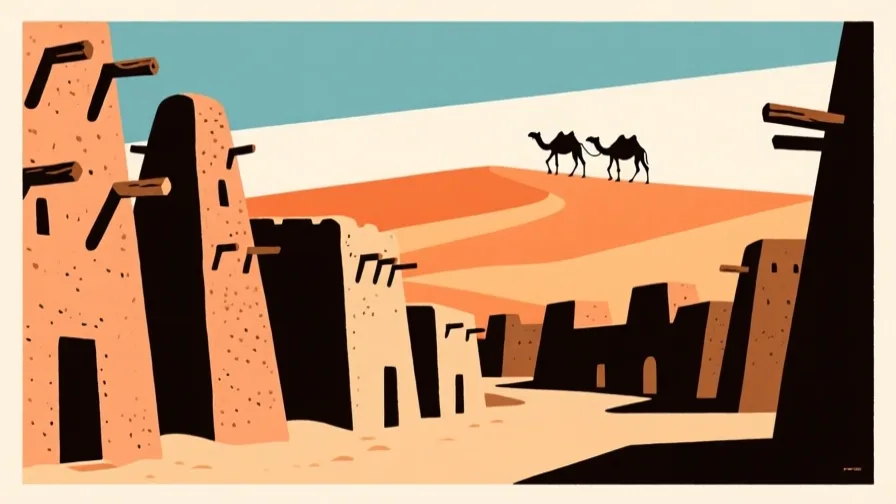
 Timbuktu · AI illustration, not a photograph
Historical place · Africa
Timbuktu
Also known as Tombouctou, Tinbuktu
A city on the Niger's northern bend that became a centre of trans-Saharan trade and of Islamic scholarship and manuscript copying.
Saved in this browser — no account needed. Sign in later and it comes with you.
Read its story
Where it is
Timbuktu stands a few kilometres north of the Niger, at the top of the river's great arc, where the water comes closest to the Sahara. That places it exactly at the seam between two transport systems: boats on the river to the south and west, camels across the desert to the north. Goods that cross the desert and goods that come up the river have to change vehicle somewhere, and the geography chooses here.
The land and water around it
The Niger's northern bendriver
The stretch where the river runs north-east toward the desert before turning south again. Everything about the town's position follows from this bend.
The Sahara's southern margindesert
The desert edge, whose caravan routes reached Saharan salt mines and, beyond them, North African markets.
Its history, in short
Founded as a seasonal camp and grown into a town, Timbuktu became wealthy on the exchange between the two systems and became a centre of Islamic learning as a result. It came under Mali and then Songhay authority, was taken by a Moroccan expedition at the end of the sixteenth century, and declined as Atlantic coastal shipping drew West African trade toward the sea. It has been under French colonial rule and then part of independent Mali, and in 2012 it was occupied by armed groups who destroyed several of its mausoleums.
Timeline
Dates are shown on a timeline rather than as changing shapes on the map. The globe draws modern boundaries only, and tinting a modern outline to stand for a historical one would state something we cannot source.
Post-classical world
c. 12th century
A settlement at the river's edge of the desert
A seasonal camp develops into a permanent settlement serving the meeting of river and desert traffic. Early dating rests on later written accounts and on archaeology, and is approximate.
Approximate dateUNESCO World Heritage Centre14th century
Under the Mali Empire
Timbuktu comes under the authority of Mali, whose rulers' wealth and pilgrimages drew notice as far as the Mediterranean world. Building of mosques including Djingareyber belongs to this period.
Well attestedUNESCO World Heritage Centre
Early modern & oceanic
Later 15th century
Under Songhay
The Songhay Empire takes control of the city, and Timbuktu's scholarly institutions reach their widest reputation under its rule.
Well attestedUNESCO World Heritage Centre1591
A Moroccan expedition takes the city
A force sent from Morocco, equipped with firearms, defeats Songhay and occupies Timbuktu. Scholars are deported and the city's institutional life is disrupted.
Well attestedUNESCO World Heritage Centre
Contemporary
1988
Inscribed as World Heritage
The mosques and the historic town are inscribed on the World Heritage List.
Well attestedUNESCO World Heritage Centre2012–2013
Occupation, destruction and evacuation
Armed groups occupy the city. Fourteen of the sixteen listed mausoleums of the saints are destroyed, three mosques are severely damaged, and 4,203 manuscripts are burned. The site is placed on the List of World Heritage in Danger. Residents and librarians move roughly 285,000 to 300,000 manuscript items out of the city, mainly to Bamako.
2014–2015
The mausoleums are rebuilt
Local masons rebuild the destroyed mausoleums in two phases using traditional technique — two near the Djingareyber Mosque in spring 2014, the remaining twelve between February and September 2015. They are consecrated in a ceremony in July 2015 and again in February 2016.
Well attestedGetty Publications2025
Still in danger, and weathering
The World Heritage Committee retains Timbuktu on the List of World Heritage in Danger and continues reinforced monitoring. Conservation work on the mosques has progressed, and heavy rain and flooding have damaged exterior wall finishes; a maintenance manual and conservation plan for the rebuilt mausoleums remain outstanding. Monitoring is constrained by a shortage of vehicles and staff.
Well attestedUNESCO World Heritage Centre
Places that carry meaning
Djingareyber Mosque14th century, with later rebuilding
An earthen mosque whose fabric is maintained by periodic re-plastering, a practice that makes the building's age a question about continuity rather than about original material.
Sankore Mosque and its teaching circles14th–16th centuries
A mosque associated with teaching. Describing it as a 'university' imports a European institutional model; scholarship here was organised around individual scholars and their students rather than around a chartered corporation.
Whether 'university' is an appropriate description is argued between scholars who see it as recognising an equivalent institution and those who see it as imposing a European category. Both readings are current.
DjennéContemporary with Timbuktu's rise
The upstream, river end of the same trading system, whose Great Mosque is re-plastered communally each year.
Languages here
Places are usually multilingual. This lists what is actually spoken, not one language per border.
SonghaySonghay family
A principal local language of the city and the middle Niger.
Spoken along the river through the region Timbuktu sits in, and the language of the empire that ruled the city in the fifteenth and sixteenth centuries.
TamasheqBerber family
Language of Tuareg communities of the surrounding desert.
The language of the desert side of the exchange, written in the Tifinagh script as well as in Arabic and Latin scripts.
ArabicSemitic family
The written and scholarly language of the manuscript tradition.
Most surviving Timbuktu manuscripts are in Arabic, and some are in African languages written in Arabic script — a body of writing sometimes called Ajami.
FrenchRomance family
Official language of Mali, used in administration and schooling.
A legacy of colonial rule, and the language of the state rather than of the street.
Learn the language here
- 1Understand which languages are spoken hereTimbuktu is multilingual. Start with which languages are used, by whom, and for what — the phrase list only covers one of them.Written by Globe Quest
- 2Practise with people: Arabic practice · DohaAn in-person practice circle. It is a prepared plan and needs a host before it runs.Run by members
- 3Read why the language is what it isThe quest for this place covers how its languages got here and who speaks them.Written by Globe Quest
Check yourself
What does Timbuktu's position at the Niger's bend give it?
A meeting point between river transport and desert caravans
It is where boats and camels exchange cargo, which is what made the town valuable.
Where were Timbuktu's manuscripts mainly held?
Across many private family collections
Dispersed private ownership is central to both the corpus's survival and the difficulty of counting it.
Worth arguing about
- Is 'university' the right word for Sankore, or does it import a category that does not fit?
- The manuscripts are private property, national heritage and world heritage at once. Who should decide where they are kept?
What we have not established
These are open questions, listed rather than filled in. We would rather show a gap than a plausible guess.
What is the total number of Timbuktu manuscripts?
Three institutional figures exist and they measure different things: roughly 285,000–308,000 items were physically evacuated to Bamako and counted or digitised, while UNESCO estimates the city's holdings at more than four hundred thousand volumes — an estimate of what exists, not a count. 'Manuscript' is not a stable unit either; the Hamburg count includes single folios and letters. Figures above 400,000 circulate without institutional backing. We give the counted range and the estimate separately rather than a single total.
Sources
- UNESCO · TimbuktuUNESCO World Heritage Centre · intergovernmental · checked 2026-09-07
- UNESCO · Old Towns of DjennéUNESCO World Heritage Centre · intergovernmental · checked 2026-09-07
- UNESCO · State of Conservation, Timbuktu (Mali), 2025UNESCO World Heritage Centre · intergovernmental · checked 2026-09-07
- Lazare Eloundou Assomo · Cultural Heritage at Risk in MaliGetty Publications · museum · checked 2026-09-07
- Safeguarding the Manuscripts of TimbuktuCentre for the Study of Manuscript Cultures, University of Hamburg · university · checked 2026-09-07
Reviewed by Globe Quest editorial on 2026-09-07.
Related places
Themes: Trade & exchange, Religion & pilgrimage, Indigenous & living cultures, Languages & contact