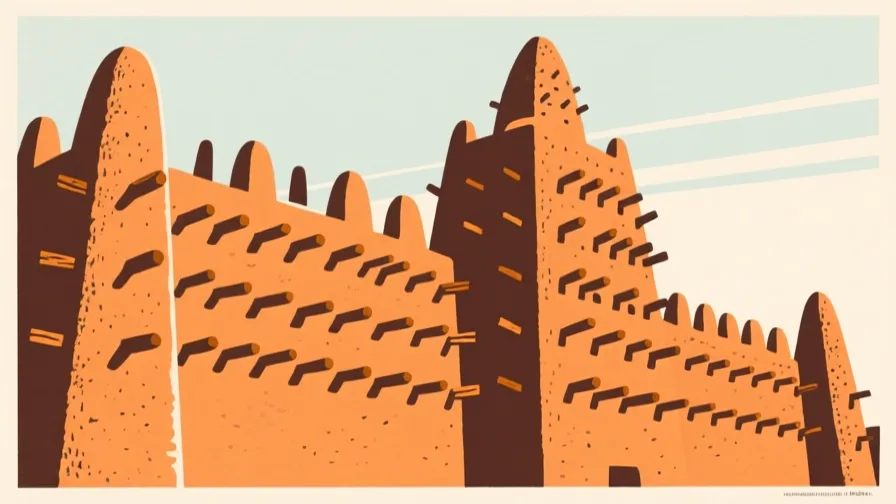
 Djenné · AI illustration, not a photograph
Historical place · Africa
Djenné
Also known as Jenne, Djenné-Djenno
A town of the Inner Niger Delta whose Great Mosque is rebuilt in mud brick by the community each year.
Saved in this browser — no account needed. Sign in later and it comes with you.
Where it is
Djenné stands on an island in the Bani river, a tributary of the Niger, in the Inland Niger Delta of central Mali. Each year the rivers flood an area the size of a small country, and the town sits above the water on ground that becomes an island for months. Everything is built of earth: sun-dried mud brick rendered in mud plaster, with bundles of palm timber projecting from the walls.
The land and water around it
The Inland Niger Deltadelta
Not a coastal delta but an inland floodplain where the Niger spreads out and loses much of its water to evaporation before rejoining a single channel. The flood is annual, enormous and the basis of the region's fishing, herding and farming calendar.
The Baniriver
The tributary that encircles the town. Its rise makes Djenné an island each year and its fall reconnects it, which historically set the trading season.
The toguere moundsbasin
Occupation mounds raised above flood level over centuries of building on the ruins of earlier building. Djenné-Djenno is one; the region holds many.
Its history, in short
Djenné-Djenno, a mound a couple of kilometres from the present town, was occupied from around the third century BCE and shows urban settlement in West Africa long before trans-Saharan trade — which mattered, because it undercut the assumption that African cities must have been prompted from outside. The later town became a commercial partner of Timbuktu, handling the river end of the gold, salt and slave trades and becoming a centre of Islamic learning. It came under successive states, then French rule, and its Great Mosque was rebuilt in 1907 in a form that is itself now the emblem of the architecture. Since 2016 Mali's security situation has kept researchers and visitors away and left the buildings dependent on a maintenance tradition under strain.
Timeline
Dates are shown on a timeline rather than as changing shapes on the map. The globe draws modern boundaries only, and tinting a modern outline to stand for a historical one would state something we cannot source.
Classical world
c. 3rd century BCE
Djenné-Djenno is settled
Occupation begins on the mound. Excavation from the 1970s showed a substantial urban settlement developing over centuries, with iron working and long-distance exchange, before trans-Saharan caravan trade reached the region.
Approximate dateUNESCO World Heritage Centre
Post-classical world
9th–14th centuries
A city, then an abandonment
The mound reaches its greatest extent and is then abandoned, while settlement shifts to the site of the present town. Why is not established; proposed reasons include the arrival of Islam and changing river conditions.
Approximate dateUNESCO World Heritage Centrec. 13th–14th centuries
Islam and the first Great Mosque
The ruler converts and a mosque is built. Its form is known only from later description; the building standing today is not it.
DisputedEncyclopædia BritannicaDates for the conversion and the first mosque come from later chronicles written in Timbuktu and from local tradition; they differ and cannot be independently checked.
Early modern & oceanic
15th–16th centuries
Under Songhai
Djenné is brought into the Songhai empire and prospers as the southern commercial partner of Timbuktu, with scholars moving between them.
Approximate dateEncyclopædia Britannica
Industrial & imperial
1893
French occupation
The town is taken by French forces during the conquest of the Niger bend. Administration, taxation and trade routes are reorganised around the colonial system.
Well attestedEncyclopædia Britannica1907
The mosque as it now stands
The Great Mosque is rebuilt on the site of the earlier one, under French administration. How much of the design is a continuation of the older building and how much is a colonial-era interpretation is argued — and the building is nonetheless the largest mud-brick structure in the world and a working mosque.
DisputedUNESCO World Heritage CentreThe degree of French involvement in the 1907 design is disputed between architectural historians and local accounts, which emphasise the town's own masons.
Contemporary
1988
Inscribed as World Heritage
The old towns of Djenné — the present town and the archaeological mounds — are inscribed together, which is unusual: a living town and its abandoned predecessor in one listing.
Well attestedUNESCO World Heritage Centre2016 onward
On the list of sites in danger
The property is placed on the List of World Heritage in Danger as Mali's security situation deteriorates, with deterioration of the earthen buildings and unchecked urbanisation among the stated concerns.
Well attestedUNESCO World Heritage Centre
Places that carry meaning
The Great Mosque1907, on a much older site
Rendered mud brick with projecting palm timbers that serve as permanent scaffolding for the annual re-plastering. The building is maintained by the town rather than preserved by a conservator.
Djenné-Djennoc. 250 BCE – c. 1400 CE
The mound whose excavation showed West African urbanism developing before trans-Saharan trade. Looting of terracotta figures for the art market has damaged its archaeology badly.
The masons' guildContinuing
The barey ton, the corporation of masons, holds the knowledge of building and rendering in earth and leads the annual re-plastering of the mosque. The building survives because a trade does.
The guild's structure, ranks and the practices around the re-plastering are held and transmitted by the masons of Djenné themselves rather than from a written archive.
Languages here
Places are usually multilingual. This lists what is actually spoken, not one language per border.
BozoMande family
Spoken by the fishing communities of the inland delta.
Bozo groups have long-standing arrangements with Fulani herders and Bambara farmers over who uses the floodplain and when — an agreement between livelihoods carried in part in language and kinship.
BambaraMande family
The most widely spoken language in Mali, and the town's lingua franca.
A Manding variety, mutually intelligible with several neighbours, and spoken as a second language by most Malians whatever their first.
ArabicSemitic family
The language of scholarship and of the manuscript tradition.
West African scholars wrote in Arabic and also used Arabic script to write their own languages — the ajami tradition, which means the region's written record is much larger than a search for Arabic-language texts alone would find.
FrenchRomance family
The official language of Mali.
The language of administration and secondary schooling, and a first language for very few — which is a common and consequential arrangement across the region.
Learn the language here
- 1Understand which languages are spoken hereDjenné is multilingual. Start with which languages are used, by whom, and for what — the phrase list only covers one of them.Written by Globe Quest
- 2Practise with people: Arabic practice · DohaAn in-person practice circle. It is a prepared plan and needs a host before it runs.Run by members
Check yourself
What did the excavation of Djenné-Djenno establish?
That urban settlement here predates trans-Saharan caravan trade
The city developed before the caravan trade arrived, which undercut the assumption that West African urbanism needed an external prompt.
What are the timbers projecting from the mosque's walls for?
Permanent scaffolding for the annual re-plastering
The building is re-rendered every year by the town, and the toron are what people stand on to do it.
Worth arguing about
- A building maintained annually by its community, rather than conserved by specialists. Which approach keeps more of a place?
- The mound proved a city existed before the trade that was supposed to have caused it. What other origins are we assuming came from outside?
What we have not established
These are open questions, listed rather than filled in. We would rather show a gap than a plausible guess.
How much of the 1907 mosque follows the older building?
Descriptions of the earlier mosque are brief and second-hand, and no measured record of it exists. The extent of French involvement in the rebuilding is disputed and we present it as such rather than settling it.
Sources
- UNESCO · Old Towns of DjennéUNESCO World Heritage Centre · intergovernmental · checked 2026-09-08
- UNESCO · TimbuktuUNESCO World Heritage Centre · intergovernmental · checked 2026-09-08
- Britannica · DjenneEncyclopædia Britannica · encyclopedia · checked 2026-09-08
- NASA Earth Observatory · Inland Delta of the Niger RiverNASA Earth Observatory · government · checked 2026-09-08
Reviewed by Globe Quest editorial on 2026-09-08.
Related places
Themes: Trade & exchange, Religion & pilgrimage, Rivers & cities