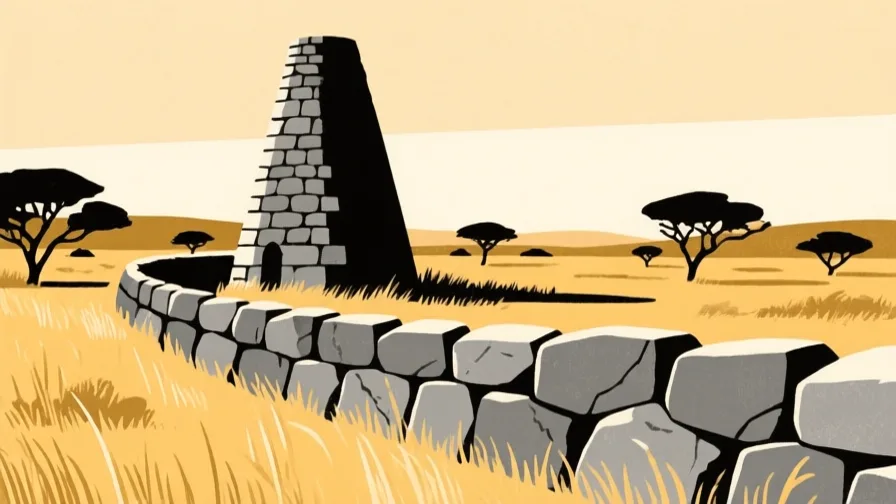
 Great Zimbabwe · AI illustration, not a photograph
Historical place · Africa
Great Zimbabwe
Also known as Dzimba dza mabwe
A large dry-stone settlement in southern Africa, built without mortar, that traded with the Indian Ocean coast.
Saved in this browser — no account needed. Sign in later and it comes with you.
Read its story
Where it is
Great Zimbabwe stands on a granite landscape in south-eastern Zimbabwe, between the Zambezi and Limpopo basins, on a plateau high enough to be relatively free of tsetse fly and therefore suitable for cattle. It is several hundred kilometres inland from the Indian Ocean coast. The local granite weathers into slabs, which is the material the site is built from.
The land and water around it
The Zimbabwean plateauplateau
High ground between the Zambezi and Limpopo, with grazing suitable for cattle and a granite geology that supplied the building material directly.
Its history, in short
The settlement grew from the eleventh century, reached its greatest extent in the thirteenth and fourteenth, and was largely abandoned by the fifteenth. It was the centre of a state whose wealth came from cattle, from gold, and from trade with the Indian Ocean coast. From the late nineteenth century European writers attributed the site to non-African builders, a claim that archaeological work contradicted from early on and that had official backing under Rhodesian rule. The country adopted the site's name at independence in 1980.
Timeline
Dates are shown on a timeline rather than as changing shapes on the map. The globe draws modern boundaries only, and tinting a modern outline to stand for a historical one would state something we cannot source.
Post-classical world
c. 11th century
Settlement begins
Occupation of the site begins and stone building follows. Dating rests on archaeological sequence and radiocarbon, and is given as a range rather than a year.
Approximate dateUNESCO World Heritage Centre13th–15th centuries
Greatest extent
The Great Enclosure and Hill Complex reach their full scale, and imported goods from the Indian Ocean trade appear in the material record.
Early modern & oceanic
c. 15th century
Largely abandoned
The site is left. Explanations offered include exhaustion of local resources, changing trade routes and political fragmentation; the relative weight of these is not settled.
DisputedUNESCO World Heritage CentreArchaeologists advance environmental, economic and political explanations for the abandonment. No single account commands consensus.
Industrial & imperial
1871 onward
European attribution to outsiders
European visitors and writers attribute the site to Phoenicians or other non-African builders. Excavation from the early twentieth century supports local construction, but the claim persists in official Rhodesian accounts.
Well attestedUNESCO World Heritage CentreRecorded here as a documented episode in the history of the site's interpretation, not as a competing archaeological account.
Contemporary
1980
Independence and a name
Zimbabwe takes its name from the site at independence, and the soapstone bird carved at Great Zimbabwe appears on the national flag.
Well attestedUNESCO World Heritage Centre1986
Inscribed as World Heritage
The monument is inscribed on the World Heritage List.
Well attestedUNESCO World Heritage Centre2017
The population estimate is challenged
A study in PLOS ONE argues that the site's areas were not all occupied simultaneously, that the absence of large waste deposits is inconsistent with a dense population, and that the total across the whole 800-year occupation is unlikely to have exceeded 10,000 people. Earlier estimates ranged from about 1,000 (Garlake) to 11,000 and then 18,000–20,000 (Huffman). The disagreement is methodological rather than evidential.
Chirikure and colleagues argue against the long-standing 18,000–20,000 peak-population figure; Huffman's earlier method assumed simultaneous occupation and applied a late-1960s Rhodesian population pyramid. UNESCO's own inscription text still says the population 'exceeded 10,000', so the listing and the current archaeology are in tension.
Places that carry meaning
The Great Enclosure13th–15th centuries
An elliptical dry-stone wall several hundred metres in circumference, with a solid conical tower inside. Its function is interpreted rather than known; elite residence and ritual use are both argued.
The enclosure's purpose is inferred from layout and finds. Archaeologists differ on whether it is primarily residential, ceremonial or both.
The Hill Complex11th century onward
The earliest built area, on a granite hill above the valley, incorporating natural boulders into its walls.
Languages here
Places are usually multilingual. This lists what is actually spoken, not one language per border.
ShonaBantu family
The language of the communities in the surrounding region, and of the site's builders' descendants.
'Dzimba dza mabwe', from which the site's name derives, is Shona for houses of stone. Shona is one of Zimbabwe's most widely spoken languages today.
EnglishGermanic family
An official language of Zimbabwe, used in administration and schooling.
A legacy of colonial rule, and the language most published archaeology of the site appears in.
Learn the language here
- 1Understand which languages are spoken hereGreat Zimbabwe is multilingual. Start with which languages are used, by whom, and for what — the phrase list only covers one of them.Written by Globe Quest
- 2Read why the language is what it isThe quest for this place covers how its languages got here and who speaks them.Written by Globe Quest
Check yourself
What are the walls made of and how are they held together?
Dressed granite laid in courses without mortar
Dry-stone granite, shaped and coursed, standing without mortar.
Which question about Great Zimbabwe is settled?
Who built it
Local construction is established. The abandonment and the enclosure's function remain debated.
Worth arguing about
- The site's authorship was denied for a century for political reasons. How would you tell whether a current interpretation is doing something similar?
- Which claims about a monument near you are observation, which inference, and which politics?
What we have not established
These are open questions, listed rather than filled in. We would rather show a gap than a plausible guess.
How much of the surrounding non-stone settlement has been surveyed?
Most residents would have lived in earthen housing that leaves far less trace than the walls. We have not identified a current published survey extent to cite, and the question matters: population estimates depend on it directly.
Sources
- UNESCO · Great Zimbabwe National MonumentUNESCO World Heritage Centre · intergovernmental · checked 2026-09-07
- UNESCO · Ruins of Kilwa Kisiwani and Ruins of Songo MnaraUNESCO World Heritage Centre · intergovernmental · checked 2026-09-07
- Chirikure et al. · What was the population of Great Zimbabwe (CE1000–1800)?PLOS ONE · journal · checked 2026-09-07
Reviewed by Globe Quest editorial on 2026-09-07.
Related places
Themes: Trade & exchange, Empires & independence, Indigenous & living cultures