 Globe Quest
 Human Quest · LearningSign in
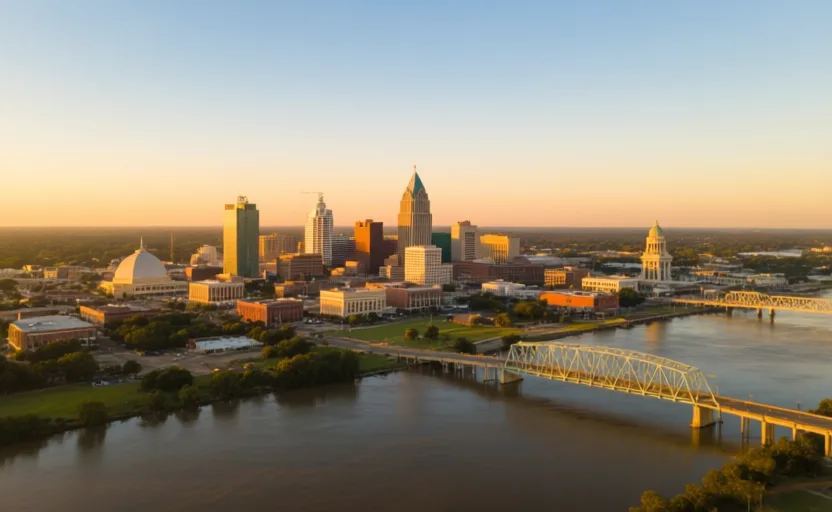 Baton Rouge · AI city illustration · Artistic impression
City · North America
Baton Rouge
Saved in this browser — no account needed. Sign in later and it comes with you.
Where it is
The city lies on the east bank of the lower Mississippi, in the Florida Parishes of south-eastern Louisiana, on the Istrouma Bluff: the first high ground a traveller meets going upriver from the delta. Dry land above the seasonal floods suited a trading post and then a port, while levees were later raised southward to protect the low farmland along the river. Elevation is modest, roughly 17 to 19 metres. The climate is humid subtropical, with about 141 centimetres of rain a year and a standing risk of Gulf hurricanes. Ocean-going ships can come this far upriver and no further, so cargo changes here between ship, rail, pipeline and barge.
The land and water around it
Istrouma Bluffbluff
The first natural rise on the river's east side above the delta. Its height kept a business quarter clear of seasonal flooding, which is why a fort, a town and later a capital grew here instead of on the low ground downstream.
The Mississippiriver
The river is both the reason for the port and the hazard behind the levees. Ocean-going tankers and cargo ships can reach Baton Rouge, and beyond it goods move on by barge, rail and pipeline.
The Gulf storm climateclimate
Hot, humid summers, heavy rain and exposure to the Gulf mean tornadoes and hurricanes are a year-round possibility. Hurricane Gustav in 2008 brought winds above 100 miles an hour and closed the city for five days, and Katrina in 2005 turned it into a refuge and relief headquarters.
Its history, in short
Hunter-gatherers raised earthwork mounds in this district from about the fourth millennium BCE, and later Muskogean-speaking societies belonged to the wider Mississippian world. When a French party under d'Iberville went upriver at the end of the 1690s, they noted a painted red pole marking the line between Houma and Bayagoula hunting grounds, and the city's French name translates that landmark. The French set up a military and trading post in the early 1720s. After 1763 the settlement belonged to British West Florida, then fell to Spanish forces under Bernardo de Gálvez in 1779, and in 1810 local settlers rebelled against Spain and briefly formed a Republic of West Florida before the United States took the district. Acadians expelled from eastern Canada settled to the west and south from 1765 and became the Cajuns. Steamboat trade fuelled growth, and the legislature chose Baton Rouge as capital in 1846. Union troops held the city from 1862, and the state government returned for good in 1882. Petrochemical plants along the river pulled the city outward in the mid-twentieth century.
Timeline
Dates are shown on a timeline rather than as changing shapes on the map. The globe draws modern boundaries only, and tinting a modern outline to stand for a historical one would state something we cannot source.
First cities & states
From the 4th millennium BCE
Mound builders
Hunter-gatherer societies build earthwork mounds along the Mississippi and the nearby Comite and Amite rivers. People had lived in the district for thousands of years before that.
Approximate dateWikipedia
Early modern & oceanic
1698 or 1699
The red pole
D'Iberville's expedition records a red-painted post set up by native nations to mark a boundary. The name Istrouma behind the French translation may come from Choctaw words for red pole. Accounts differ by a year on when the expedition passed.
About 1721
French post
French colonists establish a military and trading post on the bluff, after a fort is said to have been built nearby in 1719.
1779
Spanish capture
A Spanish force under Bernardo de Gálvez takes the British fort in the Battle of Baton Rouge and renames it Fort San Carlos. Britain turns West Florida over to Spain when the Revolutionary War ends.
Well attestedWikipedia
Industrial & imperial
1817
Incorporation
Baton Rouge is incorporated five years after Louisiana becomes a state. The US Army builds the Pentagon Barracks between 1819 and 1822, and the post stays a command centre through the Mexican–American War.
1862 to 1865
Union occupation
Union troops enter in May 1862 and stay for the rest of the war. Confederate forces under Breckinridge and Ruggles try to retake the town that summer, and the state government relocates elsewhere.
Well attestedWikipedia1882
The capital returns
After the Bourbon Democrats regain power, helped by intimidation and voter suppression of Black Republicans, the state government moves back from New Orleans and has stayed in Baton Rouge since.
Well attestedWikipedia
Contemporary
Mid-20th century onward
Petrochemical boom
Refineries and chemical plants along the river expand the city well beyond its original centre. A corridor of 85 miles toward New Orleans, known as “Cancer Alley”, has a mostly African-American population and high rates of cancer and premature birth, which researchers link mainly to industrial air pollution.
Places that carry meaning
Scott's Bluff and the red pole siteBefore 1698
The pole is presumed to have stood on the bluff where Southern University's campus now sits. It was reported as about thirty feet tall and hung with fish bones, a boundary marker between two nations rather than a settlement.
Pentagon BarracksCompleted 1822
A barracks complex used in turn by Spanish, French and British authorities, then by the Confederate and US armies. It passed to the state in 1951 and is on the National Register of Historic Places.
Old Louisiana State CapitolBegun 1847
James Dakin designed the first statehouse in Gothic Revival style, with turrets, battlements and stained glass, rather than copying the national Capitol. It overlooks the river and is a National Historic Landmark.
Languages here
Places are usually multilingual. This lists what is actually spoken, not one language per border.
EnglishGermanic family
The everyday language of the city and the de facto national language.
Across the United States 77 per cent of people speak only English at home, and English is the working language here, even though French survives in the surrounding parishes.
Louisiana FrenchRomance family
A regional French spoken across ethnic lines, especially in the southern parishes.
Linguists prefer this name to “Cajun French” because speakers include Cajuns, Creoles and members of several Native nations. French is the second most spoken language in Louisiana, and the state runs an agency to support it. Acadian exiles settled the region near Baton Rouge from 1765.
ChoctawMuskogean family
Possibly the source of the words behind the city's name.
The name Istrouma may be a corruption of Choctaw iti humma, “red pole”. Choctaw speakers are also counted among the Louisiana communities who speak French.
Learn the language here
- 1Understand which languages are spoken hereBaton Rouge is multilingual. Start with which languages are used, by whom, and for what — the phrase list only covers one of them.Written by Globe Quest
- 2Learn 12 phrasesCurated everyday phrases for Baton Rouge, with audio and a written form.Written by Globe Quest
- 3Say them out loudSpeaking practice with pronunciation feedback, one phrase at a time.Globe Quest material, your own additions
- 4Come back to themSpaced review, so what you learned this week is still there next month.Written by Globe Quest
Check yourself
What was the original “red stick” that gave Baton Rouge its name?
A painted pole marking the boundary between two nations' hunting grounds
D'Iberville's party saw a red post that Houma and Bayagoula people had set up as a boundary. The French name is a translation of the native word for it.
Why did a town and port grow on this stretch of the Mississippi?
It was the first natural bluff above the delta, safe from seasonal floods
Downstream the land is low delta. The Istrouma Bluff gave dry ground, and ocean-going ships can still travel this far upriver.
Worth arguing about
- Baton Rouge was governed by six different powers in its first two centuries. What does a place keep from rulers who each stayed only briefly?
- A port that brings jobs also sits at the end of a corridor with high cancer rates. Who should carry the cost of an industrial river?
What we have not established
These are open questions, listed rather than filled in. We would rather show a gap than a plausible guess.
When was Baton Rouge first fortified or settled by the French?
Accounts give 1719 for a French fort and 1721 for a military and trading post, and date the d'Iberville expedition to 1698 in some places and 1699 in others. The order of events is clear but the exact years are not.
Sources
- Wikipedia · Baton Rouge, LouisianaWikipedia · encyclopedia · checked 2026-11-24
- Wikipedia · History of Baton Rouge, LouisianaWikipedia · encyclopedia · checked 2026-11-24
- Wikipedia · Languages of the United StatesWikipedia · encyclopedia · checked 2026-11-24
Reviewed by Globe Quest editorial on 2026-11-24. Drafted with AI assistance and checked against the sources above before publication.