 Globe Quest
 Human Quest · LearningSign in
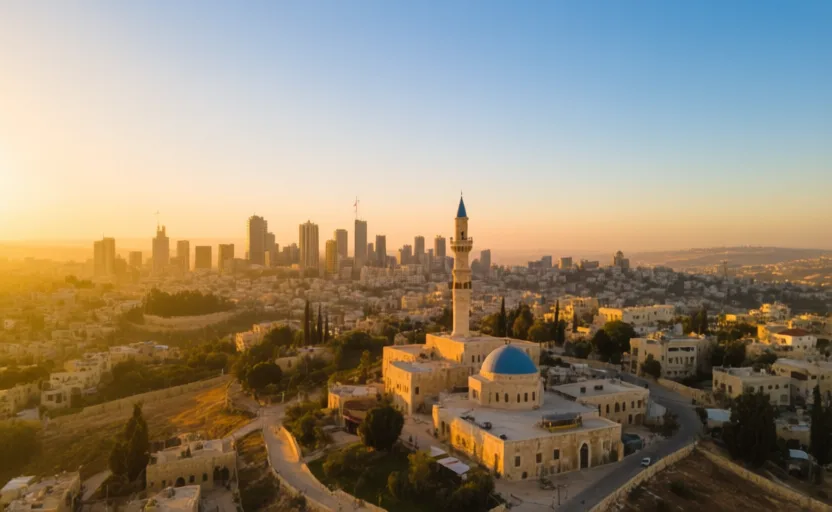 Beersheba · AI city illustration · Artistic impression
City · Middle East
Beersheba
Saved in this browser — no account needed. Sign in later and it comes with you.
Where it is
Where the farmland of the north gives way to the Negev, about 260 metres above sea level, Beersheba lies in a valley where winter flood water from the Hebron hills runs underground and stays within reach of wells. That water is why a settlement has stood here for thousands of years in a place that gets only about 195 mm of rain a year. The climate is hot desert, bordering on semi-arid, with summer highs near 35 °C, rare snow, and sandstorms. Tel Aviv is 115 km to the north-west and Jerusalem 120 km to the north-east, and the city sits at the crossroads of routes to Hebron and Jerusalem, the Dead Sea, Aqaba and Gaza.
The land and water around it
The Negev’s northern edgedesert
The city is on the line between the semi-arid north Negev and the farmed country beyond. Loess plains and dry river beds lie to the north-east, and the Goral hills, 300 to 500 metres high, rise just north-west.
Nahal Be’er Sheva and the wadisvalley
The Beersheba stream and the Kovshim and Katef wadis cross the city. Winter water comes down from the Hebron hills and is stored underground, which explains the many ancient wells. The stream was long a dumping ground and in recent years has been turned into a riverside park.
Its history, in short
Copper Age people lived in caves here, and in the 10th century BCE a planned town with gridded streets rose at Tel Be’er Sheva, 4 km east of today’s centre; the Bible makes Beersheba the southern limit of ancient Israel, in the phrase “from Dan to Beersheba”. Persians built a citadel, Rome and Byzantium used the place as part of a defence line against desert raiders, and by the eighth century it had been abandoned. For centuries it was a well and a market for Bedouin. The modern town was founded by the Ottomans about 1900 as an administrative centre for the Bedouin of the Negev, and had about 1,000 residents. The Ottoman railway reached it in 1915 and Allied forces took it in 1917. In 1948 it was occupied by Egyptian forces and then captured by Israel, and most of its Arab residents left or were expelled. Since then it has been built up as an Israeli city, with Jewish immigrants from Arab countries, India, the Soviet Union and Ethiopia, and with a university and a technology park.
Timeline
Dates are shown on a timeline rather than as changing shapes on the map. The globe draws modern boundaries only, and tinting a modern outline to stand for a historical one would state something we cannot source.
First cities & states
4th millennium BCE
Copper Age settlement
People live in caves near Tel Be’er Sheva, making metal tools and raising cattle. The habitation goes back 5,000 to 6,000 years.
Approximate dateWikipedia10th century BCE
Tel Be’er Sheva
An early Israelite town stands on a mound east of the modern city, with streets in a grid and separate areas for administration, commerce, troops and housing. The Bible credits Abraham and Isaac with digging the wells.
Approximate dateWikipedia
Classical world
4th–7th century
A Byzantine frontier post
Beersheba becomes a key point on a defence line, the Limes Palaestinae, built against desert tribes. It falls to the Arabs in the seventh century and is abandoned by the late eighth.
Approximate dateWikipedia
Industrial & imperial
1906
The Great Mosque
Ottoman authorities build the mosque with donations from the Negev Bedouin, as part of a new town meant to administer them.
Well attestedWikipedia1915
The railway
A military line branching from the Hejaz railway reaches Beersheba, with the station opened on 30 October 1915 in the presence of the Ottoman commander Jamal Pasha. It is now part of Israel’s railway network.
Well attestedWikipedia1917
The Battle of Beersheba
British-led forces, including Australian Light Horse troops, take the town during the Sinai and Palestine Campaign and capture the railway.
Well attestedWikipedia
Contemporary
1948–1949
Capture by Israel
A UN committee proposed putting Beersheba in the Jewish state, but the plan was revised and it went to the Arab state because its population was Arab. Egyptian forces were stationed there from May 1948, and in October the Israel Defense Forces took it. The 1949 armistice formally awarded the town to Israel.
DisputedWikipediaPalestinians, who place the town’s emptying within the Nakba, and Israeli accounts. Sources agree that part of the Arab population was expelled, and the town became an Israeli city with a very small Arab minority.
2011
The Great Mosque becomes a museum
Israel’s Supreme Court, sitting as the High Court of Justice, orders the former mosque to be turned into a museum of Islam and not returned to use as a place of worship. The building had been a courthouse until 1953 and then an archaeology museum.
Well attestedWikipedia
Places that carry meaning
Tel Be’er Sheva10th century BCE
The mound of the biblical town on the city’s eastern edge, with a grid of streets and a good supply of water from wells.
The Great Mosque and the Ottoman Governor’s House1906 and early 20th century
Two Ottoman survivals from the town’s founding. The mosque is now a museum, and the Governor’s House holds the Negev Museum of Art, reopened in 2004.
Abraham’s wellAt least 12th century CE
A well that tradition links to the patriarch Abraham, dated at least to the twelfth century CE and now inside a visitors’ centre.
The Nabataean desert towns3rd century BCE–2nd century CE
Haluza, Mamshit, Avdat and Shivta lie further out in the Negev along the Incense Route that carried frankincense from south Arabia to the Mediterranean. They are known for water-collecting systems that made farming possible in the desert.
Languages here
Places are usually multilingual. This lists what is actually spoken, not one language per border.
HebrewSemitic family
The main language of the city.
Jews and others are 97.3 per cent of residents. Many descend from Sephardi and Mizrahi Jews who came from Arab countries after 1948, and there are also smaller Bene Israel and Cochin communities from India.
RussianSlavic family
A strong immigrant language since the 1990s.
Immigrants from the former Soviet Union made chess a major sport, and the city is Israel’s national chess centre.
ArabicSemitic family
The language of the Bedouin towns around the city.
Arabs are about 2.7 per cent of the city’s residents. Beersheba is surrounded by Bedouin localities such as Rahat, Tel as-Sabi and Lakiya, and the metropolitan area has roughly equal Jewish and Arab populations.
Learn the language here
- 1Understand which languages are spoken hereBeersheba is multilingual. Start with which languages are used, by whom, and for what — the phrase list only covers one of them.Written by Globe Quest
- 2Learn 12 phrasesCurated everyday phrases for Beersheba, with audio and a written form.Written by Globe Quest
- 3Say them out loudSpeaking practice with pronunciation feedback, one phrase at a time.Globe Quest material, your own additions
- 4Come back to themSpaced review, so what you learned this week is still there next month.Written by Globe Quest
- 5Practise with people: Arabic practice · DohaAn in-person practice circle. It is a prepared plan and needs a host before it runs.Run by members
Check yourself
Where does Beersheba sit in the landscape?
At the northern edge of the Negev desert
It lies in a valley on the northern edge of the Negev, 260 metres up, where winter water stored underground made wells possible.
How was the Great Mosque of Beersheba funded in 1906?
By Negev Bedouin donations in the Ottoman period
The Ottomans built the new town to administer the Bedouin, and the mosque was paid for by donations from Bedouin residents of the Negev. It is now a museum.
Worth arguing about
- A town founded by the Ottomans for Bedouin, captured in 1948, and rebuilt by immigrants from dozens of countries. Whose story does the Great Mosque, now a museum, tell?
- Beersheba’s plan calls for a population of up to half a million in a desert with 195 mm of rain. What would that mean for how water is managed?
What we have not established
These are open questions, listed rather than filled in. We would rather show a gap than a plausible guess.
How large is the Arab share of Beersheba?
City figures count Arabs at under 3 per cent, while the metropolitan area, which includes Bedouin towns like Rahat, is described as roughly half Arab. The answer depends on where the boundary of Beersheba is drawn.
Sources
- Wikipedia · BeershebaWikipedia · encyclopedia · checked 2026-11-24
- UNESCO · Incense Route - Desert Cities in the NegevUNESCO World Heritage Centre · intergovernmental · checked 2026-11-24
Reviewed by Globe Quest editorial on 2026-11-24. Drafted with AI assistance and checked against the sources above before publication.