 Globe Quest
 Human Quest · LearningSign in
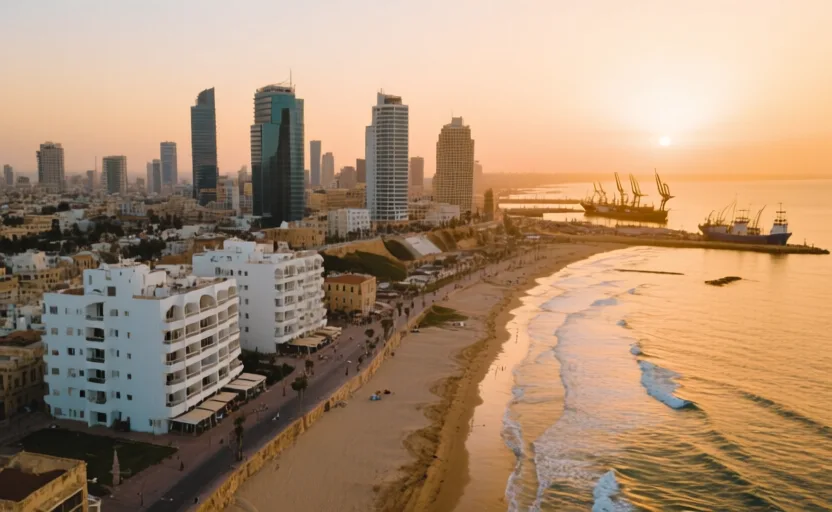 Tel Aviv · AI city illustration · Artistic impression
City · Middle East
Tel Aviv
Saved in this browser — no account needed. Sign in later and it comes with you.
Where it is
Tel Aviv was laid out on sand dunes on the Mediterranean shore, directly north of the old port of Jaffa. The ground is flat, with no real gradients, and was poor farmland, which is part of why it was cheap to buy and easy to plan. The few features are low bluffs above the sea and the mouth of the Yarkon River. The climate is Mediterranean, with about 528 mm of rain between October and April, a humid summer where August highs reach about 31 °C, and almost no frost. It sits 60 km north-west of Jerusalem and 90 km south of Haifa.
The land and water around it
The coastal dunescoast
The city occupies former sand hills on the Israeli Mediterranean shore. Their poor soil gave little reason to farm them, leaving an open strip that planners could lay out afresh in the 1900s and 1920s.
The Yarkon River mouthriver
The river reaches the sea at the northern edge of the built-up city and gives it a green corridor, Yarkon Park. It is one of the few real geographic features on an otherwise flat coastal plain.
Jaffa’s natural harbourharbour
A natural anchorage was used from the Bronze Age, which is why Jaffa existed centuries before Tel Aviv. Ships could not tie up at the 1930s Tel Aviv port, so passengers and goods were moved by small boat, as at Jaffa.
Its history, in short
Jaffa, just south, is the older city: a harbour in use since the Bronze Age and passed between Canaanites, Egyptians, Philistines, Romans, Crusaders, Mamluks and Ottomans. Tel Aviv began in 1909 as Ahuzat Bayit, a garden-suburb housing estate that a society of Jewish families, many from Jaffa, built on the dunes outside it. It took the name Tel Aviv in 1910 from the Hebrew translation of Theodor Herzl’s novel Altneuland. Under British rule it grew fast, became a separate municipality in 1934, and received many Jewish immigrants from Nazi Germany in the 1930s, a decade in which Europe-trained architects put up the modernist buildings now called the White City. Israel’s declaration of independence was proclaimed here in 1948, and the government stayed until it moved to Jerusalem in 1949. In 1950 the two towns were merged as Tel Aviv-Yafo. After a long decline from the 1960s, the population recovered in the 1990s when immigrants from the former Soviet Union arrived and the city became a centre for technology.
Timeline
Dates are shown on a timeline rather than as changing shapes on the map. The globe draws modern boundaries only, and tinting a modern outline to stand for a historical one would state something we cannot source.
First cities & states
by c. 1800 BCE
Jaffa established
Settlement at Jaffa goes back to about 7500 BCE, and the city existed by about 1800 BCE at the latest. Its harbour made it one of the region’s main ports for millennia.
Approximate dateWikipedia
Industrial & imperial
1909
Ahuzat Bayit founded
Jewish families draw lots for plots on the dunes north of Jaffa. The estate is renamed Tel Aviv a year later. Land was bought in the name of a Dutch citizen to get around an Ottoman ban on Jewish land purchases.
1925–1927
The Geddes plan
Sir Patrick Geddes, a leading planning theorist, designs the northward expansion. It is his only large-scale urban plan, and it provides the street pattern for the White City.
Well attestedUNESCO World Heritage Centre1934
Independence from Jaffa
Tel Aviv becomes a separate municipality. Immigration from Nazi Germany accelerates and its growth outpaces that of Jaffa, then mostly Arab.
Well attestedWikipedia
Contemporary
1948
Independence declared in Tel Aviv
Israel’s declaration of independence is proclaimed here, and Tel Aviv serves as the temporary seat of government until it moves to Jerusalem in December 1949. Egyptian air raids and shelling during the war killed about 150 people in the city.
Well attestedWikipedia1950
Merger with Jaffa
Tel Aviv began annexing parts of Jaffa after the 1947–1949 war and was fully joined with it in April 1950, becoming Tel Aviv-Yafo in August that year.
Well attestedWikipediaEarly 1980s
Embassies move
Thirteen embassies leave Jerusalem for Tel Aviv after the UN’s response to Israel’s 1980 Jerusalem Law. Most national embassies remain in or near Tel Aviv today.
Well attestedWikipedia2003
The White City is listed
UNESCO inscribes the central White City, Lev Hair with Rothschild Avenue, and the Bialik area, for what it calls an outstanding large-scale application of early modern town-planning ideas.
Places that carry meaning
The White City1930s
A cluster of modernist buildings by architects trained in several European countries, adapted to the local heat and light. Together they make up the biggest gathering of International Style architecture anywhere, Bauhaus-related work included.
Neve TzedekLate 19th century
The oldest of the Jewish suburbs built outside Jaffa, known for two-storey sandstone houses, and restored from the late twentieth century.
Old JaffaBronze Age onward
The walled port town is the only urban centre in the city that predates the twentieth century. Its Arab population shrank sharply after 1948, and gentrification is now replacing many remaining residents with young professionals and artists.
Languages here
Places are usually multilingual. This lists what is actually spoken, not one language per border.
HebrewSemitic family
The everyday language of the city.
Tel Aviv was founded to be a Hebrew-speaking town in a country where Hebrew was being revived as a spoken language. Its early cinema, theatres and record companies were Hebrew-language institutions.
ArabicSemitic family
Spoken by the Arab residents of Jaffa and other neighbourhoods.
Arabs were about 4.5 per cent of residents in 2019, mostly Muslims and about one in six Christians. Jaffa, with its historic Arab majority, is where the language is most heard.
RussianSlavic family
A major immigrant language since the 1990s.
The city absorbed 42,000 immigrants from the former Soviet Union in the 1990s, many of them engineers and scientists. It also has many other languages from foreign workers and asylum seekers, including those from Sudan and Eritrea.
Learn the language here
- 1Understand which languages are spoken hereTel Aviv is multilingual. Start with which languages are used, by whom, and for what — the phrase list only covers one of them.Written by Globe Quest
- 2Learn 12 phrasesCurated everyday phrases for Tel Aviv, with audio and a written form.Written by Globe Quest
- 3Say them out loudSpeaking practice with pronunciation feedback, one phrase at a time.Globe Quest material, your own additions
- 4Come back to themSpaced review, so what you learned this week is still there next month.Written by Globe Quest
- 5Practise with people: Arabic practice · DohaAn in-person practice circle. It is a prepared plan and needs a host before it runs.Run by members
Check yourself
What was Tel Aviv called when it was founded in 1909?
Ahuzat Bayit
The housing society was called Ahuzat Bayit, roughly ‘house estate’. The name Tel Aviv, from the Hebrew translation of Herzl’s novel Altneuland, was chosen in 1910, ahead of Herzliya and other suggestions.
What gave the White City its street plan?
Patrick Geddes’s plan of the 1920s
Geddes drew up a master plan in 1925–1927 based on an environmental approach to the city. It is his only large-scale plan to be built, and the modernist architects of the 1930s filled it in.
Worth arguing about
- Tel Aviv and Jaffa share one municipality but were separate for decades, with different majorities and different founding stories. Whose history does the shared name carry?
- A city built on poor dunes with a plan, then planned again and again: is it easier to plan a city on land nobody farmed, and what does that leave out?
What we have not established
These are open questions, listed rather than filled in. We would rather show a gap than a plausible guess.
Is Tel Aviv Israel’s largest city?
It depends on whether East Jerusalem, whose status is disputed internationally, is counted within Jerusalem. With it, Jerusalem is larger; without it, Tel Aviv is. The Tel Aviv metropolitan area, Gush Dan, is far larger than the city proper.
When did Tel Aviv’s port open?
Accounts give 1936 and 1938 as the opening year, and the port closed in 1965. The two dates have not been reconciled.
Sources
- Wikipedia · Tel AvivWikipedia · encyclopedia · checked 2026-11-24
- Wikipedia · History of Tel AvivWikipedia · encyclopedia · checked 2026-11-24
- UNESCO · White City of Tel-Aviv – the Modern MovementUNESCO World Heritage Centre · intergovernmental · checked 2026-11-24
- Wikipedia · IsraelWikipedia · encyclopedia · checked 2026-11-24
Reviewed by Globe Quest editorial on 2026-11-24. Drafted with AI assistance and checked against the sources above before publication.