 Globe Quest
 Human Quest · LearningSign in
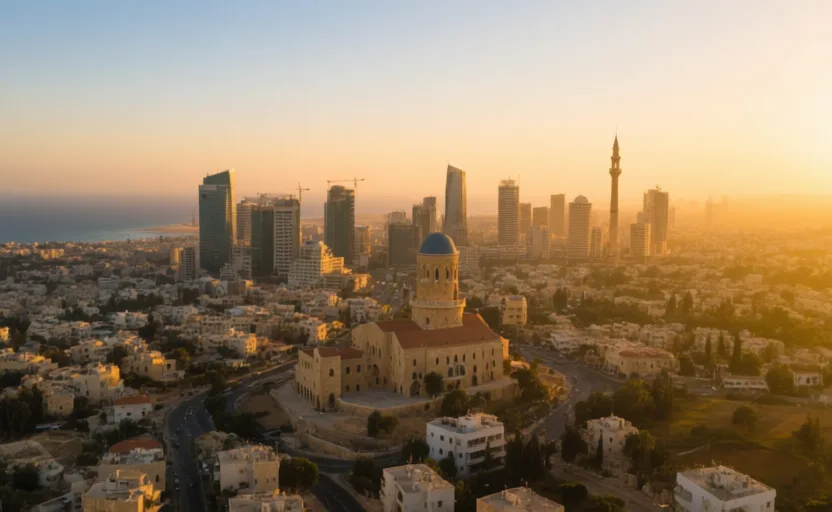 Netanya · AI city illustration · Artistic impression
City · Middle East
Netanya
Saved in this browser — no account needed. Sign in later and it comes with you.
Where it is
Netanya is the main town of the Sharon, the coastal plain that runs from the Mediterranean to the hills of Samaria and from the Tel Aviv conurbation up toward Mount Carmel. It occupies a stretch of low cliffs and sandy shore, 30 km up the coast from Tel Aviv and 56 km short of Haifa, with the Poleg stream marking its southern edge and the Avihayil stream its northern. About 14 km of beach face west. Unlike the towns around Tel Aviv, it stands apart: open farmland, kibbutzim and moshavim separate it from its neighbours, and eastward the next large town is Tulkarm in the West Bank.
The land and water around it
The Sharon plainplain
A coastal plain from the sea to the Samarian hills. Netanya is its capital, though it lies close to the sea and is otherwise surrounded by farmland, kibbutzim and moshavim. Before heavy settlement the plain was covered by an oak woodland, the Forest of Sharon.
The coastal cliffs and beachescoast
Low cliffs and about 14 km of beach front the city. Several recent neighbourhoods are on the clifftop, and the beaches are why planners designated the coast a tourist zone in 1933.
The Poleg stream and winter poolsmarsh
The Poleg nature reserve and the Iris Dora rain pool, a seasonal pool that fills in winter and dries in summer, preserve a habitat that the plain’s farming and building have removed elsewhere. The park holds the largest known population of the iris Iris atropurpurea.
Its history, in short
Until the nineteenth century the Sharon carried open woodland of Mount Tabor oak, grazed and cut by local Arab villagers and then largely cleared as farming intensified. Netanya was founded in 1929 when a Jewish association, Bnei Binyamin, bought about 350 acres of land belonging to the Arab village of Umm Khalid. It was named for Nathan Straus, a New York merchant and philanthropist who gave to projects in Palestine. Water was found in February 1929, the first five settlers arrived, and a 1933 plan by the British architect Clifford Holliday laid it out as a seaside resort. From 1934 ships of the clandestine Aliyah Bet movement landed Jewish immigrants on its beach. In 1947 the Irgun, for which the town was a stronghold, kidnapped and killed two British sergeants near Netanya. Umm Khalid’s inhabitants left in 1948, and Netanya was declared a city that December, with 11,600 people. Immigrant waves followed: Libyan Jews in the 1950s, Russians and Ethiopians in the 1990s and French Jews in the 2000s and 2010s. It is now the seventh-largest city in Israel.
Timeline
Dates are shown on a timeline rather than as changing shapes on the map. The globe draws modern boundaries only, and tinting a modern outline to stand for a historical one would state something we cannot source.
Industrial & imperial
1929
Founded on Umm Khalid’s land
Bnei Binyamin buy 350 acres of the Arab village’s land in 1928. A team begins digging for water in December and finds it in February 1929, when the first five settlers move in. The 1929 riots slow the work, but cornerstones for ten houses are laid by September.
Well attestedWikipedia1933
The Holliday plan
The architect Clifford Holliday divides the town into a tourist zone along the shore, a middle zone of housing and commerce, and farming and industry to the east. The first hotel opens the same year.
Well attestedWikipedia
Contemporary
July 1947
The sergeants affair
After the British sentence three Irgun fighters to death, the Irgun abducts two British sergeants in Netanya. The army declares martial law and a curfew, and when the three are hanged, the Irgun hangs the sergeants.
Well attestedWikipedia1948
Umm Khalid emptied, Netanya a city
The remaining land of Umm Khalid is deserted by its inhabitants in the 1948 war, and Netanya expands eastwards. It is declared a city on 3 December, with 11,600 residents.
DisputedWikipediaSome accounts describe Umm Khalid as simply deserted by its inhabitants during the war. Palestinians place the emptying of villages like it within the Nakba, as flight and expulsion. All accounts agree that the inhabitants left.
1950s
Libyan and other immigrants
About 14,000 Libyan Jews settle in the years after independence, and the population reaches 31,000 by 1955. The Housing Ministry builds flats of 50 square metres, and a religious neighbourhood, Kiryat Sanz, is begun in 1956.
Well attestedWikipedia1990s
Soviet and Ethiopian immigration
Netanya absorbs many immigrants from the former Soviet Union and Ethiopia. Today one resident in four speaks Russian, and its Ethiopian Jewish community, numbering over 12,000, is the largest in Israel.
Well attestedWikipedia2000s–2010s
French Jews arrive
Netanya becomes one of the main destinations of French aliyah, and thousands of French immigrants settle there. By 2023, 15,622 residents who arrived after 1990 came from France.
Well attestedWikipedia2025–2026
A new mayor
Miriam Feirberg, mayor since 1998, dies in office in November 2025 after 27 years. Avi Slama is elected in a special vote in January 2026.
Well attestedWikipedia
Places that carry meaning
The Well House1928
A museum in a building from 1928 that documents the first years of the town, beside the place where the water that made settlement possible was first found.
Poleg nature reserve and the Iris Dora RainpoolPresent day
A reserve on the southern edge of the city with a seasonal pool and rare irises, and signs about the plants and animals of that ecosystem.
Kiryat SanzFrom 1956
A religious neighbourhood on the northern beachfront, chosen in 1956 as home base for the Sanz Hasidic dynasty. The Sanzer Hasidic dynasty is based here, and Chabad Lubavitch is also well represented.
Languages here
Places are usually multilingual. This lists what is actually spoken, not one language per border.
HebrewSemitic family
The main language of the city.
About 88 per cent of residents are Jewish and around half are secular. Mizrahi Jews of Middle Eastern and North African origin were about 46 per cent of the population in 2022.
RussianSlavic family
The language of about one resident in four.
More than 21,000 residents came from Russia and nearly 18,000 from Ukraine after 1990, according to municipal statistics published in 2023.
FrenchRomance family
The language of a large newer community.
French immigrants of recent decades have influenced local culture, and Netanya is among the main destinations of immigration from France.
Learn the language here
- 1Understand which languages are spoken hereNetanya is multilingual. Start with which languages are used, by whom, and for what — the phrase list only covers one of them.Written by Globe Quest
- 2Learn 12 phrasesCurated everyday phrases for Netanya, with audio and a written form.Written by Globe Quest
- 3Say them out loudSpeaking practice with pronunciation feedback, one phrase at a time.Globe Quest material, your own additions
- 4Come back to themSpaced review, so what you learned this week is still there next month.Written by Globe Quest
Check yourself
Who is Netanya named after?
Nathan Straus, an American merchant and philanthropist
The founders named the town for Nathan Straus, co-owner of Macy’s in New York, in the hope that he would fund it. By one account he told them he had no more to give, and they kept the name.
How did Netanya begin?
As a 1929 settlement on land bought from the Arab village of Umm Khalid
A Jewish association bought land from Umm Khalid, a village on the coastal plain. Water found in February 1929 made it possible to settle.
Worth arguing about
- A town planned in 1933 as a seaside resort grew into one of Israel’s largest cities. What is gained and lost when the plan for a place is written before its people arrive?
- Netanya has taken in Libyan, Soviet, Ethiopian and French Jews within a few decades. What makes a place able to absorb successive waves of newcomers?
Sources
- Wikipedia · NetanyaWikipedia · encyclopedia · checked 2026-11-24
Reviewed by Globe Quest editorial on 2026-11-24. Drafted with AI assistance and checked against the sources above before publication.