 Globe Quest
 Human Quest · LearningSign in
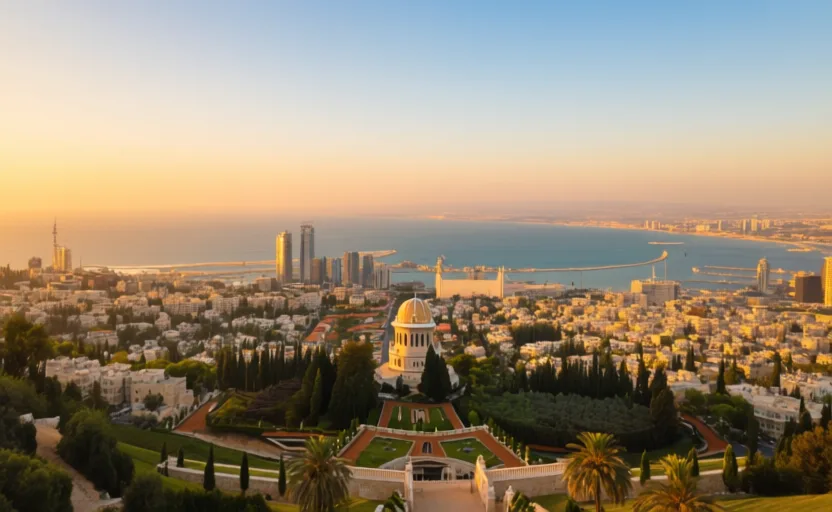 Haifa · AI city illustration · Artistic impression
City · Middle East
Haifa
Saved in this browser — no account needed. Sign in later and it comes with you.
Where it is
Mount Carmel drops to the sea here and Haifa climbs it in three tiers. The lowest, on the flat ground of Haifa Bay near the mouth of the Kishon River, holds the port, industry and commerce. Older residential districts cover the slopes above, and newer neighbourhoods crown the ridge with views toward the Western Galilee and the Lebanese border. Three wadis, Lotem, Amik and Si’ach, cut through the city from the summit to the shore. About 629 mm of rain falls a year, mostly between September and May, and snow last fell in 1950. The city lies roughly 90 km north of Tel Aviv.
The land and water around it
Mount Carmelmountains
A coastal mountain ridge that ends at the sea, giving Haifa its three tiers and its terraced streets. The Carmel is also cut by three wadis that remain largely undeveloped and carry wildlife, including boar, jackals, hyrax and chameleons, into the city.
Haifa Bay and the Kishon mouthbay
The bay curves north toward Acre, and the Kishon River drains into it. A harbour on this coast has been valuable since the Bronze Age, though silting shifted the ancient port to a new site in the Hellenistic period. Today the bay holds heavy industry, oil refining and chemical plants.
Its history, in short
Settlement began on the shore with a small port at Tell Abu Hawam in the fourteenth century BCE, and by about the third century CE the town was known for dye made from sea snails. A fortified settlement later developed a few kilometres to the north-west. Crusaders took it about 1100, Saladin’s army in 1187, and Richard the Lionheart’s in 1191. The Ottomans ruled from 1516, and in the 1760s the old site was demolished and a new fortified town built farther east, the nucleus of today’s Old City. Growth in the late nineteenth century, including the planned German Colony and Jewish immigration from 1881, turned a nearly all-Arab town into a mixed one. By 1945 the population was 55 per cent Jewish and 45 per cent Arab. In the Battle of Haifa in 1948 most of the Arab residents left, by flight or expulsion, and the Old City was afterwards demolished; by 1951 Arabs were about 5 per cent. The city is now Israel’s main northern port and a centre of universities and industry.
Timeline
Dates are shown on a timeline rather than as changing shapes on the map. The globe draws modern boundaries only, and tinting a modern outline to stand for a historical one would state something we cannot source.
First cities & states
14th century BCE
Tell Abu Hawam
A port and fishing village appears at the site now called Tell Abu Hawam, the earliest known settlement near Haifa. It was abandoned by the twelfth century CE.
Approximate dateWikipedia
Classical world
3rd century CE
A dye-making town
The Talmud gives the first mention of Haifa, as a village of Jewish fishermen. Fishermen collected murex sea snails here, whose purple dye was used for prayer shawls.
Approximate dateWikipedia
Post-classical world
1100 or 1101
Siege by the Crusaders
Haifa is besieged and taken by European Crusaders, from a mostly Jewish population and a Fatimid garrison. Saladin’s army captures it in 1187, and the Crusaders retake it in 1191.
Approximate dateWikipedia
Early modern & oceanic
1760s
A new walled town
The medieval town is demolished and rebuilt about two and a half kilometres to the east as a fortified settlement. Over time this ‘New Haifa’ became known as the Old City.
Approximate dateWikipedia
Industrial & imperial
1909
The Báb’s remains reach Carmel
The remains of the Báb, forerunner of Bahá’u’lláh, are moved from Acre to a shrine on Mount Carmel. Bahá’ís rank it second among their holy places, behind the Shrine of Bahá’u’lláh at Acre.
Well attestedWikipediaSeptember 1918
British capture
Indian cavalry of the British Army overrun Ottoman positions on the Carmel and take the city. Britain then governs it under the Mandate.
Well attestedWikipedia
Contemporary
1948
The Battle of Haifa and the Arab exodus
The 1947 UN plan puts Haifa in the proposed Jewish state, and violence between Jews and Arabs breaks out. After the battle the city becomes part of Israel and its Arab population falls from about 45 per cent in 1945 to about 5 per cent in 1951.
DisputedWikipediaPalestinians, who place the departure of Haifa’s Arab residents within the Nakba, and Israeli accounts. Sources agree that most Arabs left and disagree on how far they fled and how far they were expelled.
2006
Rockets in the Second Lebanon War
Hezbollah fires 93 rockets at Haifa, killing 11 civilians and sending about half of the population away within a week. A train depot and the oil refinery are among the sites hit.
Well attestedWikipedia
Places that carry meaning
The Shrine of the Báb and gardens1909 onward
A Bahá’í shrine on the Carmel slope, where the Báb’s remains were buried. It was designed by ʻAbdu’l-Bahá and finished by his grandson Shoghi Effendi, and ʻAbdu’l-Bahá is buried in a separate room. The shrine belongs to the Bahá’í World Centre, which is listed by UNESCO and draws Bahá’í pilgrims.
The German Colony19th century
Built under the Ottomans, it gave Haifa its first example of planned streets. Some buildings have been restored, and the district is now an evening centre.
Wadi Nisnas and Wadi SalibOttoman and Mandate periods
Wadi Salib, on the edge of the old centre, has been bisected by a main road and partly razed for government buildings. Wadi Nisnas next to it remains the centre of Arab life in the city and is largely Christian.
Languages here
Places are usually multilingual. This lists what is actually spoken, not one language per border.
HebrewSemitic family
The main language of the Jewish majority and of administration.
Jews are about 82 per cent of residents. The Technion and the University of Haifa are based here, and the city founded a Hebrew repertory theatre in the 1950s.
ArabicSemitic family
The language of the Arab minority, about one tenth of the city.
Haifa has the second-largest Arab Christian community in Israel, most living in the lowland neighbourhoods near the sea. The Arabic theatre al-Midan and the newspapers al-Ittihad and al-Madina are based here.
RussianSlavic family
A major immigrant language.
Immigrants from the former Soviet Union make up about a quarter of the population, so Russian ranks among the city’s three main spoken languages.
Learn the language here
- 1Understand which languages are spoken hereHaifa is multilingual. Start with which languages are used, by whom, and for what — the phrase list only covers one of them.Written by Globe Quest
- 2Learn 11 phrasesCurated everyday phrases for Haifa, with audio and a written form.Written by Globe Quest
- 3Say them out loudSpeaking practice with pronunciation feedback, one phrase at a time.Globe Quest material, your own additions
- 4Come back to themSpaced review, so what you learned this week is still there next month.Written by Globe Quest
- 5Practise with people: Arabic practice · DohaAn in-person practice circle. It is a prepared plan and needs a host before it runs.Run by members
Check yourself
On which mountain is Haifa built in three tiers?
Mount Carmel
Mount Carmel runs down to the sea at Haifa. The port sits on the low ground, older neighbourhoods on the slopes and newer ones on the ridge above.
What was the balance of Haifa’s population in 1945?
55 per cent Jewish and 45 per cent Arab
In 1872 the town was 98 per cent Arab, and Jewish immigration changed the mix. By 1945 Jews were a slim majority, and after 1948 Arabs fell to about 5 per cent.
Worth arguing about
- Haifa is often held up as a model of Arab and Jewish coexistence, yet its Old City was demolished and its Arab population collapsed in 1948. How should a city remember both of those things?
- A mountain city on an industrial bay: how much of Haifa’s identity comes from the fact that the port is at the bottom and the universities are at the top?
What we have not established
These are open questions, listed rather than filled in. We would rather show a gap than a plausible guess.
Where does the name Haifa come from?
Several explanations are offered: the priest Caiaphas, Saint Peter’s Aramaic name Keipha, a Hebrew root meaning to cover or shield, and the Hebrew words for shore or for beautiful shore. None has been shown to be correct.
Sources
- Wikipedia · HaifaWikipedia · encyclopedia · checked 2026-11-24
Reviewed by Globe Quest editorial on 2026-11-24. Drafted with AI assistance and checked against the sources above before publication.