 Globe Quest
 Human Quest · LearningSign in
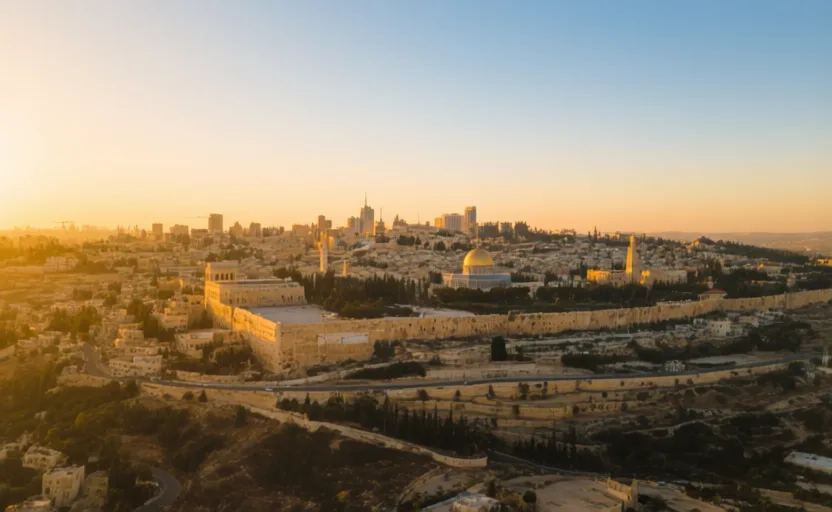 Nazareth · AI city illustration · Artistic impression
City · Middle East
Nazareth
Saved in this browser — no account needed. Sign in later and it comes with you.
Where it is
A bowl in the hills of Lower Galilee, with the town spread from about 320 metres above sea level up to ridge crests near 488 metres. The hills belong to the Nazareth Range, the southernmost of several parallel ranges running east to west across Lower Galilee. The Sea of Galilee lies about 25 km east and Mount Tabor about 9 km to the east, while the coast is far enough away that summers are hot and Mediterranean rather than sea-cooled. Jerusalem is roughly 146 km south and Tel Aviv about 108 km south-west.
The land and water around it
The Nazareth Rangemountains
The southernmost of Lower Galilee’s parallel hill ranges. The town sits in a natural bowl on its slopes, which keeps the old town compact and sets it apart from the valleys around.
Mount Tabor and the Sea of Galileemountains
Mount Tabor lies about 9 km east of the town and the Sea of Galilee about 25 km away. In the seventeenth century the Franciscans ran pilgrimage tours from Nazareth to the sacred sites of the surrounding region, though the monks were often kidnapped for ransom by Bedouin tribes.
Its history, in short
People used caves and sites around the bowl in prehistoric times, and a cult and burial centre at Kfar HaHoresh, nearby, is about 9,000 years old. Nazareth itself is a small village through the Roman and Byzantine periods, a Jewish village by the fourth century, and is best known as the home of Mary and the place where, in the Gospels, Jesus grew up. Crusaders made it the seat of the Principality of Galilee, but under the Mamluks it declined and after the Ottoman conquest its Christians were expelled until a Druze emir let them return. In the eighteenth century Daher al-Umar, a ruler of the Galilee, encouraged settlement and made it a large town, and in the nineteenth and early twentieth centuries European churches and orders built monasteries, schools and hospitals. It had a Christian majority through the British Mandate. After 1948 it became the largest Arab town in Israel, absorbing displaced Palestinians, and since then it has had a Muslim majority and a large Christian minority. It is now the main city of the country’s Arab citizens.
Timeline
Dates are shown on a timeline rather than as changing shapes on the map. The globe draws modern boundaries only, and tinting a modern outline to stand for a historical one would state something we cannot source.
First cities & states
c. 9,000 years ago
Kfar HaHoresh
A funerary and cult centre near today’s Nazareth, from the Pre-Pottery Neolithic B. The remains of some 65 people were buried under plaster-covered stone structures, with decorated skulls.
Approximate dateWikipedia
Classical world
c. 375
A Jewish town
Epiphanius counts Nazareth among the towns of Galilee that had no non-Jewish population, in the account of a rich Jewish convert to Christianity who wanted to build churches there.
Approximate dateWikipedia
Post-classical world
c. 670
Two churches seen by a pilgrim
The bishop Arculf records two churches in Nazareth, one at the house of Joseph and one at the house of Mary, thirty years after the Arab conquest of 638. He saw no synagogue, which might have become a mosque.
Approximate dateWikipedia
Early modern & oceanic
1620
Franciscans return
The Druze emir Fakhr al-Din II lets the Franciscans put up a modest church over the grotto, after they had been evicted from the ruined basilica in 1584.
Well attestedWikipediac. 1740
Daher al-Umar
Daher al-Umar, who governed the Galilee, restores stability and encourages migration. He builds an administrative building that housed stables and a prison.
Approximate dateWikipedia
Industrial & imperial
1922
A Christian-majority town
The British census records 7,424 residents: 66 per cent Christian, 33 per cent Muslim and about 1 per cent Jewish. By 1946 the town had 15,540 residents, roughly 60 per cent Christian and 40 per cent Muslim.
Well attestedWikipedia
Contemporary
1948–1950s
Nazareth inside Israel
Nazareth was not itself a battlefield in 1948, though troops of the Arab Liberation Army entered on 9 July and the local militia’s defence of the hills gave way to Israeli shelling and an armoured advance. In its first years under Israel the town’s affairs were dominated by land expropriation, internally displaced refugees and martial law, with curfews and travel limits.
Well attestedWikipedia1997–2000
The Annunciation plaza dispute
Plans to build a paved plaza for pilgrims ahead of a papal visit led a small group of Muslims to occupy a site by the basilica where the tomb of a relative of Saladin is said to lie. When the government approved plans for a large mosque on the site, Christian leaders protested.
Well attestedWikipedia
Places that carry meaning
Church of the AnnunciationLate antiquity onward
One of the largest Christian churches in the Middle East, built over the Grotto of the Annunciation. Catholics place Gabriel’s announcement to Mary there. The Greek Orthodox Church of the Annunciation, also called the Church of Saint Gabriel, marks the place for the Orthodox.
Catholic tradition, which locates the Annunciation at the Grotto, and Greek Orthodox belief, which locates it at the Church of Saint Gabriel. Both sites draw pilgrims.
Mary’s Well and the Roman bathhouseRoman period
Tunnels discovered by a shopkeeper in the mid-1990s turned out to be the hypocaust of an ancient bathhouse near Mary’s Well. An early Roman house was found next to the basilica in 2009.
The Nazareth Brigades buildingAround 1740
An Ottoman building put up by Daher al-Umar as his home and as the seat of government from which he oversaw security in the Marj Ibn Amer plain. It held stables and a prison.
Languages here
Places are usually multilingual. This lists what is actually spoken, not one language per border.
ArabicSemitic family
The main language of the city.
The Arabic name is an-Nāṣira, and the city is known as the Arab capital of Israel. Its population is about 69 per cent Muslim and 31 per cent Christian, among them Greek Orthodox, Melkite Greek Catholic, Latin Catholic, Maronite, Armenian and Protestant communities.
HebrewSemitic family
The state language, used by the Jewish share of the wider area.
The wider Nazareth metropolitan area, about 210,000 people, is 59 per cent Arab and 41 per cent Jewish, and takes in neighbouring towns such as Nof HaGalil and Migdal HaEmek.
Learn the language here
- 1Understand which languages are spoken hereNazareth is multilingual. Start with which languages are used, by whom, and for what — the phrase list only covers one of them.Written by Globe Quest
- 2Learn 12 phrasesCurated everyday phrases for Nazareth, with audio and a written form.Written by Globe Quest
- 3Say them out loudSpeaking practice with pronunciation feedback, one phrase at a time.Globe Quest material, your own additions
- 4Come back to themSpaced review, so what you learned this week is still there next month.Written by Globe Quest
- 5Practise with people: Arabic practice · DohaAn in-person practice circle. It is a prepared plan and needs a host before it runs.Run by members
Check yourself
Where in the landscape does Nazareth sit?
In a natural bowl in the Nazareth Range of Lower Galilee
The town lies in a bowl running from about 320 to 488 metres above sea level, in the southernmost of Lower Galilee’s east–west hill ranges, about 25 km west of the Sea of Galilee.
Who allowed the Franciscans to build a church at the Grotto of the Annunciation in 1620?
Fakhr al-Din II, a Druze emir
Fakhr al-Din II controlled this part of Ottoman Syria. The Franciscans had been evicted from the site in 1584, and the permission let them organise pilgrim tours to nearby shrines.
Worth arguing about
- Nazareth’s Christian majority became a Muslim one within a generation. What do places holy to one community owe to the changing community that lives around them?
- A city that is a pilgrimage centre for the world and a centre of Arab politics in Israel: which role does the local economy depend on, and which does the city’s identity?
What we have not established
These are open questions, listed rather than filled in. We would rather show a gap than a plausible guess.
Which Nazareth do the earliest texts mean?
Ancient texts point to two locations: the Galilean town of the Christian Gospels, and a southern, Judaean site named in several early non-canonical texts. Which of the two a given text means is not settled.
Sources
- Wikipedia · NazarethWikipedia · encyclopedia · checked 2026-11-24
Reviewed by Globe Quest editorial on 2026-11-24. Drafted with AI assistance and checked against the sources above before publication.