 Globe Quest
 Human Quest · LearningSign in
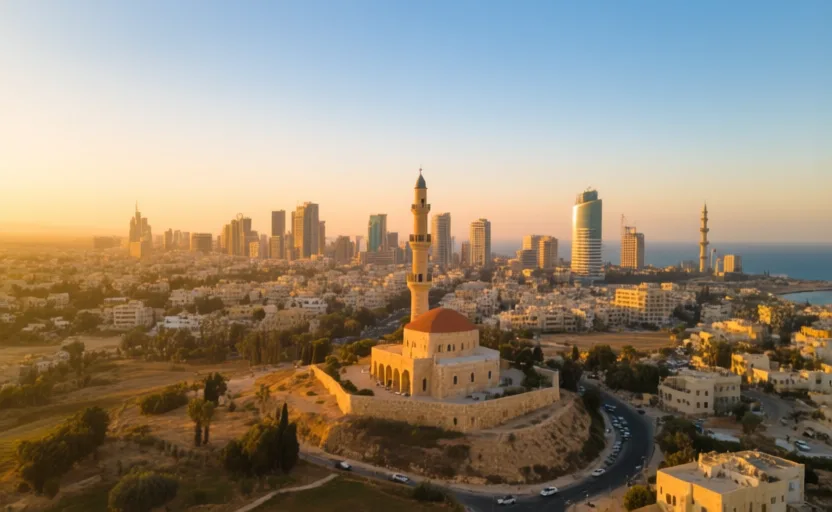 Ashdod · AI city illustration · Artistic impression
City · Middle East
Ashdod
Saved in this browser — no account needed. Sign in later and it comes with you.
Where it is
The modern city lies on Mediterranean sand hills, 32 km down the coast from Tel Aviv and 20 km above Ashkelon, with the port at its northern end. It was built on empty coastal dunes known as Rimal Isdud, a few kilometres from the old site, so there was no earlier town to work around and the planners could use wide avenues and self-contained neighbourhoods. Summers are hot and humid, winters cool and wet, and about 510 mm of rain falls a year, mostly between November and March. The three industrial zones sit beside the port to the north, where the prevailing southerly winds carry pollution away from the homes.
The land and water around it
Rimal Isdud sand hillscoast
Coastal dunes north-west of the ancient site. Nothing stood on them when the plan for the city was drawn in the 1950s, and the plan divided the land into seventeen neighbourhoods of ten to fifteen thousand people, each with its own park, shops and schools.
The Mediterranean coast and its two ancient harbourscoast
Ports at Ashdod-Yam and Tel Mor served the ancient city. Ashdod-Yam, on the coast south-west of the modern city, was a separate town for most of its history. The modern port, opened in 1963, handles about 60 per cent of Israel’s imported goods.
Its history, in short
The ancient town of Ashdod, now Tel Ashdod and known in Arabic as Isdud, stood a few kilometres inland and had a history of about 3,700 years. It was a fortified Canaanite city from the 17th century BCE and one of five Philistine city-states; Judah, Assyria, Persia, Greece and Rome each held it in turn, and in Greek and Roman times it was called Azotus. Its seaport, Ashdod-Yam, grew more important than the inland city in the Byzantine period. By the Middle Ages it was a village. In 1948 most of Isdud’s population left. The present city was founded in 1956 as a planned town on the dunes to the north-west, and its first residents were 22 families from Morocco. A port was built from 1961 and opened in 1963, and it became Israel’s biggest. Immigration from Romania, Georgia, the Soviet Union and Ethiopia made it a city of newcomers, and between 1990 and 2001 more than 100,000 people arrived, a 150 per cent increase.
Timeline
Dates are shown on a timeline rather than as changing shapes on the map. The globe draws modern boundaries only, and tinting a modern outline to stand for a historical one would state something we cannot source.
First cities & states
17th century BCE
A fortified Canaanite city
The first urban settlement at Tel Ashdod. The Late Bronze Age ended in its destruction, and in the Iron Age it became one of the five Philistine city-states, named 13 times in the Hebrew Bible.
Approximate dateWikipedia
Classical world
760 BCE
Captured by Judah
King Uzziah of Judah takes the city, which later falls to the Assyrians. Under Hellenistic rule it is called Azotus, and the Hasmoneans incorporate it in 143 BCE.
Approximate dateWikipedia4th–6th century
Azotos Paralios, a bishop’s seat
The port town, called Azotos Paralios, overshadows the inland city. Bishops of Azotus attend the church councils of 325 and, in Jerusalem, 536, and appear to have lived at the port.
Approximate dateWikipedia
Contemporary
late 1948
The end of Isdud
The UN partition plan had assigned Isdud to the Arab state. After the Egyptian defenders withdrew in late 1948, most of the roughly 5,000 residents fled, and the 300 who stayed were driven south by the Israel Defense Forces.
DisputedWikipediaPalestinians, who place the emptying of Isdud within the Nakba, and Israeli accounts that describe wartime departure. Sources agree that most residents left and that those who stayed were removed, and differ on how far departures were forced.
1956
The new city
On 1 May, finance minister Levi Eshkol approves a company to build a city on the sand hills. The first residents, 22 families from Morocco, arrive in November, followed by a small number from Egypt. The government grants the company 24 square kilometres in 1957.
Well attestedWikipedia1961–1965
The port
Work on the port starts in April 1961 and it is inaugurated in November 1963. A Swedish ship is the first to use it in November 1965.
Well attestedWikipediaFrom 1991
A wave of immigration
Large numbers of immigrants arrive from the Soviet Union and Ethiopia, and between 1990 and 2001 the population grows by more than 100,000. A business district and five further residential quarters are built.
Well attestedWikipedia
Places that carry meaning
Tel Ashdod (Isdud)17th century BCE to 1948
The mound of the ancient city, about 6 km south-east of the modern centre, with Canaanite, Philistine, Hellenistic, Roman and Byzantine layers. Its last Arab village was emptied in 1948.
Ashdod-YamBronze Age to the Middle Ages
The coastal site south-west of the city, settled in the Bronze Age and a bishop’s seat in the Byzantine period. An Umayyad caliph built a fort here, which the Fatimids and Crusaders later rebuilt, and the port stops being mentioned under the Ayyubids and Mamluks.
Port of AshdodFrom 1963
Israel’s largest port, which anchors the city’s economy and its industrial zones. It sits at the northern edge so that the prevailing winds carry fumes away from housing.
Corinne Mamane Museum of Philistine CultureReopened 2014
A museum devoted to the Philistines, with objects from each of the five cities of their pentapolis.
Languages here
Places are usually multilingual. This lists what is actually spoken, not one language per border.
HebrewSemitic family
The main language of the city.
Over 95 per cent of residents are Jewish, and over 30 per cent are Haredi. It holds Israel’s biggest Moroccan Jewish community and its biggest Karaite one.
RussianSlavic family
The largest immigrant language.
More than 60,000 immigrants from the Soviet Union settled here in the 1990s, and about 85 per cent of the city’s new immigrants, who are roughly a third of residents, come from the former USSR.
GeorgianKartvelian family
Spoken in the city’s Georgian Jewish community.
Immigrants from Georgia, then part of the Soviet Union, arrived in the 1970s, and Ashdod now has the largest Georgian Jewish community in the world.
Learn the language here
- 1Understand which languages are spoken hereAshdod is multilingual. Start with which languages are used, by whom, and for what — the phrase list only covers one of them.Written by Globe Quest
- 2Learn 12 phrasesCurated everyday phrases for Ashdod, with audio and a written form.Written by Globe Quest
- 3Say them out loudSpeaking practice with pronunciation feedback, one phrase at a time.Globe Quest material, your own additions
- 4Come back to themSpaced review, so what you learned this week is still there next month.Written by Globe Quest
Check yourself
When was modern Ashdod founded?
1956
The planned city was approved in May 1956, 6 km from the ancient site, and 22 families from Morocco arrived that November. It was declared a city in 1968.
About how much of Israel’s imported goods pass through the port of Ashdod?
60 per cent
The port, opened in 1963, is the country’s largest and handles about 60 per cent of imports. Planners put the industrial zones beside it, upwind of homes.
Worth arguing about
- Ashdod was built on empty dunes while a town on the old site was being emptied. How should a new city relate to the place it is named after?
- A planned city of seventeen self-contained neighbourhoods has absorbed many waves of immigrants. Does that plan help or hinder integration?
Sources
- Wikipedia · AshdodWikipedia · encyclopedia · checked 2026-11-24
Reviewed by Globe Quest editorial on 2026-11-24. Drafted with AI assistance and checked against the sources above before publication.