 Globe Quest
 Human Quest · LearningSign in
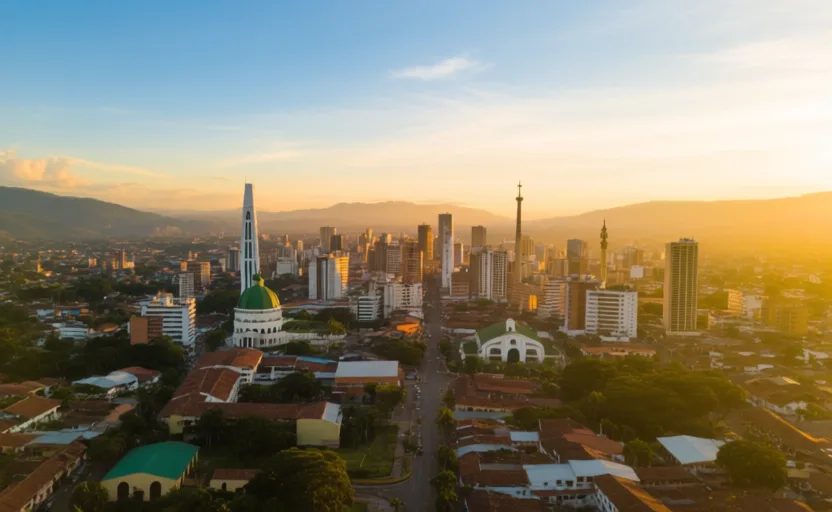 Bucaramanga · AI city illustration · Artistic impression
City · Latin America
Bucaramanga
Saved in this browser — no account needed. Sign in later and it comes with you.
Where it is
A plateau in the Cordillera Oriental holds the city, and its edges are ragged: the ground falls steeply away from the meseta, and many residents live on unstable slopes. To the west lies the canyon of the Río de Oro at about 600 metres, and to the east the mountains climb to almost 3,700 metres at the Páramo de Berlín. The air that moves between them keeps the climate steady rather than extreme, at about 22 °C on average. Cool wind from the eastern peaks tempers the days, and warm air from the canyon softens the nights, so the daily swing in temperature is narrower than in other Colombian cities.
The land and water around it
The Bucaramanga plateauplateau
The city is built on a meseta in the Cordillera Oriental. Many households live on its steep, unstable edges.
The Río de Oro canyoncanyon
West of the city the land drops to a canyon at about 600 metres above sea level. Warm air coming up from it keeps nights mild.
The eastern peaksmountains
The Andean range rises to the east, reaching almost 3,700 metres at a spot known as the Páramo de Berlín. Cool air flows down from these peaks and moderates daytime heat.
Its history, in short
The Spanish first settled the region at Girón, which was for a long time the main town. Bucaramanga began as an Indigenous village, said to have been founded on 22 December 1622, whose early economy was gold washed from river gravels, above all in the La Rosita ravine. It remained an Indigenous town until 1778 and became a parish in 1779. In the early nineteenth century it overtook Girón in population and economic weight. In the 1860s and 1870s a group of German merchants and adventurers settled in the city, the best known being Geo von Lengerke, and tension with local traders came to a head in 1879. The political reorganisation of 1886 made Bucaramanga capital of the department, replacing Socorro. The civil war of 1899 to 1902, the Thousand Days War, devastated the surrounding region, though not the city itself, and growth stayed modest until the 1960s. Since then the city has expanded rapidly into neighbouring Floridablanca, Girón and Piedecuesta, which together make up the metropolitan area of about 1.3 million people.
Timeline
Dates are shown on a timeline rather than as changing shapes on the map. The globe draws modern boundaries only, and tinting a modern outline to stand for a historical one would state something we cannot source.
Early modern & oceanic
22 December 1622
Founding as an Indigenous town
Bucaramanga is established as an Indigenous settlement, built on the first economic activity of the area, the extraction of gold from alluvial deposits.
Approximate dateWikipedia1779
A parish
After being treated as an Indigenous town until 1778, it becomes a parish dedicated to Our Lady of Chiquinquirá and San Laureano, in the mining settlement of Bucaramanga.
Well attestedWikipedia
Industrial & imperial
1860s–1870s
German merchants arrive
A group of German merchants and adventurers settles in the city, among them Geo von Lengerke.
Approximate dateWikipedia1879
La Culebra Pico de Oro
Tension between the newcomers and local merchants boils over in the episode known as the Gold Beak Snake.
Well attestedWikipedia1886
Departmental capital
The political reorganisation under the new constitution makes Bucaramanga the capital of Santander, in place of Socorro.
Well attestedWikipedia1899–1902
The Thousand Days War
The civil war devastates the surrounding region but not the city itself, although Bucaramanga grows only modestly in the first half of the twentieth century.
Well attestedWikipedia
Contemporary
From the 1960s
Rapid growth into the metropolitan area
The city expands into Floridablanca, Girón and Piedecuesta, which are now closely linked to it commercially and geographically. Together they form one of the largest metropolitan areas in Colombia.
Approximate dateWikipedia
Places that carry meaning
La Rosita ravineColonial period
The site most associated with the alluvial gold that was the first economic activity in the area and the basis of the early settlement.
San Laureano church and the Dolores ChapelColonial downtown
The church of San Laureano, named for a saint in the parish's full title, and the Dolores Chapel mark the colonial downtown.
GirónFrom the colonial period
The earliest and most important Spanish foundation in the region, ahead of Bucaramanga until the early nineteenth century. It is now part of the metropolitan area.
Languages here
Places are usually multilingual. This lists what is actually spoken, not one language per border.
SpanishRomance family
The language of the city and the department of Santander.
About 99.2% of Colombians speak Spanish. Residents share the Santandereano regional identity, one of the distinct groups, each with its own accents and customs, that geography and climate produced in Colombia. The city's food culture is that of the department, and includes mute santandereano, a soup of grains, vegetables and meat, and the pre-Columbian custom of eating hormigas culonas, large ants available in May and June.
Indigenous languages
Spoken by smaller communities elsewhere in the country.
Colombia has sixty-five Amerindian languages in twelve families and ten isolates, and about 850,000 speakers of native languages at least. Bucaramanga began as an indigenous town, though these languages are mostly not heard in the city today.
Creoles, Portuguese and Romani
Minor languages recorded across Colombia.
Two Creole languages, San Andrés Creole and Palenquero, are spoken in Colombia, along with Portuguese and the Roma language. These are national records, not figures for the city.
Learn the language here
- 1Understand which languages are spoken hereBucaramanga is multilingual. Start with which languages are used, by whom, and for what — the phrase list only covers one of them.Written by Globe Quest
- 2Learn 12 phrasesCurated everyday phrases for Bucaramanga, with audio and a written form.Written by Globe Quest
- 3Say them out loudSpeaking practice with pronunciation feedback, one phrase at a time.Globe Quest material, your own additions
- 4Come back to themSpaced review, so what you learned this week is still there next month.Written by Globe Quest
Check yourself
Which town was more important than Bucaramanga until the early nineteenth century?
Girón
Girón was the first and most significant Spanish town in the region. Bucaramanga, founded in 1622 as an Indigenous settlement, passed it in population and economic weight only in the early nineteenth century.
Why are daily temperature swings in Bucaramanga unusually narrow?
Cool wind from the eastern peaks by day and warm air from the canyon at night
Bucaramanga sits between high peaks to the east and a canyon to the west. The mountain wind cools the days and the canyon air warms the nights, so the average of 22 °C holds with little variation.
Worth arguing about
- A city of parks built on steep, unstable ground, where many households live on the edges of the plateau. How should a growing city weigh affordable housing against the risk of sliding slopes?
- German merchants settled in the 1860s and 1870s, and their arrival caused tension with local traders in 1879. What does that episode suggest about who benefits when outsiders enter a small town's trade?
What we have not established
These are open questions, listed rather than filled in. We would rather show a gap than a plausible guess.
How many people live in Bucaramanga?
Two figures sit side by side: a 2023 projection of 613,400 and an estimate of 681,130 from the 2018 census and the metropolitan area's own data. The second is higher despite being older; the difference may reflect different boundaries or methods, but the sources do not say. The metropolitan area has about 1.3 million people.
Sources
- Wikipedia · BucaramangaWikipedia · encyclopedia · checked 2026-11-24
- Wikipedia · ColombiaWikipedia · encyclopedia · checked 2026-11-24
- Wikipedia · Languages of ColombiaWikipedia · encyclopedia · checked 2026-11-24
Reviewed by Globe Quest editorial on 2026-11-24. Drafted with AI assistance and checked against the sources above before publication.