 Globe Quest
 Human Quest · LearningSign in
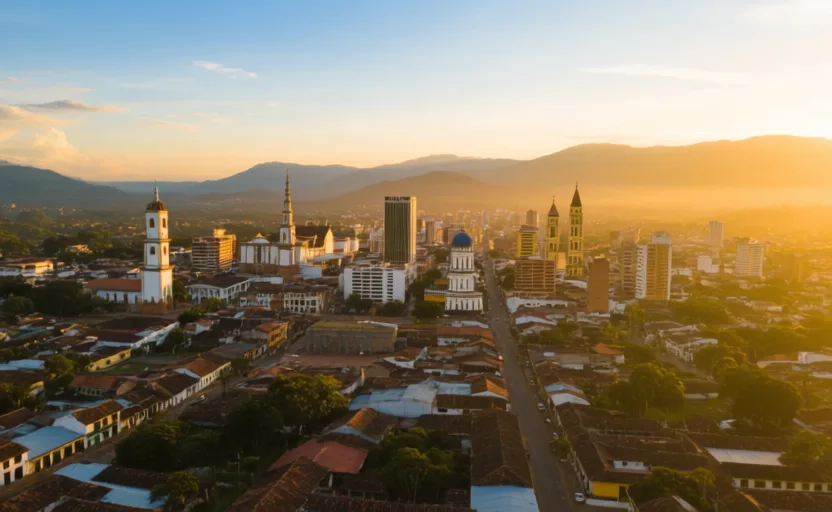 Cúcuta · AI city illustration · Artistic impression
City · Latin America
Cúcuta
Saved in this browser — no account needed. Sign in later and it comes with you.
Where it is
Cúcuta fills a valley beneath the Eastern Ranges of the Colombian Andes, 320 metres above sea level and a short distance from the Venezuelan frontier. The Pamplonita River crosses the department, and the climate is hot: tropical savanna bordering on semi-arid, with a mean near 27.6 °C, afternoons around 32 °C and about 900 mm of rain a year, split sharply between wet and dry seasons. The municipality covers roughly 1,119 square kilometres, but only 64 of them are urban. Higher ground nearby is cooler and wetter than the valley floor.
The land and water around it
The Cúcuta valleyvalley
A low basin at the foot of the Cordillera Oriental, close to the Venezuelan border. At 320 metres it is well below the surrounding ranges, where the climate is cooler and wetter.
The Pamplonita and its neighboursriver
The Pamplonita crosses Norte de Santander, alongside the Guaramito, San Miguel and Zulia rivers. The department’s drainage runs through the valley the city occupies.
A dry-season climateclimate
Rain falls mostly in April, May and from September to November, while January, February, June and July are driest. Annual rainfall near 900 mm is modest for the tropics, and the city’s shaded avenues date from a deliberate replanting after 1875.
Its history, in short
The valley held an indigenous settlement long before Spain arrived, and an encomienda over it was granted in 1550. The present city began as a parish, founded in 1733 by Juana Rangel de Cuéllar of Pamplona. White and mestizo settlers wanted a place apart from the neighbouring “Indian village”, and the Motilon-Bari people were resisting their advance on the valley. The parish was first called San José de Guasimales and took the name Cúcuta, after a local cacique, in 1793. In 1813 Simón Bolívar won a battle here that opened his Admirable Campaign, and in 1821 delegates met at nearby Villa del Rosario to create Gran Colombia. An earthquake in 1875 flattened much of the town. It was rebuilt on a reformed grid and planted with shade trees, and a railway built from 1878 tied the valley to the river port of Puerto Santander and to Venezuela. Because it sits on the border, the city has repeatedly been a place where trade, treaties and migration cross, most recently as a transit point for people leaving Venezuela.
Timeline
Dates are shown on a timeline rather than as changing shapes on the map. The globe draws modern boundaries only, and tinting a modern outline to stand for a historical one would state something we cannot source.
Early modern & oceanic
1550
An encomienda is granted
Pedro de Ursúa entrusts the indigenous settlement at Cúcuta to Sebastián Lorenzo, the earliest Spanish grant over the valley in the record.
Well attestedWikipedia17 June 1733
A parish is founded
Juana Rangel de Cuéllar donates 782 hectares for a church and for Spanish families. The settlement is named San José de Guasimales.
Well attestedWikipedia
Industrial & imperial
28 February 1813
Battle of Cúcuta
About 400 men under Bolívar defeat roughly 800 royalists under Ramón Correa. The victory frees the valley and starts the Admirable Campaign.
Well attestedWikipedia1821
Congress of Cúcuta
Meeting in a church at Villa del Rosario, delegates write a constitution that joins New Granada and Venezuela as the Republic of Colombia, later called Gran Colombia. Bolívar is sworn in as president in October.
Well attestedWikipedia18 May 1875
The earthquake
A quake at 11:15 in the morning destroys Villa del Rosario and large parts of Cúcuta, damages towns across the border and is felt in Bogotá and Caracas.
Well attestedWikipedia1878–1888
The northern railway
The north branch links Cúcuta with Puerto Santander and Venezuela. The southern branch reaches toward Pamplona, but the western line is never built, and the railway company fails and is closed in 1960.
Well attestedWikipedia1941
Treaty of Limits
Colombia and Venezuela sign a border treaty in the city, one of several diplomatic moments the frontier has brought it.
Well attestedWikipedia
Places that carry meaning
Historic Church of Villa del Rosario1821
The church where the 1821 Congress met and where Bolívar took his oath in the sacristy. It stands at Villa del Rosario, now part of Cúcuta, within a cluster of sites that includes the House of Santander.
Park of Greater ColombiaEarly republican period
A park holding the historic church, the House of Santander and an old tamarind. Together they preserve the setting of the congress that created Gran Colombia.
Palacio de la Cúpula Chata1919
A building whose dome was partly shipped from New York in 1915. Fire damaged it in 1989, and reconstruction began in 1990.
Languages here
Places are usually multilingual. This lists what is actually spoken, not one language per border.
SpanishRomance family
The everyday and official language.
Nearly all Colombians speak Spanish, and the city sits beside a country that also speaks it, and the frontier has long shaped its trade and migration.
Indigenous languages of the region
Survives in the city’s name; the wider country still counts many.
The name comes from the cacique Kuku-ta of the Motilon-Bari, a word glossed as “House of the Goblin”. Across Colombia, 65 Amerindian languages are still in use.
Learn the language here
- 1Understand which languages are spoken hereCúcuta is multilingual. Start with which languages are used, by whom, and for what — the phrase list only covers one of them.Written by Globe Quest
- 2Learn 12 phrasesCurated everyday phrases for Cúcuta, with audio and a written form.Written by Globe Quest
- 3Say them out loudSpeaking practice with pronunciation feedback, one phrase at a time.Globe Quest material, your own additions
- 4Come back to themSpaced review, so what you learned this week is still there next month.Written by Globe Quest
Check yourself
Who founded the parish that became Cúcuta, and when?
Juana Rangel de Cuéllar, in 1733
A woman from Pamplona donated the land and set up the parish in 1733, partly so settlers could live apart from the indigenous village of Cúcuta.
What did the Congress of Cúcuta in 1821 achieve?
It created the Republic of Colombia, later known as Gran Colombia
The delegates united the territories of New Granada and Venezuela in a single state, which Ecuador later joined.
Worth arguing about
- A border city is rebuilt after an earthquake, then becomes a transit point for migrants. How much of its identity comes from what it lets pass through?
- The city is nicknamed for its trees and green streets, yet they date from a planting programme after a disaster. Can planning create a local character that feels old?
What we have not established
These are open questions, listed rather than filled in. We would rather show a gap than a plausible guess.
How many people live in Cúcuta?
Figures depend on the boundary: about 777,000 for the municipality and more than a million for the metropolitan area. Counts of people crossing the frontier are not part of either figure.
Sources
- Wikipedia · CúcutaWikipedia · encyclopedia · checked 2026-11-24
- Wikipedia · ColombiaWikipedia · encyclopedia · checked 2026-11-24
Reviewed by Globe Quest editorial on 2026-11-24. Drafted with AI assistance and checked against the sources above before publication.