 Globe Quest
 Human Quest · LearningSign in
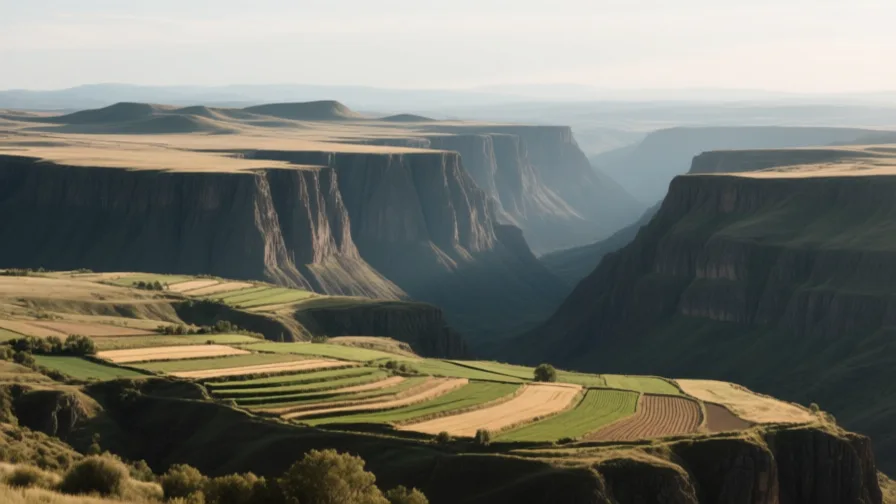 Ethiopia · AI landscape illustration · Artistic impression
Country · Africa
Ethiopia
Saved in this browser — no account needed. Sign in later and it comes with you.
Where it is
Ethiopia has no coastline, and it does not need one to feel like a country of height. A broad plateau of mountains and dissected tableland fills most of it, and most major cities sit at about 2,000 to 2,500 metres. The Great Rift Valley slices that highland diagonally from south-west to north-east, with steppe, lowland and semi-desert falling away on every side. Around 25 summits pass 4,000 metres, the highest being Ras Dashen at 4,543 metres. Because the ground tilts north-west, nearly every large river drains toward the Nile, and altitude keeps the climate far cooler than the equator would suggest.
The land and water around it
The Ethiopian Highlandsplateau
A high central plateau of mountains and cut-up tableland, with walls that rise sharply from the surrounding lowlands. Elevation peaks just before the ground drops into the Rift Valley. Height made the northern kingdoms defensible and gave cities like Gondar and Aksum a cool climate.
The Great Rift Valleyvalley
The rift runs through the plateau from south-west to north-east and divides the country between the African and Somali tectonic plates. The capital lies a few kilometres west of it. A string of lakes fills the upland valley between the two eastern ranges.
Lake Tana and the Blue Nileriver
The Abay, the upper Blue Nile, rises near Mount Denguiza and flows north to the south shore of Lake Tana. The Tekezé, the Abay and the Sobat carry about four-fifths of the highland drainage towards the Nile system, and Ethiopian rivers together supply roughly 85 per cent of the Nile’s water.
Its history, in short
Ethiopia’s deep past is physical: the fossils found in the Awash Valley, among them “Lucy”, are some of the best-preserved early hominid remains known. Written history begins in the northern highlands, first with the kingdom of D’mt and then with Aksum, whose king Ezana adopted Christianity in the fourth century. After Aksum faded, the Zagwe dynasty ruled from Lalibela until Yekuno Amlak overthrew it in 1270 and founded the Solomonic line. Wars with neighbouring Muslim states in the sixteenth century weakened the empire and opened the way for Oromo expansion, and from 1769 regional lords held the real power until Tewodros II reunited the north in 1855. Menelik II defeated an Italian army at Adwa in 1896 and went on to set the borders the country has today, so Ethiopia stayed independent while the rest of Africa was partitioned. Italy occupied it from 1936 to 1941. The monarchy fell to the Derg in 1974, the EPRDF took over in 1991, and Eritrea separated by referendum in 1993. Since 2018 armed factions have fought in several regions.
Timeline
Dates are shown on a timeline rather than as changing shapes on the map. The globe draws modern boundaries only, and tinting a modern outline to stand for a historical one would state something we cannot source.
Deep time
About 3.2 million years ago
Lucy in the Awash Valley
The Australopithecus afarensis skeleton known as Lucy, or Dinkinesh locally, was found in Afar in 1974. It is one of the most complete early hominid fossils ever uncovered, and an older relative, Ardipithecus ramidus, was found in 1994.
Approximate dateWikipedia
First cities & states
c. 980 BCE
D’mt and its capital at Yeha
The first kingdom attested by inscriptions rose in what is now Tigray and Eritrea. Historians disagree on how far it owed its form to South Arabian Sabaeans and how far to local Cushitic and Semitic-speaking peoples.
Most modern historians see a native Ethiopian civilisation; older accounts stress Sabaean colonists from southern Arabia
Classical world
c. 330 CE
Christianity under Ezana
Frumentius, consecrated first bishop of Ethiopia by Athanasius of Alexandria, converted Aksum’s king Ezana. Ezana’s coins shift from a disc and crescent to a cross, and his inscriptions record the change.
Approximate dateWikipedia
Post-classical world
1270
Yekuno Amlak founds the Solomonic line
A ruler from Shewa overthrew the Zagwe dynasty at the Battle of Ansata. His line claimed descent from the biblical Solomon and the Queen of Sheba through Aksumite legitimacy.
Well attestedWikipedia
Early modern & oceanic
1636
Gondar becomes the capital
Fasilides moved the court to Gondar after restoring the Orthodox Tewahedo church as the state religion in 1632. He built the royal fortress of Fasil Ghebbi and many churches.
Industrial & imperial
1896
Adwa
Ethiopia defeated an Italian invasion at the Battle of Adwa. Under Menelik II it then expanded and fixed its present borders, remaining independent through the Scramble for Africa.
Well attestedWikipedia1936–1941
Italian occupation
Italy invaded under Mussolini and formed Italian East Africa. British forces liberated the country in 1941, and full sovereignty returned in 1944.
Well attestedWikipedia
Contemporary
1974
The Derg
A committee of military and police officers deposed Haile Selassie on 12 September, abolished the monarchy in 1975 and declared a Marxist-Leninist state. Its rule lasted until 1991.
Well attestedWikipedia
Places that carry meaning
Yehac. 700 BCE
Capital of D’mt, in northern Ethiopia, with a temple built in a style called Sabean. No comparable architecture has been found in Yemen, which keeps the question of outside influence open.
Aksum1st century CE onward
Capital of the first great power to rise in Ethiopia, which united the northern highlands, grew into a Red Sea power and minted its own coins. The Persian religious figure Mani ranked it with Rome, Persia and China among the four great powers he knew.
LalibelaAfter the fall of Aksum
The Zagwe dynasty established its capital here after Aksum declined, and held it until the Solomonic dynasty took power in the thirteenth century.
Gondar and Fasil GhebbiFrom 1636
Gondar was the third long-term capital of the Christian kingdom and its most important centre of commerce. Fasilides built the royal fortress and forty-four churches here.
Languages here
Places are usually multilingual. This lists what is actually spoken, not one language per border.
AmharicSemitic family
The language of the Amhara and the main language of the capital.
Spoken by the Amhara, one of the four largest groups. With Oromo, Somali and Tigrinya it covers about three-quarters of the population. It is written in the Ge’ez script.
OromoCushitic family
The language of the Oromo, the country’s largest ethnic group.
Oromo belongs to the Cushitic branch of Afroasiatic. Its speakers expanded across the highlands after the sixteenth century and later gained influence at the Gondarine court.
TigrinyaSemitic family
The language of the Tigrayans in the north.
Spoken in the region where Aksum and D’mt once stood. Together with Amharic, Oromo and Somali it is one of the four languages of the largest groups.
Ge’ezSemitic family
A liturgical language and the source of the main script.
Ge’ez is no longer spoken day to day but remains the liturgical language of the Ethiopian and Eritrean Orthodox churches. The script that carries its name was first used for it in the 6th and 5th centuries BCE and now writes several of the country’s languages. Between 90 and 109 languages are counted, depending on the authority.
Learn the language here
Check yourself
Why did Ethiopia stay independent through the Scramble for Africa?
It defeated an Italian invasion at Adwa in 1896
Menelik II’s army beat Italy at Adwa in 1896, and Ethiopia then fixed its borders by its own expansion. Italy returned and occupied the country only in 1936.
Where do most of Ethiopia’s large rivers end up?
In the Nile system
The plateau slopes north-west, so the Tekezé, the Abay and the Sobat carry about four-fifths of the highland drainage toward the Nile, and Ethiopia provides roughly 85 per cent of its water.
Worth arguing about
- Ethiopia was never colonised for long, yet Italy’s occupation reshaped its capital. How should a country count a short occupation in its own story?
- A federal system built on ethnicity gave language groups regional power, and conflicts have followed. Does naming peoples in the constitution reduce tension or sharpen it?
What we have not established
These are open questions, listed rather than filled in. We would rather show a gap than a plausible guess.
How many people live in Ethiopia, and how are they divided by religion?
Estimates run from about 135 million in 2025 to 138 million in 2026, and the religious shares quoted rest on the 2007 census, so a current breakdown is not settled.
Sources
- Wikipedia · EthiopiaWikipedia · encyclopedia · checked 2026-11-24
- Wikipedia · History of EthiopiaWikipedia · encyclopedia · checked 2026-11-24
- Wikipedia · Geography of EthiopiaWikipedia · encyclopedia · checked 2026-11-24
Reviewed by Globe Quest editorial on 2026-11-24. Drafted with AI assistance and checked against the sources above before publication.