 Globe Quest
 Human Quest · LearningSign in
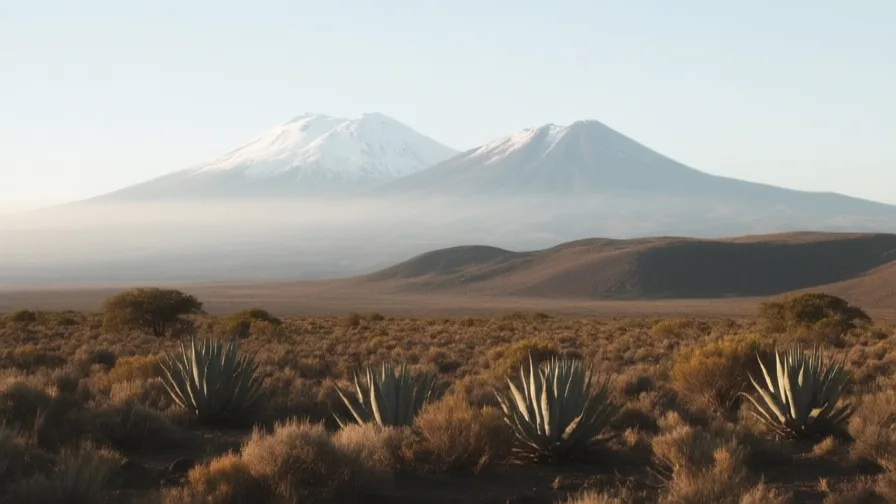 Mexico · AI landscape illustration · Artistic impression
Country · Latin America
Mexico
Saved in this browser — no account needed. Sign in later and it comes with you.
Where it is
Most of Mexico is a high country. Two great mountain ranges, the Sierra Madre Occidental in the west and the Sierra Madre Oriental in the east, enclose a plateau, the Altiplano, that is about 1,100 metres high in the north and about 2,000 in the south. Across the middle runs the Trans-Mexican Volcanic Belt, the home of the highest peaks, among them Pico de Orizaba at about 5,700 metres. Narrow coastal plains separate the mountains from the Pacific, the Gulf of California, the Gulf of Mexico and the Caribbean. Water is the main constraint: five rivers in the south-east carry over half the country’s surface water, while the north and centre, with most of the people, have under a tenth.
The land and water around it
The Mexican Altiplanoplateau
A high plateau between the two Sierras Madre. Its southern part, higher than the north, holds valleys left by ancient lakes, and some of the country’s largest cities, including Mexico City and Guadalajara, stand in them.
The Trans-Mexican Volcanic Beltvolcano
A belt about 900 kilometres long that crosses the country from the Pacific to the Gulf and holds Mexico’s highest volcanoes: Pico de Orizaba, Popocatépetl and Iztaccíhuatl. It is seismically active and treated by geographers as the dividing line between North and Central America.
The Sierra Madre rangesmountains
The Occidental range runs about 1,250 kilometres south from near the US border and the Oriental about 1,350 kilometres from Big Bend. Between them and the sea lie narrow coastal plains.
Its history, in short
People have lived in what is now Mexico for well over ten thousand years, and the domestication of maize, tomato and beans allowed farming villages to appear from about 5000 BCE. Mesoamerica produced a series of states, including the Olmecs, Maya, Zapotecs, Teotihuacan and Purépecha, and by 1519 the Mexica of the Aztec Empire dominated the centre. Hernán Cortés landed at Veracruz that year and took Tenochtitlan in 1521 with Indigenous allies, founding New Spain on the ruins. Silver from the north and its position between Europe and Asia made it a jewel of the Spanish empire. After the cry of Dolores in 1810, independence was reached in 1821. A century of coups, foreign invasions and civil wars followed, including the loss of nearly half the national territory to the United States in 1848, French intervention and the reforms of Benito Juárez. The long rule of Porfirio Díaz ended in the revolution of 1910 to 1920, which produced the 1917 constitution and a one-party state that held power for 71 years until 2000. Since NAFTA in 1994, the economy has been closely tied to North America.
Timeline
Dates are shown on a timeline rather than as changing shapes on the map. The globe draws modern boundaries only, and tinting a modern outline to stand for a historical one would state something we cannot source.
First cities & states
From about 5000 BCE
Farming villages
Maize, tomato and beans are domesticated, and the agricultural surplus supports settled villages and later states across Mesoamerica.
Approximate dateWikipedia
Early modern & oceanic
1519–1521
The fall of the Aztec Empire
Cortés lands at Veracruz in 1519. With Indigenous allies he captures Tenochtitlan in 1521 and founds Mexico City on its ruins, beginning three centuries of rule as New Spain.
Industrial & imperial
16 September 1810
The Cry of Dolores
The priest Miguel Hidalgo called his parishioners to arms in Dolores, starting the war for independence. He was executed in 1811 and independence came in 1821.
Well attestedWikipedia1848
Loss of territory
In the war with the United States, Mexico gives up close to half of its land.
Well attestedWikipedia1857–1867
Reform and French intervention
A liberal constitution separates church and state, civil war follows, and the French impose Maximilian as emperor before Benito Juárez’s republicans overthrow him.
Well attestedWikipedia1910–1920
The Mexican Revolution
Uprisings after a fraudulent election drive Díaz out in 1911 and lead to a decade of conflict and the constitution of 1917.
Well attestedWikipedia
Contemporary
Places that carry meaning
Mexico CityFrom about 1325
The capital, built on the island site of Tenochtitlan in a former lake, and the centre of the largest metropolitan area in the country with about 21.8 million people in 2020.
TeotihuacanPre-Columbian
Inscribed as a World Heritage Site in 1987, and among the best examples of ancient pyramid building in Mesoamerica.
Zacatecas and GuanajuatoColonial era
The two most important silver mining areas of the colony. Fighting during the independence war damaged them and with them the engine of the colonial economy.
Languages here
Places are usually multilingual. This lists what is actually spoken, not one language per border.
SpanishRomance family
The de facto national language.
Spoken by nearly everyone, which gives Mexico more Spanish speakers than any other country. Mexican Spanish differs from region to region in sound, structure and vocabulary.
Indigenous languages
Spoken by about 8.3 million people in 2015.
The federal government recognises 68 linguistic groups and 364 varieties. The country’s name comes from the Nahuatl name for the Mexica heartland.
Learn the language here
Check yourself
Which feature holds Mexico’s highest volcanoes?
The Trans-Mexican Volcanic Belt
The belt crosses the country east to west and holds Pico de Orizaba, Popocatépetl and Iztaccíhuatl. The Altiplano lies to the north of it.
What started the war of independence in 1810?
A call to arms by the priest Miguel Hidalgo in Dolores
The Cry of Dolores on 16 September 1810 is celebrated as Independence Day. Hidalgo was executed in 1811, but independence came in 1821.
Worth arguing about
- Most Mexicans live in the dry north and centre while most of the water is in the south-east. How should a country manage that mismatch?
- The capital sits on the ruins of an Aztec city and the country’s name comes from Nahuatl. How present is the pre-Hispanic past in how Mexico understands itself?
What we have not established
These are open questions, listed rather than filled in. We would rather show a gap than a plausible guess.
How large is Mexico?
Totals differ by source and by what is counted: about 1,972,550 square kilometres in one count, and a lower figure of about 1,957,000 in another. Islands and water are treated differently.
Sources
- Wikipedia · MexicoWikipedia · encyclopedia · checked 2026-11-24
- Wikipedia · History of MexicoWikipedia · encyclopedia · checked 2026-11-24
- Wikipedia · Geography of MexicoWikipedia · encyclopedia · checked 2026-11-24
Reviewed by Globe Quest editorial on 2026-11-24. Drafted with AI assistance and checked against the sources above before publication.