 Globe Quest
 Human Quest · LearningSign in
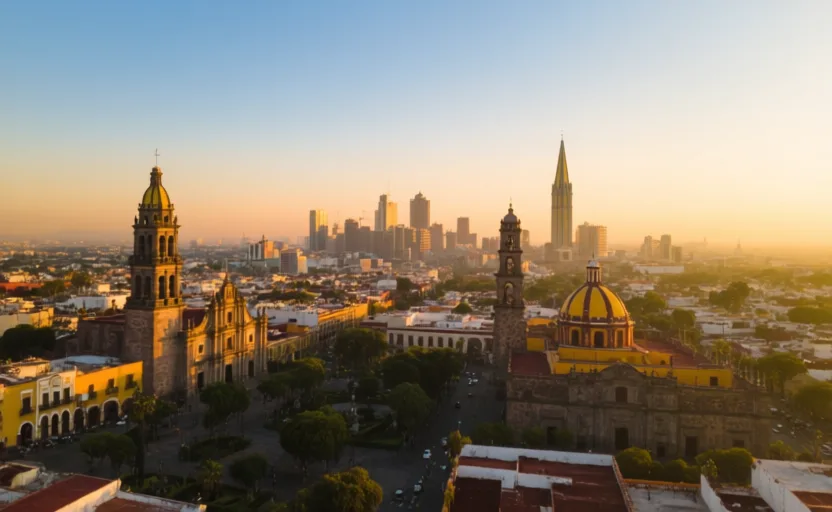 Guadalajara · AI city illustration · Artistic impression
City · Latin America
Guadalajara
Saved in this browser — no account needed. Sign in later and it comes with you.
Where it is
Guadalajara fills the Atemajac Valley in western Mexico, on the high southern Altiplano, a little over 1,500 metres above sea level. To the north the Barranca de Huentitán cuts a deep gorge, and to the west the La Primavera forest and the Los Colomos woods give the metropolitan area more green space than Mexico City or Monterrey have. Warm all year, the climate swings between a dry winter and a wet summer, when the northward shift of the tropical rain belt brings heavy rain. The city has spread so far that it has swallowed its neighbouring villages and merged with Zapopan, Tlaquepaque and Tonalá into one metropolitan area.
The land and water around it
The Atemajac Valleyvalley
Unlike the villages that surrounded it, the central valley had no settlements before the Spanish chose it. Guadalajara’s grid grew out into the plain, absorbing the surrounding villages one by one.
La Barranca de Huentitáncanyon
A deep gorge, a national park, just north of the municipality. Together with La Primavera forest and Los Colomos it forms the green belt of a city that otherwise has little room for trees.
La Primavera Forestforest
A forest west of the city whose pines, oaks and sweetgum are among the most important natural areas in the metropolitan zone.
Its history, in short
Guadalajara moved three times before it stayed. The first Spanish settlement of 1532 was in the north and failed for want of water, a second near Tonalá came next, and a third at Tlacotán was swept up in the Mixtón War, in which the Caxcan and neighbouring peoples fought the colonisers under Tenamaxtli. The survivors credited the Archangel Michael, now the city’s patron, and moved once more, in 1542, to the Atemajac Valley, naming the town after the Spanish birthplace of the conqueror Nuño de Guzmán. It became capital of the Kingdom of Nueva Galicia, grew rich after silver discoveries, and by the eighteenth century was Mexico’s second-largest city. In December 1810 Miguel Hidalgo set up Mexico’s first insurgent government here and decreed the abolition of slavery. The city flourished under Díaz, was spared the worst of the revolution, and in 1929 saw the end of the Cristero War. Its population passed one million in 1964 and rose to 2.5 million by 1980. Today it is known for electronics and software and for mariachi, tequila and a film festival.
Timeline
Dates are shown on a timeline rather than as changing shapes on the map. The globe draws modern boundaries only, and tinting a modern outline to stand for a historical one would state something we cannot source.
Early modern & oceanic
1532–1542
Three failed sites
Cristóbal de Oñate founded the first settlement in 1532. It was moved near Tonalá in 1533 and to Tlacotán a few years later, partly for lack of water and partly because of the Mixtón War of 1540 to 1542.
Well attestedWikipedia14 February 1542
Foundation in the Atemajac Valley
The city was officially founded at its present site, with about 126 residents at the time.
Well attestedWikipedia1559–1560
Capital of Nueva Galicia
Royal and church offices were moved here from Compostela, and in 1560 the city became the province’s capital. Work on the cathedral began in 1563.
Well attestedWikipedia
Industrial & imperial
6 December 1810
Slavery abolished
Miguel Hidalgo, in the city with his insurgent army, proclaimed the abolition of slavery. Royalist forces defeated him at Calderón Bridge in January 1811.
Well attestedWikipedia1823
Capital of the state of Jalisco
After independence the old kingdom became the state of Jalisco, with Guadalajara as its capital.
Well attestedWikipedia1929
End of the Cristero War
President Plutarco Elías Calles proclaimed the Grito de Guadalajara, bringing the war to an end within the city’s confines.
Well attestedWikipedia
Contemporary
1964
One million people
The population passed one million. By the 1970s it was the country’s second-largest city and the largest in the west.
Well attestedWikipediaApril 1992
The sewer explosion
More than 1,000 barrels of gasoline leaked from a corroded pipeline into the sewers and exploded, killing 190 people and injuring nearly 1,500 in a working-class district.
Well attestedWikipedia
Places that carry meaning
Hospicio CabañasEarly 19th century
A hospice for orphans, the elderly and the sick, designed by Manuel Tolsá around twenty-three courtyards in single-storey blocks. Its chapel dome carries José Clemente Orozco’s frescoes, painted in the late 1930s, among them the Man of Fire.
Cathedral and Teatro DegolladoFrom 1563
The seats of church and civic life stand around the old Plaza de Armas. The cathedral, begun in 1563, and the theatre are the purest examples of neoclassical architecture in the city.
Mercado San Juan de DiosModern
The largest indoor market in Latin America, in the historic east side of the city.
Languages here
Places are usually multilingual. This lists what is actually spoken, not one language per border.
SpanishRomance family
The language of the city, whose people call themselves tapatíos.
Mexican Spanish varies from region to region in sound and vocabulary.
Indigenous languages
Spoken by migrants from other parts of Mexico.
The federal government recognises 68 linguistic groups across the country, and Indigenous language speakers number about 8.3 million nationally.
Learn the language here
- 1Understand which languages are spoken hereGuadalajara is multilingual. Start with which languages are used, by whom, and for what — the phrase list only covers one of them.Written by Globe Quest
- 2Learn 11 phrasesCurated everyday phrases for Guadalajara, with audio and a written form.Written by Globe Quest
- 3Say them out loudSpeaking practice with pronunciation feedback, one phrase at a time.Globe Quest material, your own additions
- 4Come back to themSpaced review, so what you learned this week is still there next month.Written by Globe Quest
Check yourself
Why is Guadalajara at its present site?
It moved there in 1542 after earlier sites failed
The first Spanish settlements failed for lack of water or in the Mixtón War, and the city finally settled in the Atemajac Valley, where earlier peoples had left it empty.
Who painted the frescoes of Hospicio Cabañas?
José Clemente Orozco
Orozco painted fifty-seven frescoes in the chapel in the late 1930s, with the Man of Fire in the dome.
Worth arguing about
- Guadalajara is Mexico’s second metropolis but is often seen as provincial in comparison with the capital. What does it do to a city to be the largest outside the centre?
- Mariachi comes from a nearby town but is tied to Guadalajara in the world’s mind. Who gets to own a cultural symbol?
What we have not established
These are open questions, listed rather than filled in. We would rather show a gap than a plausible guess.
How high is Guadalajara?
The municipality is given at about 1,700 metres above sea level in one account and about 1,536 metres in another, and the metropolitan area spans a range of heights.
Sources
- Wikipedia · GuadalajaraWikipedia · encyclopedia · checked 2026-11-24
- Wikipedia · MexicoWikipedia · encyclopedia · checked 2026-11-24
- Wikipedia · Geography of MexicoWikipedia · encyclopedia · checked 2026-11-24
- UNESCO · Hospicio Cabañas, GuadalajaraUNESCO World Heritage Centre · intergovernmental · checked 2026-11-24
Reviewed by Globe Quest editorial on 2026-11-24. Drafted with AI assistance and checked against the sources above before publication.