 Globe Quest
 Human Quest · LearningSign in
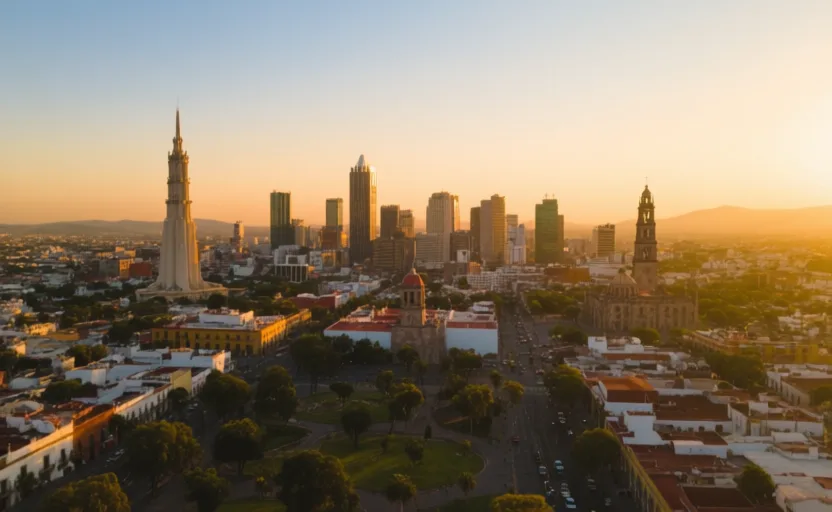 Monterrey · AI city illustration · Artistic impression
City · Latin America
Monterrey
Saved in this browser — no account needed. Sign in later and it comes with you.
Where it is
Where the Sierra Madre Oriental breaks up into foothills in north-eastern Mexico, a valley opens at about 540 metres, and Monterrey fills it. Mountains close the city in on several sides, among them the saddle-shaped Cerro de la Silla and, to the west, the Cerro de las Mitras, whose outline recalls bishops’ mitres. The Santa Catarina River crosses the city from west to east, dry on the surface most of the year but carrying water underground, and when it does flood, as in 1988, the result can be disastrous. The climate is semi-arid and among the hottest of any large Mexican city: highs reach 36 degrees in August and sometimes 30 in January.
The land and water around it
The Sierra Madre Orientalmountains
The city lies at the northern foothills of this range. The mountains to the south form the Cumbres de Monterrey National Park, a biosphere reserve since 2006, with canyons, trails and forests of oak and pine.
The Santa Catarina Riverriver
A river that is usually dry on the surface runs east to west through the city, splitting it into northern and southern halves, and drains toward the San Juan River and the Rio Grande. In 1988 Hurricane Gilbert made it overflow and more than 100 people died.
Cerro de la Sillamountains
The saddle-shaped peak that stands over the city. Together with Cerro de las Mitras to the west, it is part of the skyline that gave the city its folk etymology of “king mountain”.
Its history, in short
Monterrey’s early history is a record of failed starts. Before the Spanish, small nomadic groups, among them the Azalapas, Huachichiles, Coahuiltecos and Borrados, lived in the valley. A settlement called Santa Lucía was marked out in 1577, and in 1582 Luis Carvajal founded another, but attacks and legal trouble emptied both. The city proper was founded on 20 September 1596 by Diego de Montemayor and thirteen families, beside a spring, and named after the viceroy, the Count of Monterrey. It stayed small through the colonial period but became a trading link between San Antonio, Tampico and Saltillo. In 1824 it became the capital of the state of Nuevo León, and in 1846 it was the site of the first large battle of the Mexican–American War. The Cuauhtémoc brewery opened in 1890, a railway link arrived in the same decade and the Monterrey steel foundry followed in 1900, and the city has since become Mexico’s biggest industrial centre, home to steel, cement, glass and brewing firms. Its location near the US border has driven much of that growth.
Timeline
Dates are shown on a timeline rather than as changing shapes on the map. The globe draws modern boundaries only, and tinting a modern outline to stand for a historical one would state something we cannot source.
Early modern & oceanic
1577
Santa Lucía
The captain Alberto del Canto marked out a first settlement in the valley, which was abandoned after attacks by local peoples.
1582
San Luis Rey de Francia
Luis Carvajal founded a second settlement on the same ground, which was depopulated in the violence that followed.
20 September 1596
Monterrey founded
Diego de Montemayor led thirteen families to found the Metropolitan City of Our Lady of Monterrey beside the Ojos de Agua de Santa Lucía spring, where the Museum of Mexican History now stands.
Well attestedWikipedia
Industrial & imperial
1824
Capital of Nuevo León
The New Kingdom of León became a state and Monterrey was chosen as its capital.
Well attestedWikipedia1846
Battle of Monterrey
The first major clash of the Mexican–American War was fought in the city. Mexican forces surrendered only after repelling the first US advances, with heavy casualties on both sides.
Well attestedWikipedia1900
The steel foundry
The Monterrey foundry, one of the world’s biggest, started production and accelerated the city’s industrialisation. The Cuauhtémoc brewery had begun in 1890.
Well attestedWikipedia
Contemporary
1988
Hurricane Gilbert
The normally dry Santa Catarina overflowed, killing more than 100 people.
Well attestedWikipediaSummer 2022
Drought and cut water supply
Reservoirs fell to as low as 1 per cent, and water was cut off for weeks in some areas and limited to six hours a day in others, before heavy rains refilled them in September.
Well attestedWikipedia
Places that carry meaning
Santa Lucía Riverwalk1996–2007
An artificial river built to link the Macroplaza with Fundidora Park, passing the spring beside which the city was founded.
Parque FundidoraFrom 1900
A park named after the steel foundry that drove the city’s industrial growth, at the end of the Santa Lucía riverwalk.
Cumbres de Monterrey National ParkNatural
Mountains south of the city with trails, canyons and the Chipinque park, within UNESCO’s Man and the Biosphere programme.
Languages here
Places are usually multilingual. This lists what is actually spoken, not one language per border.
SpanishRomance family
The language of the city.
Spanish arrived with the founding families in 1596. Local food, such as cabrito cooked on embers, and norteño music are part of a distinct northern culture.
Chinese
Seen on signs in a recent industrial district.
After the USMCA trade agreement, an industrial Chinatown took shape to benefit from duty-free trade with the United States, with signs in both Spanish and Chinese.
Learn the language here
- 1Understand which languages are spoken hereMonterrey is multilingual. Start with which languages are used, by whom, and for what — the phrase list only covers one of them.Written by Globe Quest
- 2Learn 11 phrasesCurated everyday phrases for Monterrey, with audio and a written form.Written by Globe Quest
- 3Say them out loudSpeaking practice with pronunciation feedback, one phrase at a time.Globe Quest material, your own additions
- 4Come back to themSpaced review, so what you learned this week is still there next month.Written by Globe Quest
Check yourself
What is unusual about Monterrey’s river?
It is dry on the surface for most of the year but can flood violently
The Santa Catarina carries water underground most of the time, but in 1988 Hurricane Gilbert made it overflow with deadly results.
Who founded Monterrey in 1596?
Diego de Montemayor
Montemayor led thirteen families after earlier attempts in 1577 and 1582 had failed. He named the city after the viceroy, the Count of Monterrey.
Worth arguing about
- Monterrey grew because of its position between Texas, the Gulf and central Mexico. What does it do to a city’s politics to be built on trade routes more than on a state capital’s power?
- A semi-arid city on an almost always dry river depends on distant reservoirs. How should it plan for years like 2022?
What we have not established
These are open questions, listed rather than filled in. We would rather show a gap than a plausible guess.
When did the steel works that drove industrialisation begin?
One account places the foundry’s founding in 1900 and another says industrialisation was accelerated by the steel company in the mid-nineteenth century, so the exact start of heavy industry is unclear.
Sources
- Wikipedia · MonterreyWikipedia · encyclopedia · checked 2026-11-24
- Wikipedia · History of MonterreyWikipedia · encyclopedia · checked 2026-11-24
- Wikipedia · MexicoWikipedia · encyclopedia · checked 2026-11-24
Reviewed by Globe Quest editorial on 2026-11-24. Drafted with AI assistance and checked against the sources above before publication.