 Globe Quest
 Human Quest · LearningSign in
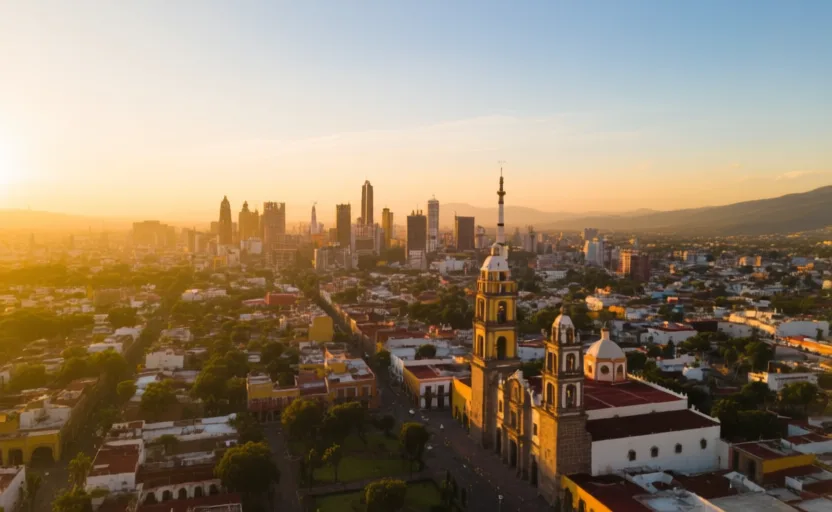 Zapopan · AI city illustration · Artistic impression
City · Latin America
Zapopan
Saved in this browser — no account needed. Sign in later and it comes with you.
Where it is
Zapopan lies north-west of the old centre of Guadalajara, in the same high valley of the southern Altiplano, and today shares one continuous built-up area with it. Two roads once joined the villa to Guadalajara, one crossing the Colomos stream and entering the west of the city, the other running east through Zoquipan and Atemajac. The older villages around it, such as Tesistán to the north-west and Santa Ana Tepetitlán to the south, are now parts of the same municipality, which is the most populous in Jalisco. The name means “among the sapote trees”, and the municipality was long known as the former corn village.
The land and water around it
The Colomos streamriver
A stream that once separated Zapopan from the west of Guadalajara. One of the two old roads between the villa and the city crossed it.
The southern Altiplanoplateau
Zapopan lies in one of the valleys of the southern Altiplano, a high plateau whose valleys were formed by ancient lakes and which also holds Mexico City.
Its history, in short
Historians disagree about how much was here before the Spanish. Some describe a sizeable Tecuexe settlement, called Tzapopan, with sun shrines and maize cultivation, under the authority of Atemajac and the larger Tonalá, though one that was shrinking from wars with nomadic neighbours. Others point out that no document of the time mentions it, unlike nearby Ixcatán, Tesistán and Tonalá. What is clear is that Nuño de Guzmán’s conquest reached the area around 1530, but the Spanish did not settle until after the Mixtón War, in 1541. That year the encomendero Francisco de Bobadilla moved about 130 Indigenous people to the site, together with an image of the Virgin Mary that became Our Lady of Zapopan. A shrine grew around her, and the basilica was begun in the late 1600s. In 1824 the new state of Jalisco made Zapopan the seat of one of its departments, and fighting between General Ramón Corona and rebels under Manuel Lozada took place nearby in 1873. John Paul II came to the basilica in 1979.
Timeline
Dates are shown on a timeline rather than as changing shapes on the map. The globe draws modern boundaries only, and tinting a modern outline to stand for a historical one would state something we cannot source.
Post-classical world
1160–1325
A pre-Hispanic settlement?
One account has Zapotec, Nahua and Maya groups moving into the area between about 1160 and 1325 and mixing with later arrivals. Another notes that contemporary documents do not mention a settlement at the site.
DisputedWikipediaSome regional historians describe a Tecuexe town; others argue there is no written evidence for one
Early modern & oceanic
c. 1530
Conquest
Nuño de Guzmán conquered the Kingdom of Tonalá, which included Zapopan. Spanish settlement waited until after the Mixtón War.
Approximate dateWikipedia8 December 1541
The image of the Virgin arrives
Two friars set a statue of the Virgin Mary in the settlement, and she became its patroness. Some accounts add that Francisco de Bobadilla resettled about 130 Indigenous people here the same year, but others argue that the Indigenous communities east of the river were not displaced.
DisputedWikipediaColonial chronicles and later historians differ on whether the area was repopulated
1689–1690
The sanctuary is begun
Construction of a sanctuary and then the present basilica began for the statue, which would take on the name Our Lady of Zapopan.
Approximate dateWikipedia
Industrial & imperial
27 March 1824
A department of Jalisco
Under the political division plan of the new state, Zapopan became the seat of one of its departments and a villa, ratified again in November when the constitution was published.
Well attestedWikipedia1873
Corona against Lozada
General Ramón Corona fought rebels led by Manuel Lozada, known as the Tiger of Álica, at the Rancho de la Mojonera.
Well attestedWikipedia
Contemporary
1979
Papal visit
The pope came to the basilica of Our Lady of Zapopan.
Well attestedWikipedia
Places that carry meaning
Basilica of Our Lady of ZapopanFrom the late 17th century
The shrine that houses the sixteenth-century image of the Virgin Mary. Several popes have recognised it.
Ixtépete5th to 10th century
An archaeological zone with a pyramidal structure that shows Teotihuacan influence, one of three important archaeological sites in the municipality, alongside El Grillo.
El GrilloPre-Hispanic
A site north of the Atemajac Valley beside a stream that is now dry, with fourteen shaft tombs.
Languages here
Places are usually multilingual. This lists what is actually spoken, not one language per border.
SpanishRomance family
The language of the municipality.
Spanish is the national language of Mexico. Everyday life in Zapopan is lived in it, in the same Mexican Spanish used across the Guadalajara area.
NahuatlUto-Aztecan family
The source of the municipality’s name.
Zapopan comes from the Nahuatl tzapotl, “sapote”, with the locative ending -pan. The area’s own pre-Hispanic people are recorded as Tecuexes.
Learn the language here
- 1Understand which languages are spoken hereZapopan is multilingual. Start with which languages are used, by whom, and for what — the phrase list only covers one of them.Written by Globe Quest
- 2Learn 12 phrasesCurated everyday phrases for Zapopan, with audio and a written form.Written by Globe Quest
- 3Say them out loudSpeaking practice with pronunciation feedback, one phrase at a time.Globe Quest material, your own additions
- 4Come back to themSpaced review, so what you learned this week is still there next month.Written by Globe Quest
Check yourself
What does the name Zapopan mean?
Among the sapote trees
It comes from the Nahuatl tzapotl, sapote, plus the locative ending -pan. Zapopan was also long known as the former corn village.
What object became the centre of Zapopan’s religious life?
A statue of the Virgin Mary
The image placed in 1541 became Our Lady of Zapopan, patroness of the town, and the basilica built for her draws pilgrims and popes.
Worth arguing about
- A shrine to the Virgin was placed at a place that may or may not have been a pre-Hispanic centre. How much does the choice of a site explain what later grew there?
- Zapopan is now the largest municipality in its state but part of a metropolis named after its neighbour. What does a city lose when its identity is folded into a larger one?
What we have not established
These are open questions, listed rather than filled in. We would rather show a gap than a plausible guess.
Was there a significant pre-Hispanic town at Zapopan, and when were its people resettled?
Accounts of a large Tecuexe settlement and of resettlement in 1541 conflict with the lack of contemporary documents and with chronicles that say Indigenous communities were not displaced. The date of the basilica’s start is also given as 1689 and 1690.
Sources
- Wikipedia · ZapopanWikipedia · encyclopedia · checked 2026-11-24
- Wikipedia · MexicoWikipedia · encyclopedia · checked 2026-11-24
- Wikipedia · Geography of MexicoWikipedia · encyclopedia · checked 2026-11-24
Reviewed by Globe Quest editorial on 2026-11-24. Drafted with AI assistance and checked against the sources above before publication.