 Globe Quest
 Human Quest · LearningSign in
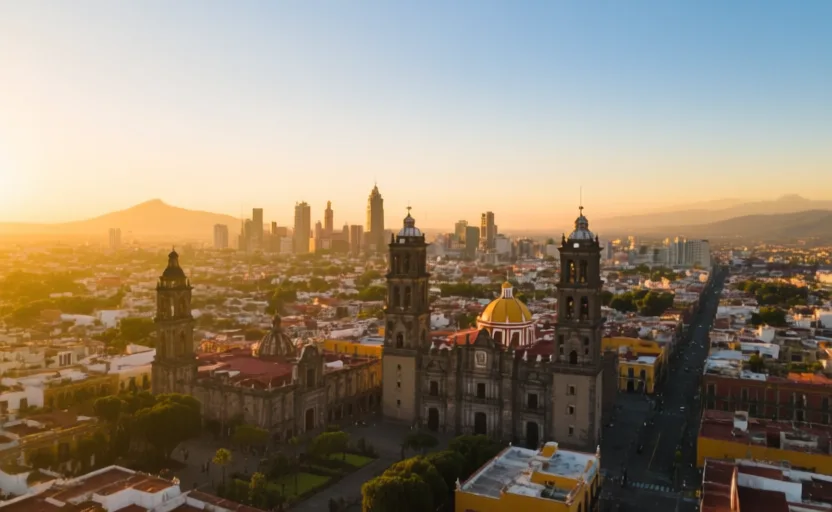 Puebla · AI city illustration · Artistic impression
City · Latin America
Puebla
Saved in this browser — no account needed. Sign in later and it comes with you.
Where it is
A broad valley ringed by mountains holds the city, at around 2,100 metres in the southern part of central Mexico. It is the Valley of Cuetlaxcoapan, part of the Trans-Mexican Volcanic Belt, and from it the snow-capped Popocatépetl and Iztaccíhuatl can be seen about 40 kilometres to the west. La Malinche stands to the north and the Pico de Orizaba to the east. Three rivers cross the valley, and the altitude keeps the climate temperate: dry winters, a rainy season from mid-May to mid-October, and few really hot days. The city lies roughly 100 kilometres east-southeast of Mexico City and 220 kilometres west of Veracruz.
The land and water around it
The volcanoes around the valleyvolcano
Popocatépetl and Iztaccíhuatl lie to the west, La Malinche to the north and Pico de Orizaba to the east. Popocatépetl is active, and ash from it falls on the city in some periods, most recently on 19 May 2023.
The Atoyac basin and its riversriver
The Atoyac river runs through the north, east and south of the municipality and ends at the Valsequillo reservoir. The San Francisco and Alseseca also cross the area. The San Francisco shaped the early city: the first settlement beside it flooded, and most settlers moved to higher ground across the river.
A highland climateclimate
At about 2,100 metres in the tropics, the city has a subtropical highland climate. Only about three days a year rise above 29 °C and nights stay cool at all seasons.
Its history, in short
Puebla was not built on an earlier indigenous capital. Spanish settlers laid it out in 1531 on empty land between Tlaxcala and Cholula, a valley the surrounding peoples had reserved for their ritual “flower wars”. The aim was practical: a Spanish town with no encomiendas, planted on the road from Mexico City to the Atlantic port at Veracruz. A legend credits Bishop Julián Garcés with a dream of angels tracing the plan, which is where the name Puebla de los Ángeles comes from. The first site flooded, so the settlers moved across the San Francisco River. The city gained royal titles in the sixteenth century and became a centre of textiles and ceramics, and its building campaigns left the baroque-tiled historic centre. In the nineteenth century it was occupied by US troops in 1847 and was the site of a Mexican victory over the French on 5 May 1862. Industry, including a large Volkswagen plant nearby, now dominates its economy.
Timeline
Dates are shown on a timeline rather than as changing shapes on the map. The globe draws modern boundaries only, and tinting a modern outline to stand for a historical one would state something we cannot source.
Early modern & oceanic
16 April 1531
Foundation of the city
The official founding date is 16 April 1531, after a letter from Bishop Garcés asking for a Spanish settlement between Mexico City and Veracruz. The first attempt failed because the riverside site flooded, and the settlers moved to higher ground.
1538
Coat of arms
Charles V granted the city its coat of arms in 1538, after the title of city in 1532. Further titles followed in 1558 and 1576, the last being “Very Noble and Very Loyal City”.
Well attestedUNESCO World Heritage Centre1575
The cathedral begun
Philip II ordered the cathedral started in 1575. Interruptions meant it took some three hundred years to finish.
Well attestedWikipedia1646
The Palafox Library
The library was established in the former archbishop’s palace and is credited with being the first library in the Americas. The Memory of the World Programme listed it in 2005.
Industrial & imperial
1847
Occupation by US forces
General Winfield Scott’s troops took the city without a shot, and its garrison was besieged for four weeks until it was relieved. The Americans left in July 1848.
Well attestedWikipedia5 May 1862
Battle of Puebla
Mexican forces under Ignacio Zaragoza repelled a French army. A decree of Benito Juárez the same year added Zaragoza’s name to the city, and 5 May is still a major local holiday. The French took the city in 1863 and left in 1866.
Well attestedWikipedia18 November 1910
The Serdán conspiracy
Siblings Carmen, Máximo and Aquiles Serdán plotted against the government of Porfirio Díaz. Federal troops surrounded their house, and the two brothers were killed in a gun battle.
Well attestedWikipedia
Places that carry meaning
The historic centreFrom 1531
Founded on a Renaissance grid of rectangular squares, the centre has many 16th and 17th-century buildings and houses clad in coloured azulejo tiles. UNESCO notes that its baroque style blends European and indigenous traditions.
Puebla Cathedral1575 onward
Begun under Philip II by the architects Francisco Becerra and Juan de Cigorondo, it was built over roughly three centuries. It anchors the plaza that the Spanish plan centred on.
Casa del DeánFinished 1580
The oldest noble house in the city was built for the cathedral dean Tomás de la Plaza Goes, evidence of how early the church and its officials shaped the town.
The Palafox Library1646
Housed in the former archbishop’s palace, it is held to be the first library in the Americas and appears on UNESCO’s Memory of the World register.
Languages here
Places are usually multilingual. This lists what is actually spoken, not one language per border.
SpanishRomance family
The language of daily life and administration.
Spanish is Mexico’s de facto national language, spoken by the great majority of the population, and it varies in sound and vocabulary from region to region. Puebla began as a Spanish colonial town, and later waves of settlers from Spain, Italy, Germany, France and Lebanon joined it around 1900.
Indigenous languages
Spoken by the descendants of the valley’s older peoples.
Mexico’s government recognises 68 linguistic groups and 364 varieties, and an estimated 8.3 million people spoke one in 2015. Before the conquest, the state was home to Nahua, Mixtec, Popoloca, Totonac, Mazatec and Otomi peoples.
Learn the language here
- 1Understand which languages are spoken herePuebla is multilingual. Start with which languages are used, by whom, and for what — the phrase list only covers one of them.Written by Globe Quest
- 2Learn 12 phrasesCurated everyday phrases for Puebla, with audio and a written form.Written by Globe Quest
- 3Say them out loudSpeaking practice with pronunciation feedback, one phrase at a time.Globe Quest material, your own additions
- 4Come back to themSpaced review, so what you learned this week is still there next month.Written by Globe Quest
Check yourself
Where was Puebla founded in 1531?
On open land between the indigenous centres of Tlaxcala and Cholula
It was planned as a Spanish city on empty land, not on top of an indigenous city, to anchor the road between Mexico City and Veracruz.
Why did the first settlers move across the San Francisco River?
The riverside site kept flooding
The first site beside the river flooded repeatedly, so most of the population moved to higher ground; a few families stayed behind in the settlement called Alto de San Francisco.
Worth arguing about
- Puebla was founded as a Spanish town on land the surrounding peoples used for ritual war. Does a city planned from nothing carry a different relationship to the land than one grown from an older capital?
- The historic centre is protected, so industry has moved to the edges. Is preserving a colonial centre a way of honouring the past, or of freezing one version of it?
What we have not established
These are open questions, listed rather than filled in. We would rather show a gap than a plausible guess.
How many people live in Puebla?
The metropolitan area, the fourth largest in Mexico, is given as about 3.3 million, but the city proper is counted on a much narrower boundary, so figures for the two are not comparable.
How many residents speak an Indigenous language?
Language counts are given for Mexico as a whole, not for the city, so the number of speakers of each language in Puebla itself is unknown.
Sources
- Wikipedia · Puebla (city)Wikipedia · encyclopedia · checked 2026-11-24
- Wikipedia · PueblaWikipedia · encyclopedia · checked 2026-11-24
- UNESCO · Historic Centre of PueblaUNESCO World Heritage Centre · intergovernmental · checked 2026-11-24
- Wikipedia · MexicoWikipedia · encyclopedia · checked 2026-11-24
Reviewed by Globe Quest editorial on 2026-11-24. Drafted with AI assistance and checked against the sources above before publication.