 Globe Quest
 Human Quest · LearningSign in
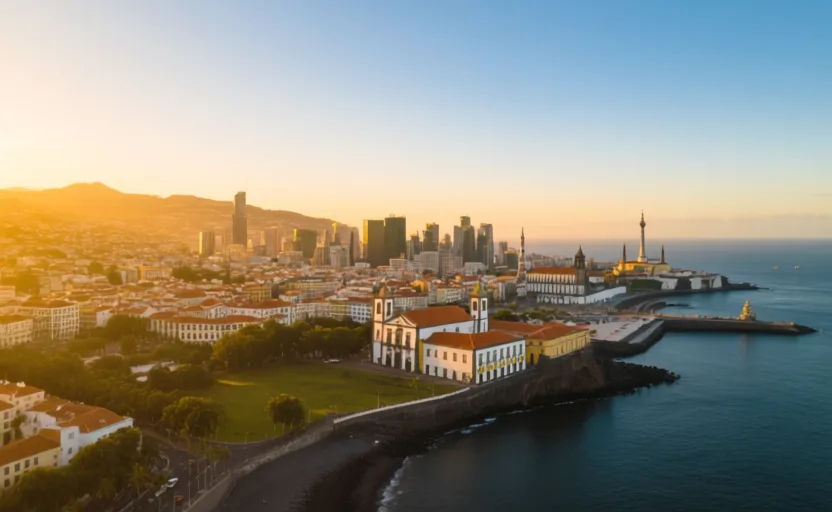 Funchal · AI city illustration · Artistic impression
City · Europe
Funchal
Saved in this browser — no account needed. Sign in later and it comes with you.
Where it is
Funchal fills a natural amphitheatre on the south coast of Madeira, where slopes run up from the sea to about 1,200 metres and give the city natural shelter. The urban area climbs from sea level to around 800 metres on its northern side, so it is common to have fog and rain in the high suburbs while the harbour has clear sky. The climate is warm all year, with a dry summer from May to September and a wetter winter, and in early summer cloud often settles over the whole bay, a feature locally called Funchal’s helmet. The municipality also includes the Selvagens Islands, a nature reserve about 294 kilometres to the south.
The land and water around it
The amphitheatre valleyvalley
The gentle slopes that start at the shore and rise toward the mountains gave early settlers shelter. That shape also divides the city by altitude, so the lower town by the sea has a different weather and a different feel from the suburbs on the mountainside.
The laurel forestforest
In the centre of the island, the Laurisilva of Madeira is the largest surviving area of primary laurel forest. It covers a series of steep, V-shaped valleys running down to the north coast, and it is a remnant of a forest type that once spread across much of southern Europe 15 to 40 million years ago. It plays a major part in the island’s water balance.
The Atlantic islandisland
Madeira is a volcanic island on the African tectonic plate, in the Atlantic Ocean. Caravels travelling between the Indies and the New World called at Funchal in the 1500s.
Its history, in short
Funchal is named after the wild fennel that covered the site when settlers arrived between 1420 and 1425, led by João Gonçalves Zarco. Its position on the sheltered south coast, with the most productive land on the island, made it the island’s port and trading base. It became a municipal seat in 1452, and in the second half of the 15th century it was the main centre of Madeira’s sugar industry, drawing merchant families from Genoa, Florence, Biscay and elsewhere. King Manuel made it a city in 1508 and its cathedral was completed in 1514, when the bishopric was established. In 1566 French corsairs sacked it for fifteen days, after which the defences were redesigned. When sugar lost out to cheaper imports from the New World and Africa, wine, above all Madeira wine, took its place, and English merchants and commercial treaties built up the trade. In the 19th century the mild climate drew royal visitors and others seeking health, the beginning of its tourism.
Timeline
Dates are shown on a timeline rather than as changing shapes on the map. The globe draws modern boundaries only, and tinting a modern outline to stand for a historical one would state something we cannot source.
Post-classical world
1420–1425
Settlement begins
Settlers led by João Gonçalves Zarco name the place after the fennel growing there, funcho in Portuguese. The island is divided into two captaincies, and Funchal’s coastal site quickly outgrows the island’s other settlements.
Approximate dateWikipedia
Early modern & oceanic
1452
A municipal seat
The settlement receives its first lighthouse between 1452 and 1454, when it becomes a vila and the seat of the municipality. It becomes a transfer point for European commercial interests.
Well attestedWikipedia1455
Madeira wine is noticed
The Venetian navigator Luís de Cadamosto visits and remarks on the excellence of the island’s wines, chiefly the Malvasia grape from Crete, which are being exported in growing quantity.
Well attestedWikipedia1508
City and bishopric
King Manuel I raises Funchal to the status of a city, and in 1514, when the Sé Cathedral is completed, the bishopric is established in it.
Well attestedWikipediaSeptember 1566
The corsair sack
French corsairs under Bertrand de Montluc land 800 men from a fleet that left Bordeaux with about 1,200 and meet almost no resistance. The sack lasts fifteen days, after which little remains.
Well attestedWikipedia1573
The city is re-fortified
The military architect Mateus Fernandes III is sent in 1567 to rebuild the defences. His 1573 map is considered the oldest plan of the city.
Well attestedWikipedia17th century
English wine merchants
Commercial treaties with England bring investment to a wine trade that had been mostly local, and many English wine-makers move to the island. They change the economy, the architecture and the way of life, building three-storey houses with cellars for the wine, and sometimes a tower from which to watch shipping in the port.
Approximate dateWikipedia
Industrial & imperial
19th century
A health resort
Royal and aristocratic visitors come for the climate, among them Queen Adelaide of the United Kingdom, the Dutch Prince Alexander, who died here in 1848, and the Empress of Austria-Hungary. Funchal becomes a centre of tourism and therapeutic health.
Approximate dateWikipedia
Places that carry meaning
The Sé CathedralBegun 1493
Construction began in 1493 and was completed in 1514. It is dedicated to Our Lady of the Assumption and is the seat of the bishop whose diocese covers the whole of Madeira.
The sixteenth-century defences1567 onward
Redesigned after the corsair raid, the system included a large fortification near the dyke at Pena. Mateus Fernandes’s plan of 1573 records it, and the earlier weakness is on record: the defenders could not even turn many of their cannon toward the land.
Holy Trinity ChurchAnglican services since 1822
The Anglican church on Rua do Quebra Costas also looks after the British Cemetery, and the first recorded Protestant service on the island was in 1774. The synagogue of 1836 is now disused.
Languages here
Places are usually multilingual. This lists what is actually spoken, not one language per border.
PortugueseRomance family
The language of the city and the island.
Funchal has been a Portuguese settlement since its founding in the 1420s, though its merchant class was drawn from Genoa, Florence, Biscay, France and Valencia.
EnglishGermanic family
A long-established second language of the wine trade and tourism.
English wine-makers settled here in the 17th century, Anglican services have been held since 1822, and the Baptist church holds its morning services in English. Funchal is also a major destination for visitors and cruise ships.
Learn the language here
- 1Understand which languages are spoken hereFunchal is multilingual. Start with which languages are used, by whom, and for what — the phrase list only covers one of them.Written by Globe Quest
- 2Learn 11 phrasesCurated everyday phrases for Funchal, with audio and a written form.Written by Globe Quest
- 3Say them out loudSpeaking practice with pronunciation feedback, one phrase at a time.Globe Quest material, your own additions
- 4Come back to themSpaced review, so what you learned this week is still there next month.Written by Globe Quest
Check yourself
Where does the name Funchal come from?
The Portuguese word for fennel, which grew wild on the site
The first settlers named the place after the wild fennel, funcho, with the suffix -al meaning a plantation of it.
What pushed Madeira’s economy from sugar toward wine?
Cheaper sugar from the New World and Africa, plus epidemics and the aftermath of the 1566 raid
Sugar had made Funchal the island’s main industrial centre in the 15th century. The industry was undercut by cheaper imports, so viticulture expanded, and English treaties and merchants later built the trade.
Worth arguing about
- Funchal’s fortunes have followed one export after another: sugar, then wine, then the visitors themselves. What happens to a small island economy that always rests on a single product?
- The city is stacked up a mountainside, so weather and wealth change with altitude. How do cities on steep ground manage to stay connected?
What we have not established
These are open questions, listed rather than filled in. We would rather show a gap than a plausible guess.
How many people live in Funchal?
The figure depends on the boundary: about 105,800 for the city and roughly 150,000 for the wider urban area that includes neighbouring parishes such as Câmara de Lobos and Santa Cruz.
Sources
- Wikipedia · FunchalWikipedia · encyclopedia · checked 2026-11-24
- Wikipedia · Geography of PortugalWikipedia · encyclopedia · checked 2026-11-24
- UNESCO · Laurisilva of MadeiraUNESCO World Heritage Centre · intergovernmental · checked 2026-11-24
Reviewed by Globe Quest editorial on 2026-11-24. Drafted with AI assistance and checked against the sources above before publication.