 Globe Quest
 Human Quest · LearningSign in
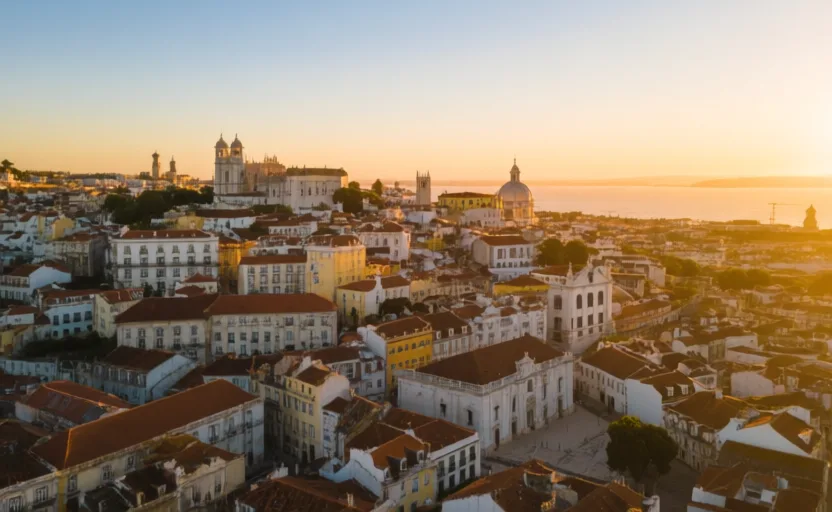 Faro · AI city illustration · Artistic impression
City · Europe
Faro
Saved in this browser — no account needed. Sign in later and it comes with you.
Where it is
Faro is the southernmost city on the Portuguese mainland, and it looks out over a lagoon rather than the open sea. Between the town and the Atlantic lies the Ria Formosa, a belt of channels, marsh and mudflats screened by sandy barrier islands, and the city’s beaches are on those islands and the peninsula. Inland the municipality rises into low hills and valleys, the barrocal. The climate is Mediterranean, hot and dry in summer. Rainfall averages about 500 millimetres a year but has fallen sharply in recent years, and the city has more tropical nights than anywhere else in Portugal.
The land and water around it
The Ria Formosalagoon
A system of channels, marshes and islets sealed from the ocean by barrier islands and peninsulas, including the Ancão peninsula and the islands of Barreta and Culatra, with tidal inlets between them. It is a protected nature park, created in 1987, and each year migratory waterbirds such as flamingos and avocets winter in it.
The barrocalhills
The inland part of the municipality is a country of low hills and valleys planted with typical Algarve vegetation, in contrast with the flat, wet coastal strip.
A dry southern climateclimate
Most rain falls in winter, and little falls between June and September. Rainfall once averaged about 500 millimetres a year, but only 178.6 millimetres fell in 2019, and the average between 2017 and 2021 was closer to 350. The record minimum temperature for Portugal, 32 degrees Celsius, was set at Faro on 26 July 2004.
Its history, in short
The lagoon has drawn people since the Palaeolithic, and the first settlements, in the period of Phoenician colonisation, are dated to the 4th century BC. The town was Ossonoba, a port exporting farm produce, fish and minerals, and it kept its standing under Rome, Byzantium and the Visigoths, when it was a bishop’s seat. After the Moorish conquest in 713 it became a short-lived princedom and later the port of Santa Maria Ibn Harun. Portuguese forces under Afonso III took it in 1249. A Jewish community then grew strong enough to print Portugal’s first book here in 1487, until a royal edict of 1496 expelled those who would not convert. John III made Faro a city in 1540, and in 1597 English privateers sacked it and carried off the bishop’s library. The decisive moment was the 1755 earthquake: the Algarve’s coast was wrecked by the tsunami, but Faro was shielded by the sandbanks of the Ria Formosa, and in 1756 it replaced Lagos as the administrative seat of the Algarve.
Timeline
Dates are shown on a timeline rather than as changing shapes on the map. The globe draws modern boundaries only, and tinting a modern outline to stand for a historical one would state something we cannot source.
Classical world
4th century BCE
Ossonoba
The first settlements on the lagoon shore are dated to this period, when Phoenician colonisation reaches the western Mediterranean. Ossonoba becomes the leading urban centre of southern Portugal and a commercial port for agricultural products, fish and minerals.
Approximate dateWikipedia
Post-classical world
713
Moorish conquest
Arabic-speaking Muslims take the town. In the 9th century, after a revolt, it becomes the capital of a short-lived princedom and is ringed with walls. By the 10th century the name Santa Maria has replaced Ossonoba.
Well attestedWikipedia1249
Taken by Portugal
Afonso III defeats and expels the Moors. With Silves in decline, Faro takes over the administration of the Algarve, and in later years it prospers from its secure port and salt.
Well attestedWikipedia
Early modern & oceanic
1487
Portugal’s first printed book
Samuel Gacon begins printing the Pentateuch in Hebrew at his workshop in Faro, the first book printed in Portugal.
Well attestedWikipediaDecember 1496
Expulsion of the Jews
An edict of Manuel I expels those Jews who will not convert to Christianity. The Jewish quarter, Vila Adentro, is replaced by a convent, the Nossa Senhora da Assunção, and the community that had long dominated the region’s trade is gone.
Well attestedWikipedia1540
City status
John III raises Faro to the rank of city, and in 1577 the bishopric of the Algarve is transferred here from Silves.
Well attestedWikipedia1597
Sacked by English privateers
Privateers led by the Earl of Essex sack the town, and the fires damage its walls, churches and other buildings. English troops seize the bishop’s library, which eventually ends up in the Bodleian Library at Oxford, including the Hebrew Pentateuch printed in Faro.
Well attestedWikipedia1756
Capital of the Algarve
The 1755 earthquake and tsunami devastate coastal towns including the regional capital, Lagos. Faro, damaged but sheltered by the Ria Formosa’s sandbanks, becomes the administrative seat the following year.
Well attestedWikipedia
Places that carry meaning
The Byzantine towers in the city wallsByzantine period
The Byzantine presence in the city endures in towers of the city walls. The walls were extended again during the Restoration Wars between 1640 and 1668, to enclose a semicircle facing the lagoon.
Vila Adentro and the convent of Nossa Senhora da Assunção1496 onward
The Jewish village of the city, replaced after 1496 by a convent that Queen Leonor patronised. The change of use marks the expulsion on the ground.
Church of Espírito Santo1499
Built during Manuel I’s expansion of the city with a hospital, a customs house and a slaughterhouse, all near the shoreline.
Languages here
Places are usually multilingual. This lists what is actually spoken, not one language per border.
PortugueseRomance family
The language of the city and the Algarve.
The city has spoken Portuguese since the conquest of 1249. Faro is the capital of the Algarve and has the region’s university and international airport.
ArabicSemitic family
The language of the Moorish rulers until 1249.
For about five hundred years Faro was part of the Arabic-speaking Muslim world, with its own princedom and the name Santa Maria Ibn Harun.
HebrewSemitic family
The language of the medieval Jewish community’s books.
Under Moorish rule Jewish residents made written copies of the Old Testament, and under Portugal they printed the Pentateuch in Hebrew in 1487.
Learn the language here
- 1Understand which languages are spoken hereFaro is multilingual. Start with which languages are used, by whom, and for what — the phrase list only covers one of them.Written by Globe Quest
- 2Learn 11 phrasesCurated everyday phrases for Faro, with audio and a written form.Written by Globe Quest
- 3Say them out loudSpeaking practice with pronunciation feedback, one phrase at a time.Globe Quest material, your own additions
- 4Come back to themSpaced review, so what you learned this week is still there next month.Written by Globe Quest
- 5Practise with people: Arabic practice · DohaAn in-person practice circle. It is a prepared plan and needs a host before it runs.Run by members
Check yourself
Why did Faro escape the worst of the 1755 tsunami?
It was protected by the sandy banks of the Ria Formosa lagoon
The barrier islands and sandbanks that screen the lagoon took the force of the wave, and Faro became the Algarve’s administrative capital in 1756 as a result.
What was printed in Faro in 1487?
The Pentateuch in Hebrew, the first book printed in Portugal
Samuel Gacon printed it in his workshop in Faro. The Jewish community that produced it was expelled in 1496, and a copy was carried off to Oxford by English raiders a century later.
Worth arguing about
- A sandbank saved Faro in 1755, and it is the reason the city became capital. How much of a city’s fortune is down to what the land around it happens to do?
- Rainfall has dropped sharply and temperatures keep rising on this coast. How should a lagoon city that depends on tourism plan for a drier future?
Sources
- Wikipedia · Faro, PortugalWikipedia · encyclopedia · checked 2026-11-24
Reviewed by Globe Quest editorial on 2026-11-24. Drafted with AI assistance and checked against the sources above before publication.