 Globe Quest
 Human Quest · LearningSign in
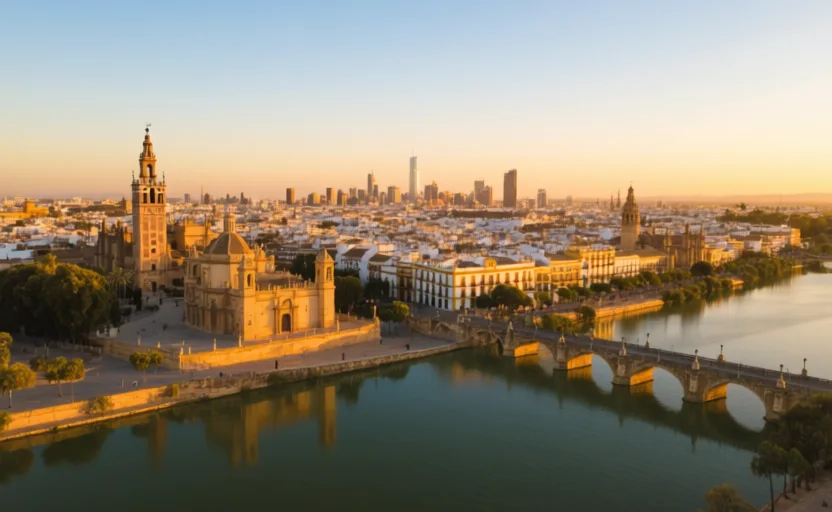 Seville · AI city illustration · Artistic impression
City · Europe
Seville
Also known as Sevilla, Ishbiliya
Saved in this browser — no account needed. Sign in later and it comes with you.
Where it is
Flat ground and a slow river define the place. Seville stands on the lower Guadalquivir at an average of 7 m above sea level, in a fertile valley in the southwest of the peninsula. The Atlantic is some 80 km downstream, yet the city is inland enough to be much hotter than the coastal towns of Cádiz and Huelva. Summer highs average above 36 °C, and roughly 60 days a year pass 35 °C. The Guadalquivir Valley is sometimes called the frying pan of Spain, and Seville is the warmest city on continental Europe’s mainland.
The land and water around it
The Guadalquivirriver
The river made Seville a port 80 km from the sea, the only river harbour in Spain, and also threatened it with floods. When drought conditions worsened and large ships struggled to reach the city, the trade that had made it rich moved downstream.
The valley floorvalley
The city lies on alluvial ground with an average height of 7 m. Roman-era timber piles found in the ground point to the instability of the site, and the oldest settlement was on an island between river channels. One reading of the name Seville derives it from a Phoenician word for “lowland”.
The hot-summer climateclimate
Very hot, long and dry summers and mild winters, with about 3,250 to 3,300 hours of sunshine a year. Snow is almost unknown: only two falls were recorded in the 20th century. A 46.6 °C reading at the airport in July 1995 is the accepted record.
Its history, in short
Seville’s first core, in the 8th century BC, was a settlement on an island in the Guadalquivir, linked to the Tartessian culture. The Romans called the town Hispalis and made it a great market and manufacturing centre, while Italica nearby, birthplace of the emperors Trajan and Hadrian, stayed the residential city. Muslim forces took it in 712–713, and after the Caliphate of Córdoba fell it became capital of its own taifa. Castile conquered it in 1248. Its real ascent came after 1503, when the Casa de Contratación was set up there and Seville gained the royal monopoly on trade with the Americas, even though ships had to climb 80 km of river to reach it. It became one of the largest cities in western Europe, then slid in the 17th century with plague, floods and economic crisis. Worsening drought conditions on the river moved the American trade to the Bay of Cádiz; the fleets followed in 1680 and the Casa in 1717. The Ibero-American Exposition of 1929 and Expo ’92 rebuilt the city’s image, and it is now the capital of Andalusia.
Timeline
Dates are shown on a timeline rather than as changing shapes on the map. The globe draws modern boundaries only, and tinting a modern outline to stand for a historical one would state something we cannot source.
Classical world
8th century BCE
A settlement on an island
The original core, near what is now Cuesta del Rosario, sits on an island in the river. Excavations in 1999 beneath the north wall of the Real Alcázar found remains from the 8th and 7th centuries BCE.
Approximate dateWikipedia206 BCE
Italica founded
After a decisive victory over the Carthaginians at Ilipa, Scipio settles veteran soldiers nearby. Hispalis next door develops into a craft and commercial centre of the province.
Well attestedWikipedia
Post-classical world
712–713
Islamic conquest
Musa ibn Nusayr takes the city in 712 and it has to be retaken in 713. Seville is the seat of the governor of Al-Andalus until 716, then the capital moves to Córdoba.
Well attestedWikipedia1248
Castilian conquest
The taifa of Seville is absorbed into the Crown of Castile under Ferdinand III, who is first to be buried in the cathedral.
Early modern & oceanic
1503
The Casa de Contratación
Seville becomes headquarters of the body that controls trade with the Indies, despite the difficulty of reaching the port. The choice favoured its size, hinterland, administrative expertise and the security of an inland site.
Well attestedWikipedia1649
The great plague
An outbreak may have killed 60,000 people, nearly half of the city’s 130,000 inhabitants, during a century of general crisis, floods and economic decline.
Approximate dateWikipedia1717
Trade leaves for Cádiz
Control of the Casa de Contratación is transferred to the Bay of Cádiz, after the fleets of the Indies had already moved there in 1680.
Well attestedWikipedia
Contemporary
1992
Expo ’92
A six-month Universal Exposition marks five centuries since the voyage to the Americas. New bridges over the Guadalquivir, a ring road, a new station and the first high-speed rail line between Madrid and Seville are built for it.
Well attestedWikipedia
Places that carry meaning
Cathedral and GiraldaFounded 1403
The cathedral, with five naves, is the largest Gothic building in Europe. It was built on the site of a mosque, and its bell tower, the Giralda, is the mosque’s old minaret, topped in the Renaissance.
Real Alcázar10th century onward
A palace complex that began as the Muslim governor’s residence and is still used by the Spanish royal family in the city. Almohad courtyards sit beside the Mudejar palace of Pedro I.
Archivo General de Indias1585
Built to house the merchants’ exchange, it became the archive in 1785 and now holds the largest collection of documents on the discovery of the New World and relations with it.
ItalicaFrom 206 BCE
A Roman city 9 km northwest, well preserved, whose ruins give a sense of what Hispalis may have looked like in the later Roman period.
Languages here
Places are usually multilingual. This lists what is actually spoken, not one language per border.
SpanishRomance family
The language of daily life and administration.
Spanish is the language of daily life in Seville. Foreign-born residents were 11.7% of the population in 2025, mainly from Colombia, Morocco, Venezuela, Nicaragua and Peru, so many newcomers also speak Spanish as a first language.
ArabicSemitic family
A historical language of the city under Islamic rule.
Known as Ishbiliya under Islamic rule, the city kept a population of Muladi converts and Christian and Jewish minorities.
Learn the language here
- 1Understand which languages are spoken hereSeville is multilingual. Start with which languages are used, by whom, and for what — the phrase list only covers one of them.Written by Globe Quest
- 2Learn 11 phrasesCurated everyday phrases for Seville, with audio and a written form.Written by Globe Quest
- 3Say them out loudSpeaking practice with pronunciation feedback, one phrase at a time.Globe Quest material, your own additions
- 4Come back to themSpaced review, so what you learned this week is still there next month.Written by Globe Quest
- 5Practise with people: Arabic practice · DohaAn in-person practice circle. It is a prepared plan and needs a host before it runs.Run by members
Check yourself
Why did Seville become the gateway to the Americas?
It was the only port awarded a royal monopoly on trade with the Americas
Seville was 80 km from the sea, a poor harbour for large ships, but the Crown picked it for its size, administrative skill and secure inland location, and gave it the monopoly.
What was the Giralda originally?
The minaret of a mosque
The cathedral stands on the site of a mosque, and its bell tower is the old Almohad minaret, with a Renaissance top added later.
Worth arguing about
- A city made rich by a royal monopoly lost it when the river became harder to navigate. How far was Seville’s decline geography, and how far was it politics?
- The cathedral’s bell tower is a minaret. What should a city do with the buildings of a former ruling culture?
What we have not established
These are open questions, listed rather than filled in. We would rather show a gap than a plausible guess.
What is Seville’s highest recorded temperature?
The airport weather station recorded 46.6 °C on 23 July 1995. A reading of 50.0 °C in August 1881 is disputed, and a 47.2 °C figure from the 2003 heat wave has not been officially confirmed.
Sources
- Wikipedia · SevilleWikipedia · encyclopedia · checked 2026-11-24
- Wikipedia · History of SevilleWikipedia · encyclopedia · checked 2026-11-24
- UNESCO · Cathedral, Alcázar and Archivo de Indias in SevilleUNESCO World Heritage Centre · intergovernmental · checked 2026-11-24
- Wikipedia · SpainWikipedia · encyclopedia · checked 2026-11-24
Reviewed by Globe Quest editorial on 2026-11-24. Drafted with AI assistance and checked against the sources above before publication.