 Globe Quest
 Human Quest · LearningSign in
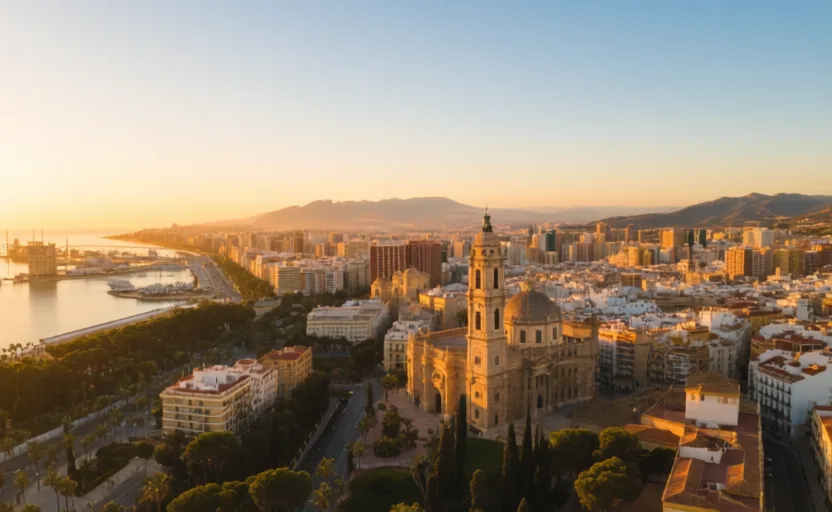 Malaga · AI city illustration · Artistic impression
City · Europe
Malaga
Saved in this browser — no account needed. Sign in later and it comes with you.
Where it is
Málaga looks south over the Alboran Sea, the westernmost part of the Mediterranean, roughly 100 km along the coast from the Strait of Gibraltar, and some 130 km north of Africa. The old city grew in the gap between the hill of Gibralfaro and the Guadalmedina, with the mouth of a second river, the Guadalhorce, close by to the west. Behind it, the Montes de Málaga rise to 1,031 m and shield the coast from cold northern winds. That shelter gives the city the warmest winters of any European city with more than 500,000 people.
The land and water around it
Gibralfaro and the Guadalmedinaharbour
The Phoenician and Roman centre grew in the area between Gibralfaro hill and the mouth of the Guadalmedina. The hill is a 130 m foothill, and above the city, the Gibralfaro Castle and the Alcazaba fortress keep watch over the harbour below.
The Guadalhorce estuaryestuary
The first Phoenician settlement, at Cerro del Villar, was an islet in the Guadalhorce estuary. River silting and changes in water level have since filled that estuary and moved the site inland, so the coastline today is not the one the first colonists used.
The Montes de Málagamountains
Part of the Penibaetic System, northeast of the city, topped by Pico Reina at 1,031 m. The range blocks the cold north winds in winter. Together with the sea breeze it gives the city about 300 days of sun a year and almost no snow: only one day of snowfall has been recorded in the city since 1900.
Its history, in short
The Phoenicians of Tyre founded a colony here around 770 BC, using the sheltered estuary as a waypoint between their homeland and the Strait of Gibraltar. Carthage then dominated it, and from 218 BC Rome, which gave the town its own municipal law and a theatre. The Visigoths and Byzantines contested it, and in the early 8th century it passed to Islamic rule. After the Nasrid Kingdom of Granada formed, Málaga became its main port, trading silks, nuts, wine and glazed pottery to the wider Mediterranean, with Genoese merchants prominent. In August 1487 Castile took it after a siege during the Granada War. The Muslim population, around 11,000 people, was enslaved, and the city was resettled by Christians from elsewhere in Iberia. Industry arrived early in the 19th century, then phylloxera destroyed the vineyards in the 1880s and 1890s. In 1937 the city fell to Franco’s forces and thousands died on the road east. Since the 1950s its coast has been remade by mass tourism, with Torremolinos the first of the resorts and technology and logistics added later.
Timeline
Dates are shown on a timeline rather than as changing shapes on the map. The globe draws modern boundaries only, and tinting a modern outline to stand for a historical one would state something we cannot source.
Classical world
c. 770 BCE
A Phoenician colony
Colonists from Tyre settle at Malake. The site commanded access to the Guadalmedina and was a stopping point for ships sailing from Phoenicia towards the Atlantic.
218 BCE
Roman rule
Malaca falls under the Roman Republic. By the 1st century CE it is a federated city governed by its own law, the Lex Flavia Malacitana, and a Roman theatre is built.
Post-classical world
c. 552
The Byzantines
The Byzantine Empire takes the city, which becomes one of the main cities of its short-lived province of Spania. The Visigoth king Sisebut retakes it in 615.
711 or 713
Islamic conquest
Arab and Berber forces take the city. Accounts give 711 or perhaps 713, and the town is later walled and organised as a medina.
Approximate dateWikipedia
Early modern & oceanic
18 August 1487
The siege of Málaga
After a siege of three months and eleven days, Castile takes the city in the most violent episode of the Granada War. Almost the whole Muslim population is enslaved, and the Jewish community is held for ransom.
Well attestedWikipedia24 August 1704
The Battle of Málaga
The largest naval battle of the War of the Spanish Succession is fought in the sea south of the city, without a clear result.
Well attestedWikipedia
Industrial & imperial
1887–1897
Phylloxera
A grapevine pest destroys the region’s vines, and the population falls in these years after a century of industrial growth.
Well attestedWikipediaFebruary 1937
The fall of Málaga
After Italian naval bombardment and the Francoist takeover, more than seven thousand people are killed as they try to flee along the road to Almería.
Well attestedWikipedia
Places that carry meaning
Cerro del VillarFrom c. 770 BCE
The islet in the Guadalhorce estuary where Phoenicians first settled, producing sea salt and purple dye from murex snails before the commercial centre shifted to the mainland.
The Roman theatreRoman period
A theatre built after Malaca received its own municipal code, a sign of the town’s status within the Roman province.
TorremolinosAnnexed 1924
A small coastal town added to the municipality in 1924. In the late 1950s and early 1960s it developed into an international tourist centre, the pattern later repeated along the Costa del Sol.
Languages here
Places are usually multilingual. This lists what is actually spoken, not one language per border.
SpanishRomance family
The language of daily life, administration and education.
Foreign-born residents made up 16.8% of the population in 2025, led by people born in Morocco, Argentina, Colombia, Paraguay and Venezuela. Their number has risen significantly since the 1970s, and the Latin American arrivals share the language of the city.
ArabicSemitic family
The language of the city under Islamic rule until 1487, and of Moroccan-born residents today.
Arab sources call the city Mālaqah. After the Christian conquest in 1487 the Muslim population was enslaved or driven out and the city was repopulated from elsewhere in Iberia, which broke the continuity of the Arabic-speaking town. Arabic is also now among the languages immigrants have brought to Spain.
Romanian, English, Chinese and Ukrainian
Other languages of recent immigration in Spain, shown here as a national picture.
Together with Arabic, these are the most prominent languages immigrants have introduced across the country. The proportions for Málaga itself are not recorded here.
Learn the language here
- 1Understand which languages are spoken hereMalaga is multilingual. Start with which languages are used, by whom, and for what — the phrase list only covers one of them.Written by Globe Quest
- 2Learn 11 phrasesCurated everyday phrases for Malaga, with audio and a written form.Written by Globe Quest
- 3Say them out loudSpeaking practice with pronunciation feedback, one phrase at a time.Globe Quest material, your own additions
- 4Come back to themSpaced review, so what you learned this week is still there next month.Written by Globe Quest
- 5Practise with people: Arabic practice · DohaAn in-person practice circle. It is a prepared plan and needs a host before it runs.Run by members
Check yourself
Why did Phoenician colonists choose the Málaga coast?
It was a stopping point for ships heading west, with a sheltered harbour
The estuary harbour sheltered sailing boats from strong currents and westerly winds, and the site controlled access to the river, so it worked as a waypoint on the road to the Strait.
What happened to Málaga’s population after the 1487 siege?
Nearly all were enslaved and replaced by Christian settlers
Around 11,000 people became war captives and only a small group was allowed to stay, yet the city kept its trading role despite an almost complete change of residents.
Worth arguing about
- A city whose whole population was replaced in 1487 still claims 2,800 years of continuity. What does continuity of place mean when continuity of people is broken?
- Torremolinos shows how quickly a small town can become a tourist resort. What does a coastline owe the people who lived there before?
Sources
- Wikipedia · MálagaWikipedia · encyclopedia · checked 2026-11-24
- Wikipedia · History of MálagaWikipedia · encyclopedia · checked 2026-11-24
- Wikipedia · Languages of SpainWikipedia · encyclopedia · checked 2026-11-24
Reviewed by Globe Quest editorial on 2026-11-24. Drafted with AI assistance and checked against the sources above before publication.